What Do 5% Rates Mean for Pensions?
Oct 2026
View available investments in your area

Sorry, we couldn't find any results matching
Please:

Key takeaways
For most of the period since the Global Financial Crisis (GFC), pension sponsors faced historically low Treasury yields. Low rates inflated the present value of pension obligations, increased the cost of settling liabilities and forced sponsors to choose between accepting funded-status volatility or allocating capital to lower-yielding liability-hedging assets.
That environment has changed. On September 15, 2026, the yield on the 10-year Treasury moved above 5% for the first time since July 2007. The number itself is not special. What matters is what it reflects: a sustained reset in rates, with real and important consequences for corporate plans.
Funded positions are also stronger. That is not a coincidence: Higher interest rates reduced liabilities while strong growth-asset returns supported asset values. The strategic question is: How much of today’s favorable funded position should plans preserve now?
Rising rates help underhedged plans; falling rates hurt them
Higher interest rates move both sides of the balance sheet. Pension liabilities represent future benefit payments discounted to today’s value. When the discount rate rises, the present value of those payments falls. But pension assets also respond to higher rates. Bonds, for example, decline in value when yields rise.
The hedge ratio is the share of a plan’s liability rate sensitivity that is offset by the rate sensitivity of its assets. A fully hedged plan will experience little change in its funded status volatility when rates rise or fall. For plans that are not fully hedged, the unhedged portion of the liability drives funding changes when rates move.
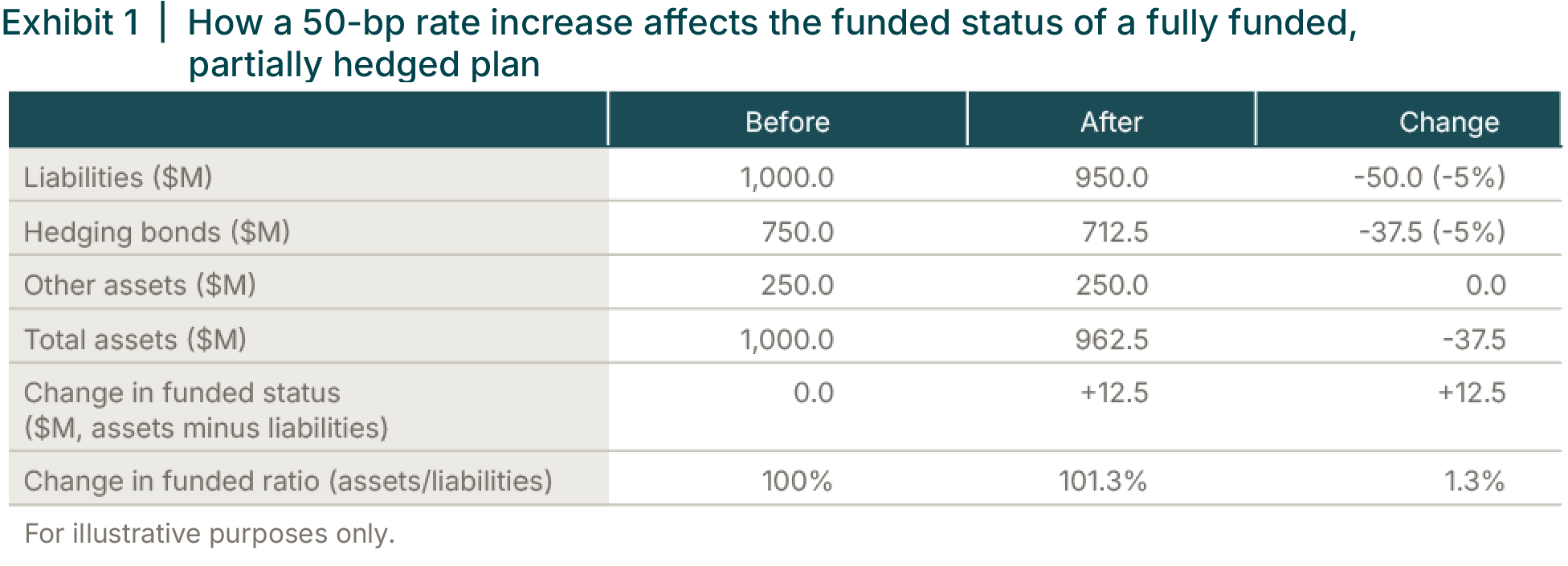
To understand how rate dynamics affect funding status in practice, first consider a fully funded plan with thefollowing starting position:
If rates rise 50 basis points (bps), a 10-year duration implies a 5% decrease in both the liabilities and the bond portfolio. Liabilities fall by $50 million, while the bond portfolio falls by $37.5 million. Assuming the value of the remaining $250 million in assets remains unchanged, total assets decline to $962.5 million, while liabilities decline to $950 million.
The result: Funded status improves by $12.5 million and the funded ratio rises from 100% to 101.3%. The 75% hedge offsets three-quarters of the liability move, leaving the plan exposed to the remaining 25% (Exhibit 1).
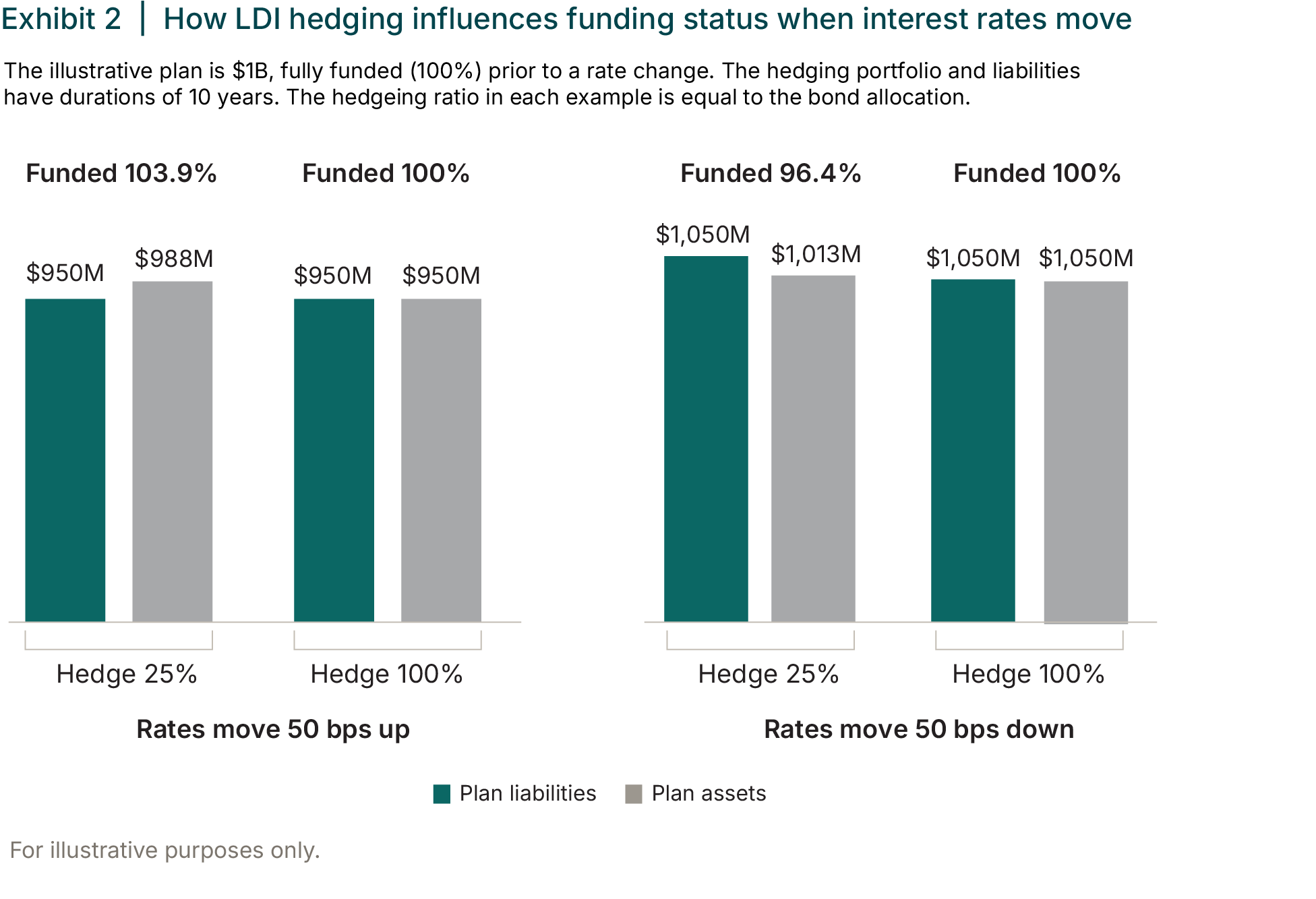
Exhibit 2 shows the same mechanics at 25% and 100% hedge ratios when interest rates move either up or down. The higher the hedge ratio, the less funded status moves when rates change. Lower hedge ratios retain more upside when rates rise, but they also create greater downside if rates fall.
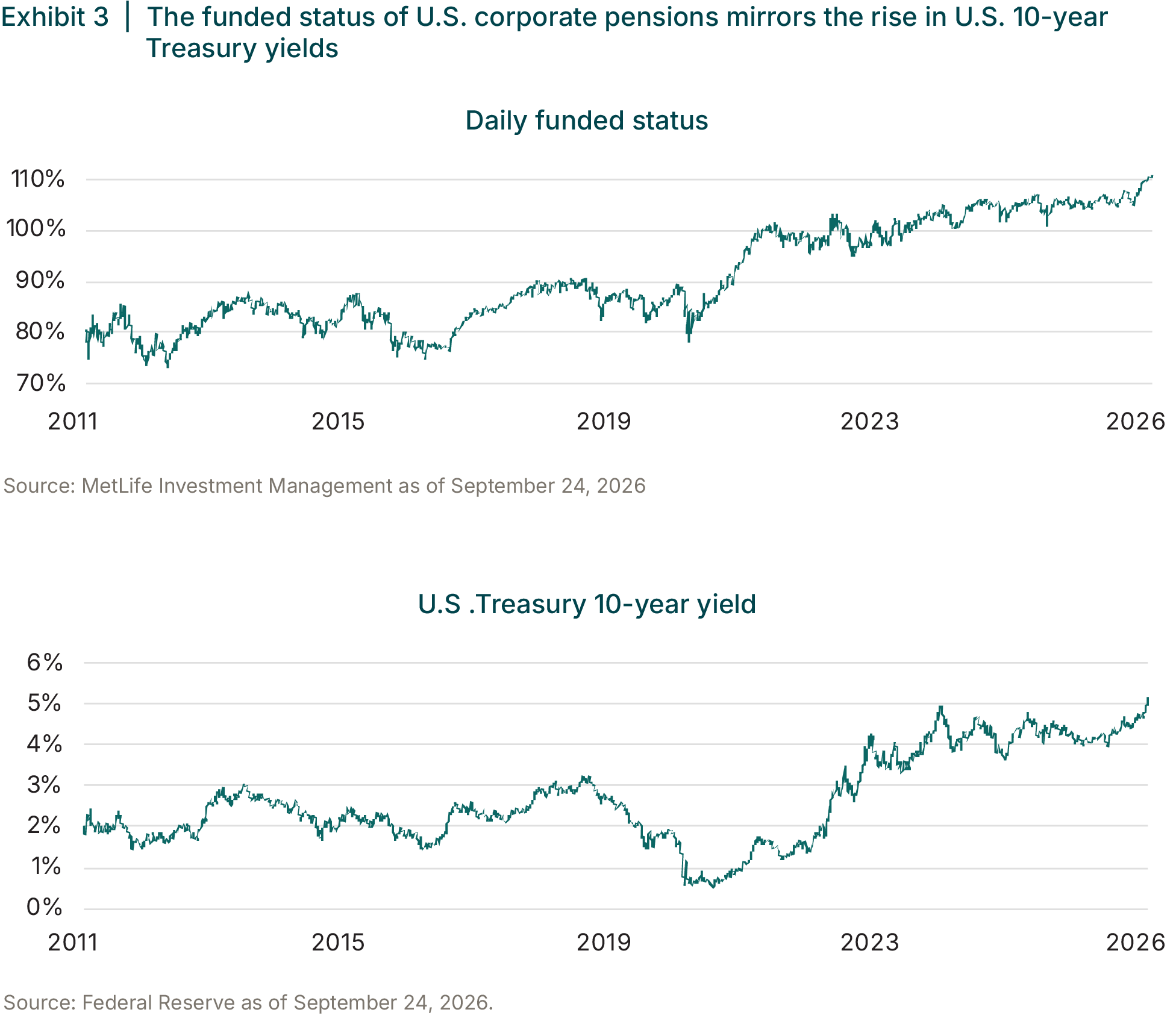
Plans have likely already realized most of the benefit of the recovery in interest rates from their unusual lows. On December 31, 2021, the yield on the US Treasury 10-year note was 1.52% and MIM estimates the average pension funded status was 97.9%. As of September 30, 2026, the yield had risen to 5.29% and the MIM estimated average pension funded status was 109.7% (Exhibit 3).
As funded status improves, staying underhedged offers less upside and more downside. A rate reversal would erode surplus already earned, which strengthens the case for higher hedge ratios.
Pension liabilities and duration
The 10-year Treasury is the benchmark long-term interest rate for financial markets but is not a perfect proxy for the interest rate exposure of a pension plan.
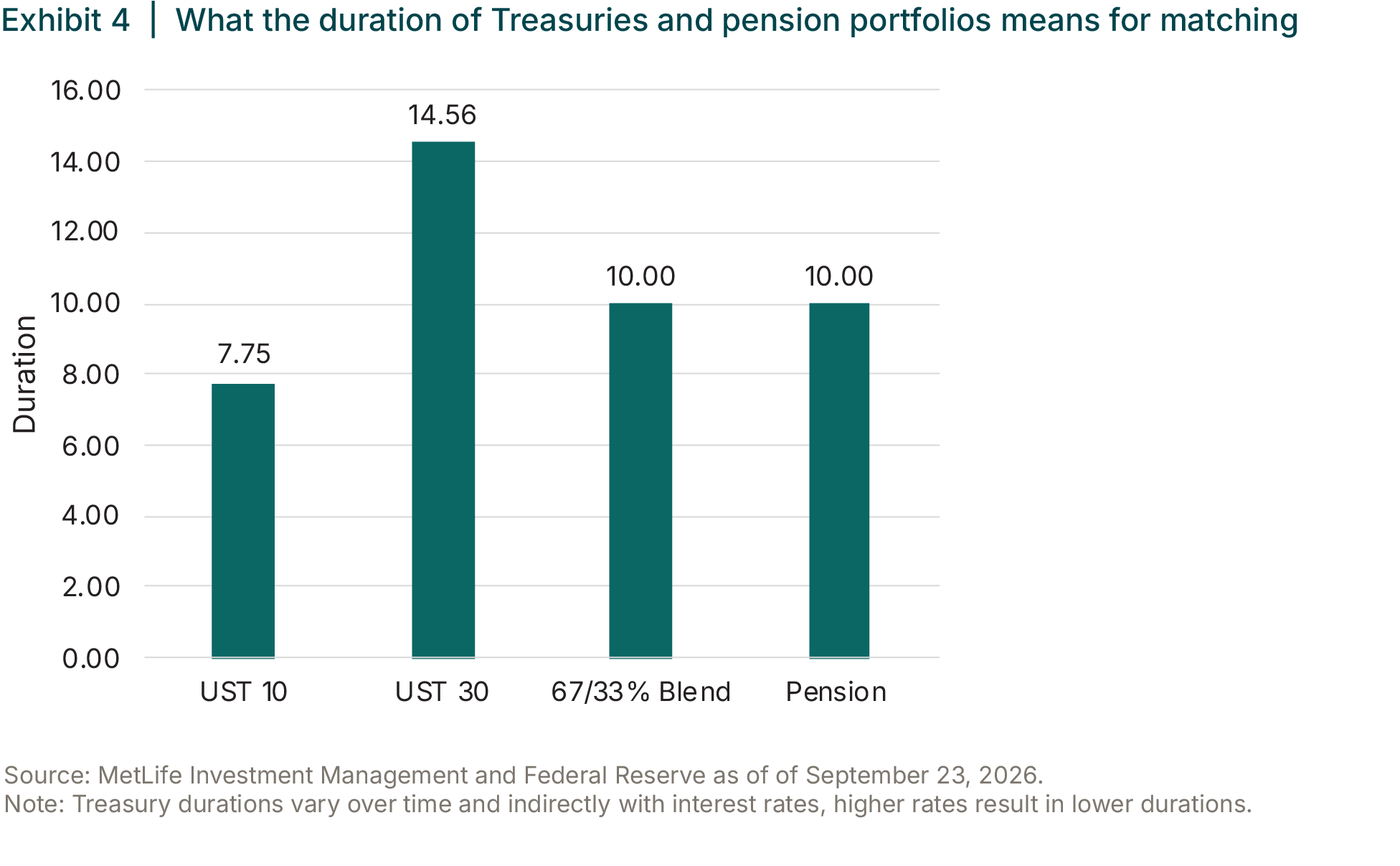
Corporate pension liabilities have been shortening as plans have closed participation and frozen benefits. We estimate the average plan duration is around 10 years, compared with a 7.7-year duration for a 10-year Treasury. A portfolio therefore needs bonds with maturities longer than 10 years to match a 10-year liability. A portfolio comprised of 67% 10-year Treasuries and 33% 30-year Treasuries would approximate the duration of a typical pension liability (Exhibit 4).
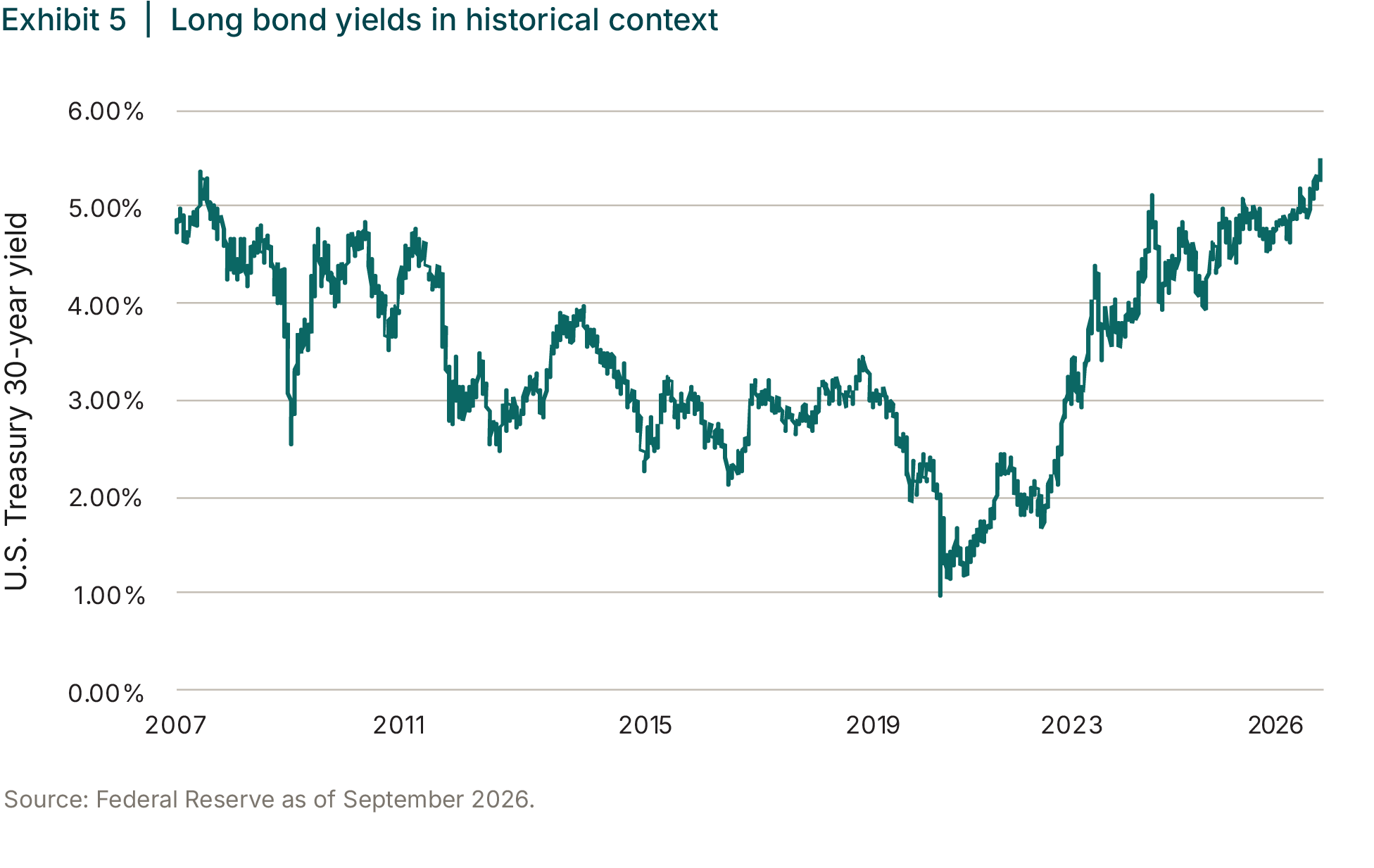
Yields for 30-year Treasuries are at levels not seen since before the GFC (Exhibit 5). That means the trade-off between liability-hedging assets and growth assets is not as high as it once was, underlining the significance of the derisking opportunity for pensions.
On the other hand, pensions with only long duration hedges are not fully protected if short and intermediate rates decline more than longer rates. More sophisticated hedging portfolios go beyond duration-matching and hedge across the yield curve. Key-rate durations estimate liability sensitivity across maturity buckets—5, 10, 15, 20 and 25+ years, for example—and the liability-driven investment (LDI) portfolio can be built to mirror the liability’s exposure across these maturity buckets. This is particularly important when the yield curve steepens.
Pension discount rates include credit spreads
Treasury yields do not translate directly into pension discount rates. U.S. corporate pensions use high-quality corporate bond yields to determine liabilities. Conceptually, pension discount rates are the sum of Treasury yields and high-quality corporate credit spreads.
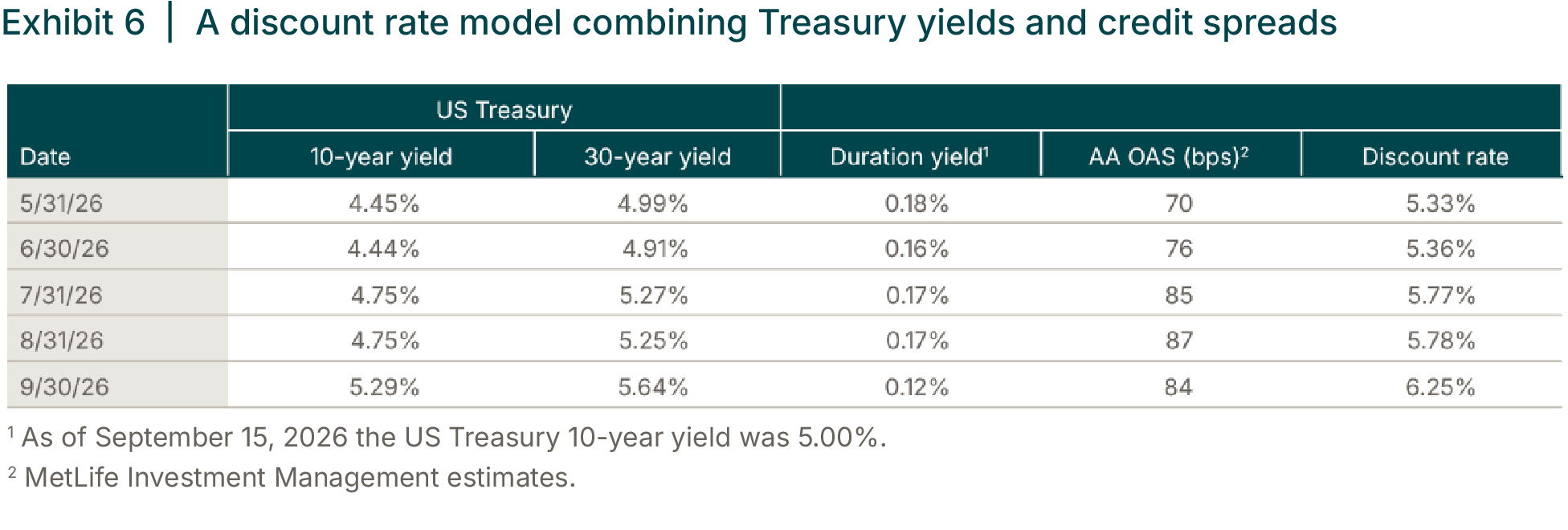
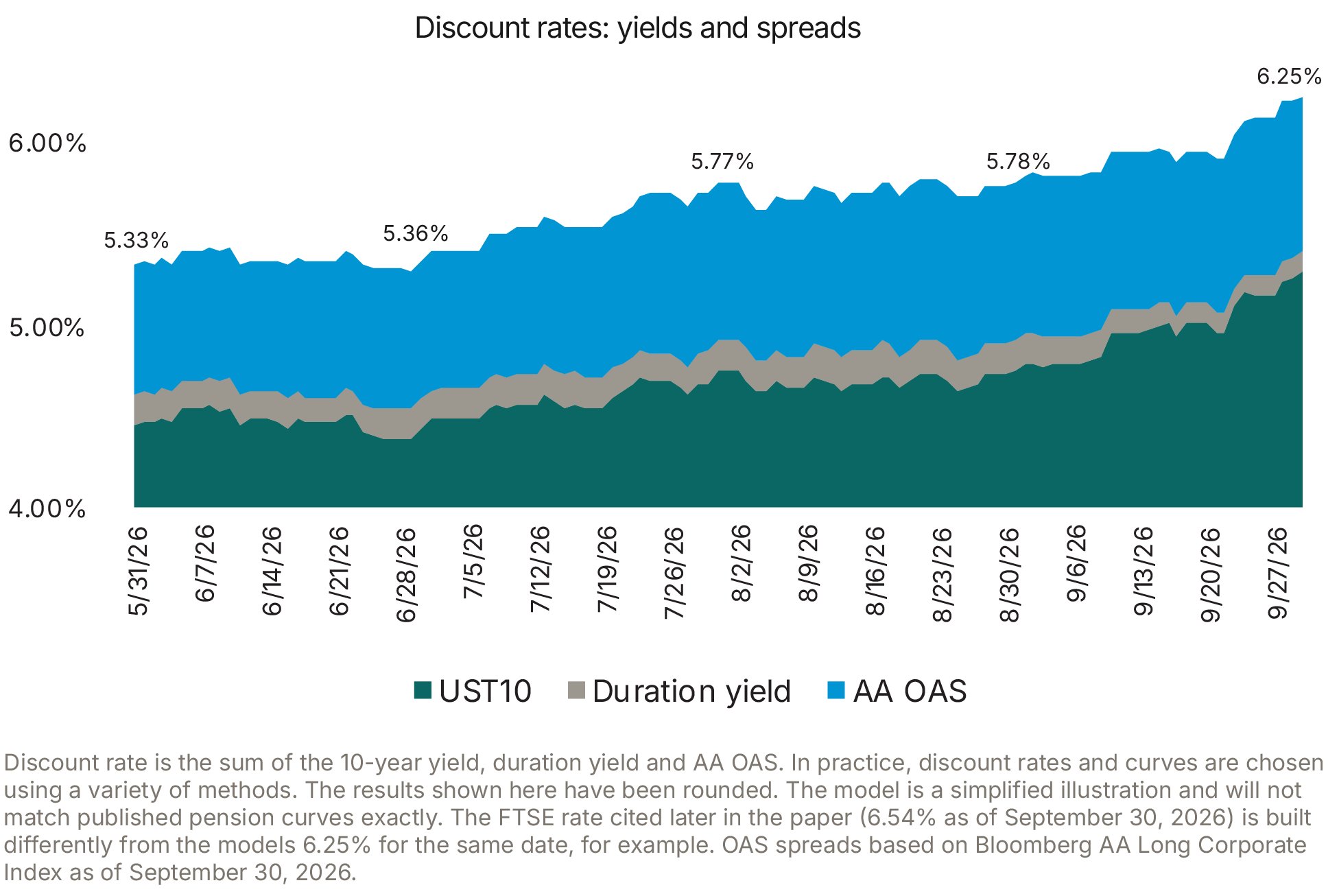
Exhibit 6 shows how these components combine to estimate the pension discount rate from May through September 2026. As we noted earlier, approximating the interest-rate sensitivity of a typical pension liability requires a Treasury portfolio of 67% 10-year Treasuries and 33% 30-year Treasuries. The duration yield is the additional Treasury yield associated with that longer-duration mix and is calculated as 33% of the difference between the 30-year and 10-year Treasury yields.
The option-adjusted spread is the additional yield high-quality corporate bonds pay over Treasuries, here measured on the Bloomberg AA Long Corporate Index. Because pension discount rates are based on high-quality corporate bond yields rather than Treasury yields alone, the discount-rate estimate combines the duration-adjusted Treasury yield and the AA credit spread.
This distinction between Treasury yields and discount rates is important because Treasury rates and corporate credit spreads often move in opposite directions. During risk-off environments, Treasury yields can fall while credit spreads widen. During strong economic environments, Treasury yields can rise while spreads tighten.
For pension investors, this creates two distinct liability risks: interest-rate risk and credit-spread risk. A Treasury-only hedge can address interest rate risk while leaving spread exposure. Long-duration corporate bonds capture both interest rate and credit spread risk and can therefore track liabilities more closely, albeit with exposure to credit and downgrade risk.
Implications for asset allocation and derisking
Higher Treasury yields change the relative economics of plan investments. Higher yields permit less risky allocations while maintaining the same expected portfolio return. This can help keep long-term plan costs within budget and help to maintain pension income and its contribution to corporate earnings per share.
More importantly, higher yields lower the cost of derisking. Consider a sample retiree group with a liability of $500 million at the end of 2021, when discount rates were 2.83%. The liability for these retirees would have dropped to $357 million on September 30, 2026, when the FTSE discount rate was 6.54%. This represents a 29% savings to a plan undertaking a pension risk transfer or lock-down LDI strategy.
One thing we have not yet considered is how higher interest rates affect the returns of the growth assets in which may pensions may invest the other side of a derisking decision. Although the link between higher rates and equity returns is complex, higher rates tend to raise financing costs for businesses, which in turn could potentially decrease equity returns. Higher rates also reduce the value investors place on future earnings by increasing the discount rate used to value those cash flows.
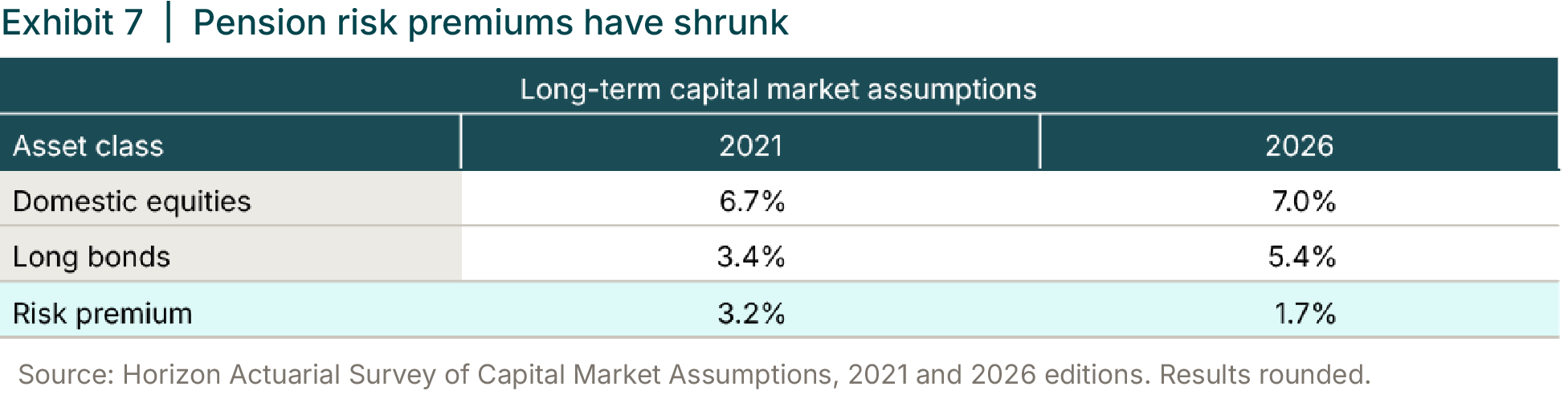
For a pension sponsor, the relevant question is not whether stocks will underperform in a higher-rate environment, but rather whether stocks’ incremental return is sufficient compensation for the additional funded-status risk. Exhibit 7 shows the equity premium over long bonds roughly halving under average capital market assumptions, shifting relative value toward hedging assets. For well-funded or overfunded plans, the reduced premium strengthens the case for glide-path derisking,
Fully hedged plans can still pursue asset outperformance and funded status improvement. For example, overfunded plans can use a portion of plan assets to hedge the liability and invest the remainder in return-seeking strategies.
Conclusion
Treasury yields of 5% do not represent a magical threshold. Rather, they create a context to reconsider the pension risk-reward equation, especially for well-funded plans.
Most corporate pensions are not fully hedged, and they have benefited as rates rose. But that benefit has already improved funded positions materially. At the same time, liability-hedging assets now offer yields that would have been difficult to imagine during much of the post-GFC period.
For many sponsors, the strategic question may shift from “How much will funded status improve if rates rise?” to “How much funding improvement should we lock in?” That change in perspective has implications for hedge ratios, key-rate duration positioning, credit exposure, growth allocations, cash-flow matching and pension risk transfer. Five percent does not provide the answer, but it does change the question.