Infrastructure Debt: A Compelling Private Credit Portfolio Addition
May 2026
View available investments in your area

Sorry, we couldn't find any results matching
Please:

Updating existing infrastructure and building new assets to accommodate increased mobility, digitalization and the continued transition to new and cleaner sources of energy will require $106 trillion in funding by 2040, according to McKinsey2 estimates. With government budgets stressed, private capital — including debt capital—will be necessary to meet this goal.
Infrastructure has grown significantly since emerging as an investable asset class in the late 1980s and early 1990s through government privatizations of public utilities and transportation assets. In 2025 alone, more than 80 infrastructure funds raised over $200 billion.3
Private debt supports the deployment of this equity capital. Historically, commercial banks were the main lenders on infrastructure projects, representing more than 90% of project funding pre-2008.4 However, with increased banking regulation after the Global Financial Crisis and the growth in private credit, non-bank infrastructure lending is becoming more prevalent. In the first half of 2025, non-bank lenders made up 53% of the private debt provided to infrastructure projects.5 For debt investors, the growing asset class represents an opportunity to diversify and capture attractive risk-return dynamics.
Any discussion of infrastructure investing should start with a clear understanding of what “infrastructure” means. At MIM, we define investible infrastructure as “a physical asset or system that provides an essential service to support the public or the economy with limited competition and/or high barriers to entry.”6 The following fundamental characteristics differentiate infrastructure debt from traditional corporate debt:
The set of assets under the infrastructure umbrella is expanding. In addition to traditional sectors such as transportation and utilities, newer asset types, such as renewable energy generation, and digital assets, such as data centers, continue to emerge.
As one of the largest global infrastructure investors, the 20-person Infrastructure Debt team at MIM manages $41.2 billion7 in infrastructure debt across over 500 credits in all major infrastructure sectors. Exhibit 1 shows how we categorize these sectors.
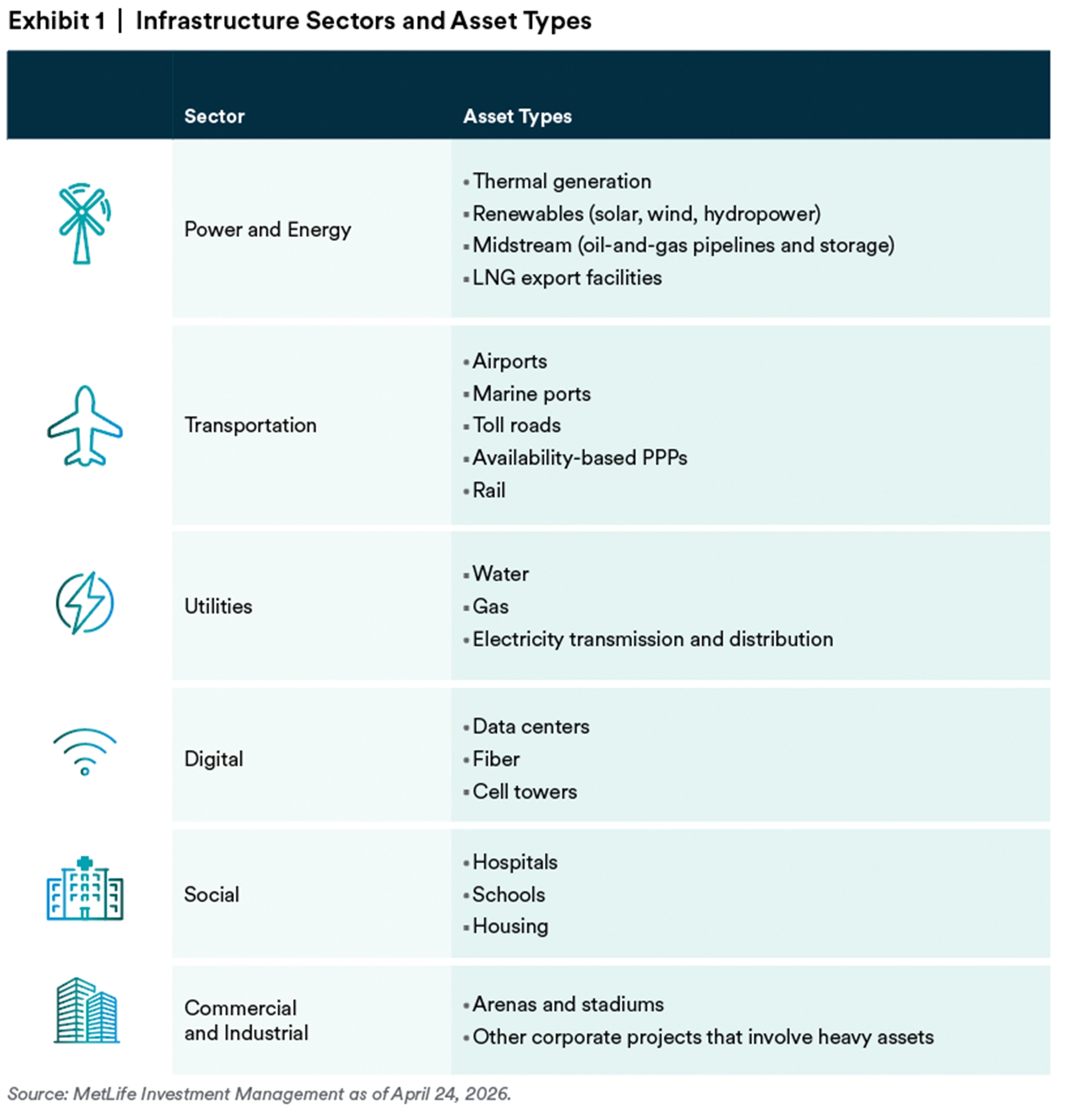
Our approach to analyzing potential investments centers on the asset’s fundamental risks and the cash flows it is likely to generate.
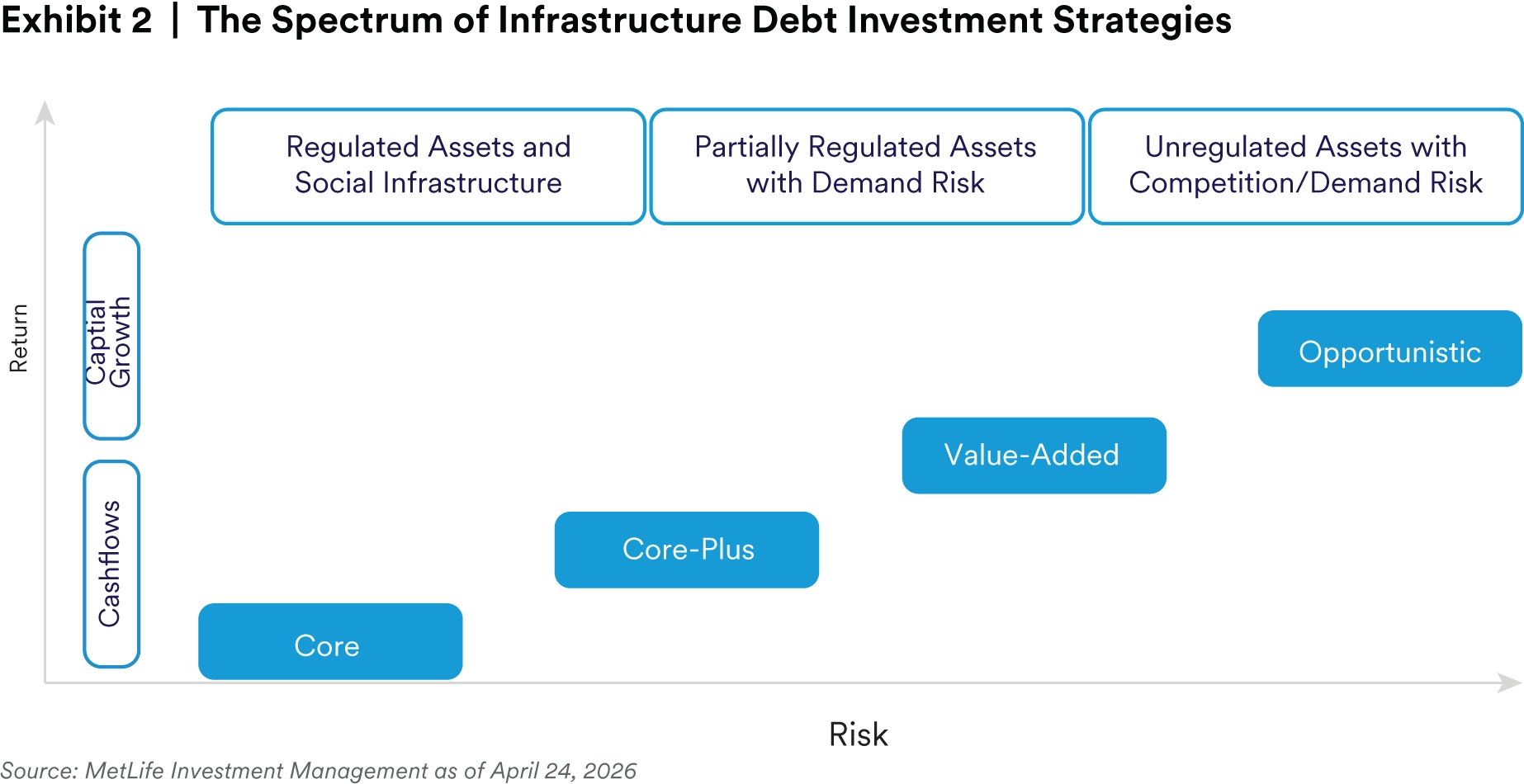
The infrastructure market typically groups investment strategies into four categories. In ascending order of risk and return, these are:
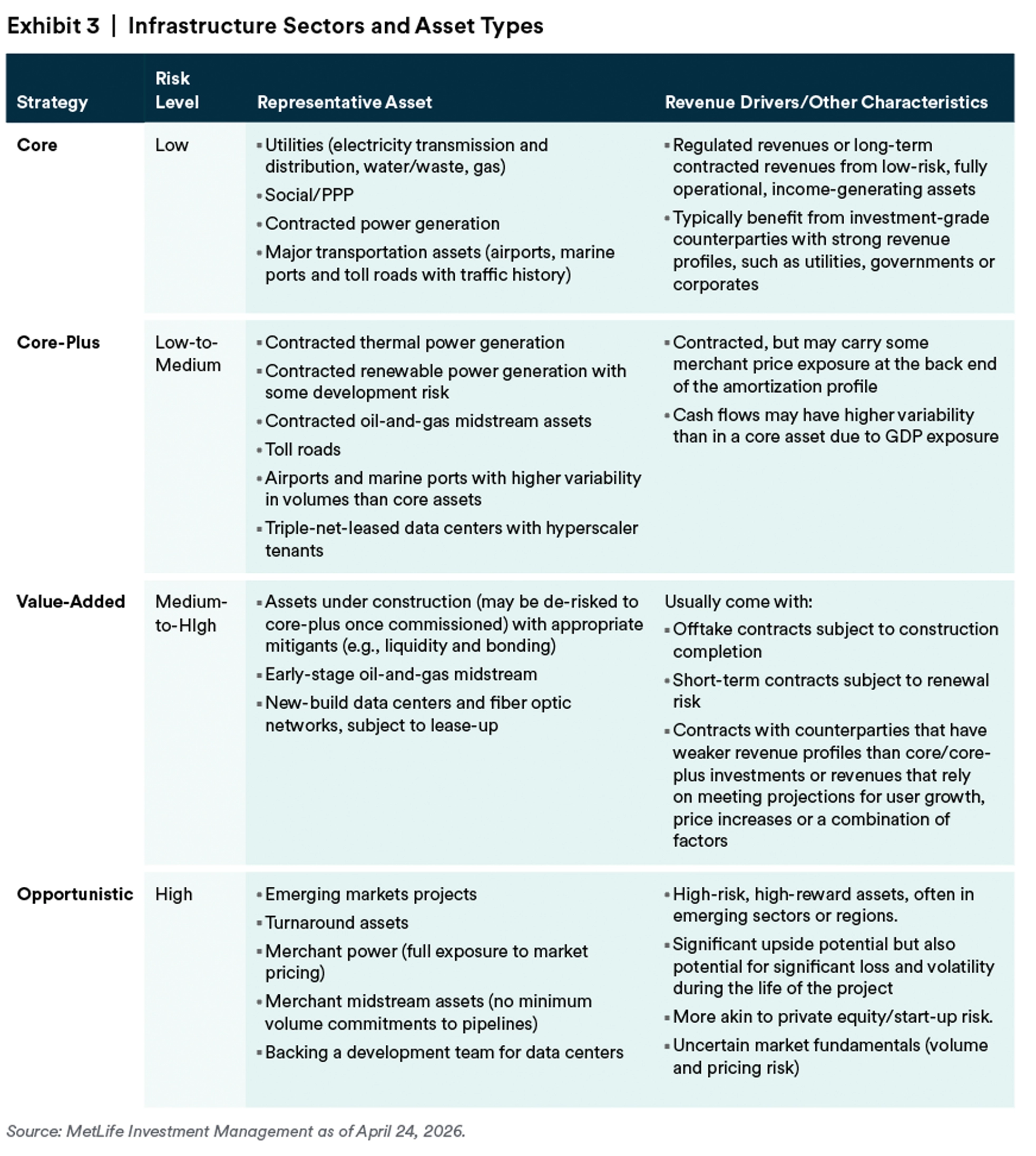
As Exhibit 2 shows, the relative level of risk depends on the degree of certainty that the underlying assets can generate projected cash flows. Core investors typically purchase assets that generate stable, predictable, regulated cash flows and have a low cost of capital that allows them to accept a lower return. At the opposite end of the spectrum, opportunistic investors seek higher returns by backing earlier-stage projects or development teams in hopes of capturing significant upside. Our Infrastructure Debt team focuses primarily on core and core-plus sponsors and value-added sponsors where there is significant risk mitigation due to the unique features of infrastructure debt. Exhibit 3 describes each type of strategy in more detail, along with examples of relevant infrastructure assets and projects.
Private high-yield infrastructure debt has several attractive features that support its addition to a portfolio, including:
We will consider each of these in turn.
In 2026, private high-yield BB infrastructure credit spreads typically started in the high-200-to-low-300-basis point (bp) range resulting in yields typically starting at approximately 7.0% or higher.8 With the usual caveat that these spreads may not be indicative of future performance, they compared favorably to the BB US High Yield Index option-adjusted spread, which averaged approximately 176 bps for the 12 months through April 2026.9
Higher infrastructure spreads generally reflect the premium investors demand for illiquidity and single-asset risks associated with infrastructure and project finance debt. Private lenders can also target sectors such as digital infrastructure or midstream oil-and-gas assets that have higher expected returns than the over-represented utility credits in the high-yield index.
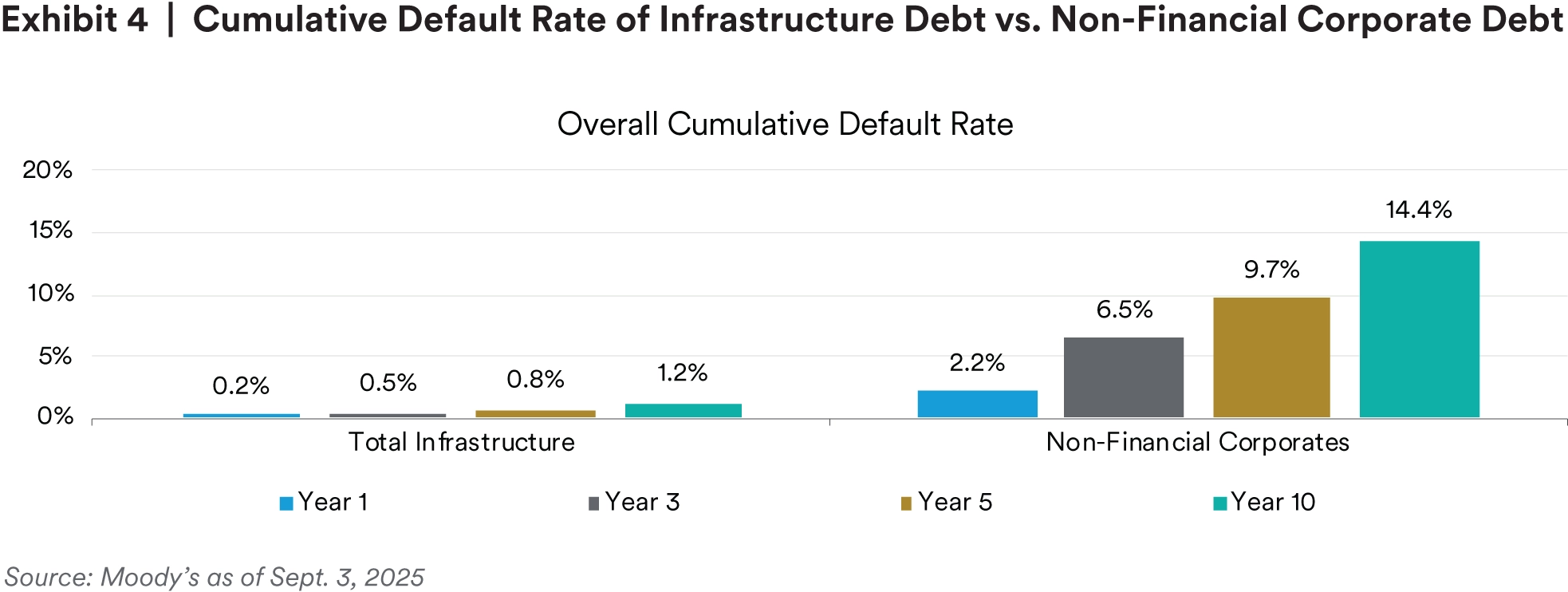
While infrastructure issuers typically pay a higher rate for debt, their track records suggest their credit risk has been lower than that of corporate borrowers. Infrastructure debt has demonstrated resilience through various cycles, with lower default rates and lower loss rates than non-financial corporate debt (Exhibit 4). A recently updated Moody’s study of debt securities from 1983–2024 showed that an average of 0.8% of total infrastructure debt securities defaulted over a five-year horizon during this time period, compared with 9.7% of non-financial corporates. The gap increased over time.10
Especially relevant for yield-seeking investors is the difference between high-yield (BB) infrastructure debt and high-yield (BB) non-financial corporates with maturities of five years or less, a comparison that reflects the shorter maturities of high-yield debt. Non-financial corporate debt’s cumulative default rates at five years were 71% higher than for infrastructure debts, at 7.9% compared to 4.6%.11
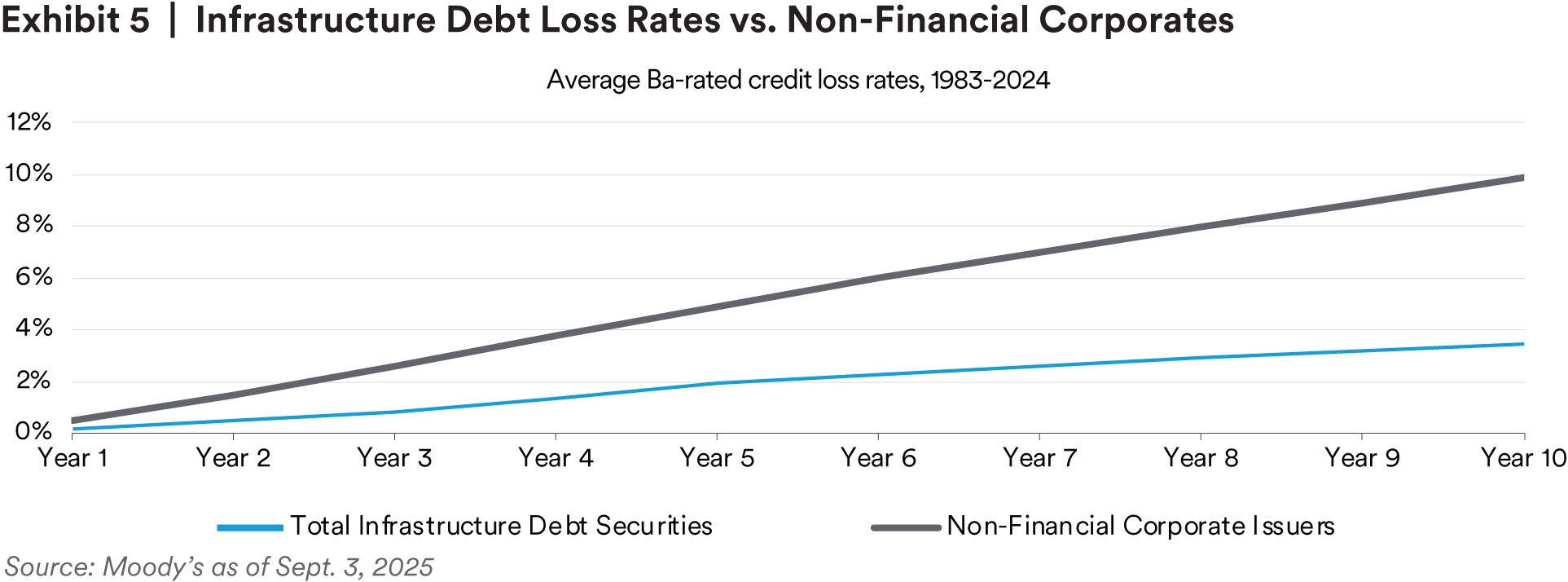
Infrastructure debt also has a history of lower losses than non-financial corporate debt. The average recovery rate for senior secured infrastructure debt, based on trading prices, was 67%12, compared to 56% for non-financial corporate issues and an 18-year average recovery rate of 40% for high-yield bonds and 59% for leveraged loans.13 Furthermore, infrastructure debt demonstrated a loss rate at the five-year horizon that was 60% lower than similarly rated BB-quality, non-financial corporate debt, at 1.95%, compared to 4.91% (Exhibit 5).14
Infrastructure debt has structural features that help limit defaults and support higher recovery rates. Compared to other sectors of the capital markets, infrastructure debt is highly structured, with a comprehensive set of covenants that restrict a borrower’s ability to undertake actions adverse to the lender’s interests. Typical restrictions include limitations on additional indebtedness and requirements to maintain debt service coverage ratios and limit leverage ratios, both to avoid a default and before any distributions are made to equity holders. This ensures an alignment of interests with the equity owners. Reserves for debt service as well as major maintenance are often included as part of the debt structure. As with real estate properties, physical infrastructure assets are often pledged as collateral to secure the debt, which helps explain the favorable historical recovery statistics.
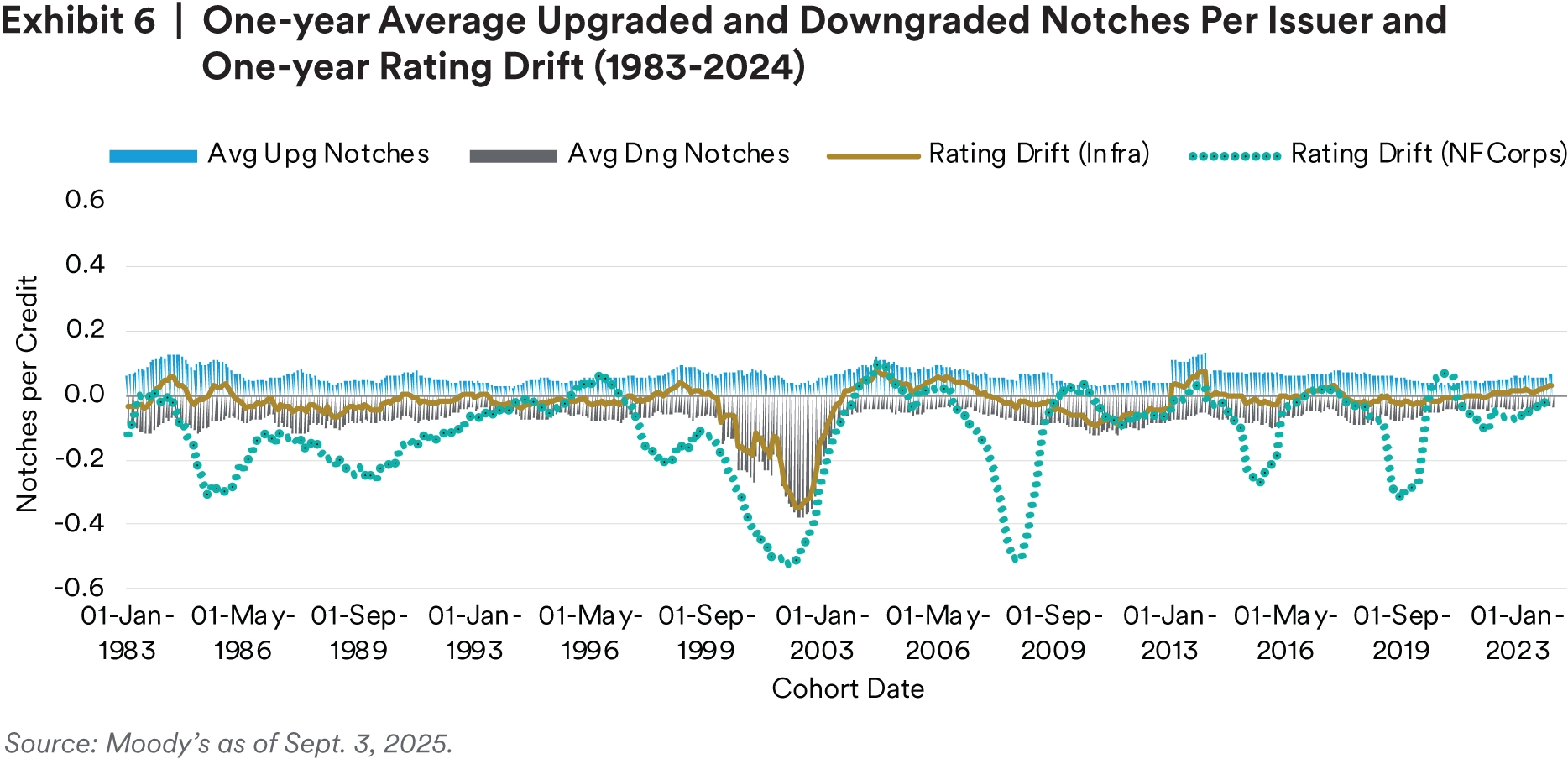
The Moody’s study also showed that ratings volatility for infrastructure debt has been “near zero” for much of the study period, aside from the energy crisis in the early 2000s, as shown in Exhibit 6.15 This was true even during the Global Financial Crisis in 2008–2009, the energy price drop in 2015–2016 and the COVID-19 shutdown in 2020–2021.
Infrastructure assets can withstand economic cycles for several reasons. First, they provide essential services. Second, the debt instruments typically require issuers to hold reserves to preserve liquidity in case of an event or operating issue that interrupts the normal generation of cash flows. Infrastructure assets also often benefit from revenue contracts that are indexed to inflation, so that as costs increase, their revenues step up with the Consumer Price Index or some other form of indexation. Finally, infrastructure revenues are often set by contracts or regulatory regimes that do not typically depend on the performance of the broader economy or consumer spending.
Investment in private infrastructure debt offers many potential benefits, but like other investments, there are also risks.
Illiquidity
Private infrastructure debt is an illiquid asset class with no readily tradable market, which means that investments cannot be readily sold. This illiquidity may limit an investor’s ability to redeem their investment. However, the Moody’s recovery study indicated that ultimate recoveries16 (i.e., being able to hold the investment to ultimate resolution) may outperform trading recoveries. Including infrastructure debt as part of a long-term investment strategy, while maintaining adequate levels of liquidity on a portfolio-wide basis, is one way to manage illiquidity risk at the portfolio level.
Legal/Regulatory Risk
Legal and/or regulatory changes that have a negative impact on the cash flows of a project due to increased costs related to remediation, fines or loss of permits or licenses could be implemented or imposed. Failure to comply with laws, statutes and regulations could result in fines or project shutdowns, which could also have a material impact on the project’s cash flows. It is important to assess these risks when analyzing an investment and seek guidance from the appropriate professionals and legal support to understand the critical issues involved.
Operating/Technology Risk
Infrastructure assets are often complex and require maintenance and technical upkeep. Ongoing operations and maintenance by qualified personnel and a sufficient budget to meet operating needs are critical to generating projected cash flows. Assets occasionally have operating issues, and appropriate staffing or response plans for any unforeseen problems are necessary to ensure they continue operating. Ways to mitigate operating issues include staffing projects properly with qualified personnel, maintaining proper insurance, requiring maintenance reserves in the debt structure and assigning risk properly. For example, insuring that technology providers offer a warranty shifts technical risk to the provider, and KPI penalties shift operating risk to the operator.
Blind Pool Risk
Investing in an infrastructure debt strategy where the manager has broad discretion to choose assets that fit within a set of investment criteria means investors are committing to “blind pools.” Investors must commit to fund the pool’s future investments without knowing what they will be. Managers may diverge from what the investors understood the strategy to be. Using stated criteria for inclusion into the pool is a partial mitigant to complete discretion but remains subject to the manager’s ultimate interpretation of the criteria. There is a risk that the manager may construct a portfolio differently than the investor anticipated.
Environmental Risk
Infrastructure investments sometimes involve environmental risks, which can potentially result in fines, regulatory changes and contamination — all of which may negatively affect operating performance. Proper compliance with a sound operating plan and a commitment to follow existing laws and regulations can mitigate potential environmental issues. Any contamination associated with a project could become the financial burden of that project.
Credit Discipline and Rigorous Underwriting
At MIM, we invest the capital of our parent company, MetLife, among other clients. Our focus, therefore, is first and foremost on capital preservation and stable, consistent, risk-adjusted cash returns — not short-term paper gains.
We apply fundamental asset analysis to sub-investment grade exposures, including in-depth due diligence, detailed cash-flow modeling, covenant structuring and review with counsel, as well as collateral evaluation. A credit committee consisting of senior members from across the Private Fixed Income group, including the Infrastructure Debt team, reviews the deals that make it through the fundamental analysis.
Integrated ESG Research and Cross-Platform Insights
MIM deploys an integrated approach to sustainable investing, such that investment analysts, asset originators and portfolio managers are responsible for implementing our Sustainable Investment Policy and associated practices. Dedicated sustainability resources throughout our organization support these teams.
As part of our Infrastructure Debt team’s disciplined, bottom-up, research-driven security selection process, we evaluate financially material environmental, social and governance (ESG) considerations alongside other material risks and opportunities to determine fair value at the issuer and security level. We benefit from the input of teams around MIM to better understand individual investment opportunities, including material sustainability risks. Some of these partnerships include:
Infrastructure debt offers investors a powerful combination of stable cash yields, downside protection, portfolio diversification and exposure to long-term secular growth themes. Its historical record of reduced ratings volatility, lower defaults and higher recoveries relative to traditional corporate credit demonstrates the resilience that a strategy that invests in assets that provide essential services can provide across economic cycles.
As governments increasingly rely on private capital to fund the modernization of energy, digital, transportation and utility systems, the opportunity set for private lenders continues to expand. These trends create durable demand for experienced debt investors capable of navigating complex structures, assessing long-lived physical assets and underwriting projects with disciplined risk management.
Our approach is grounded in credit discipline, sustainable investing principles and a long-standing focus on capital preservation. As both a balance sheet investor for MetLife and a fiduciary for third party clients, MIM’s Infrastructure Debt team combines fundamental asset-level analysis with infrastructure expertise, global reach and an extensive origination network to source, evaluate and structure transactions designed to deliver stable, risk adjusted returns to investors looking to incorporate infrastructure debt into their private credit allocations.