Asset owners tend to pause allocation decisions when valuations tighten or volatility spikes. Yet it’s likely only a matter of time before conditions shift and spreads widen out again. Rather than allowing dry powder to wait on the sidelines, the question should be: How can investors best position to capture alpha opportunities that will emerge when the tides turn?
A key aim of multi-asset credit is to allow managers the flexibility to make tactical relative value decisions to capture incremental risk-adjusted returns – which can often mean providing high yield returns with less than high yield risk. It seeks to do so by dynamically and consistently identifying relatively undervalued assets and tilting the portfolio toward areas that provide the best opportunities to capture incremental returns. This makes MAC an attractive option for asset owners looking to partner with an active manager who can nimbly make those relative value decisions.
Here we delve into the fundamentals underlying multi-asset credit strategies and why we believe they appeal to investors seeking strong and consistent income – especially during times of market stress.
Multi-asset credit, as its name implies, can incorporate many different credit asset classes. MAC tends to be long-only credit in focus: The objective for this type of strategy is generally to provide excess returns over a market cycle, rather than positive returns during all time periods or over a very short-term basis. For this reason, a multi-asset credit allocation can provide advantages to investors during times of market disruption and when alpha is difficult to come by.
Excess returns are sought on multiple levels by combining top-down portfolio construction (with regard to asset class allocation, sector selection, and duration management) with bottom-up security selection that aims to capture value from mispriced opportunities across credit quality, structural complexity, and liquidity premiums within each asset class and sector. Such an approach requires extensive experience across a broad spectrum of credit-related asset classes.
MAC is distinct from both absolute return and unconstrained strategies in several key ways. While these strategies can all be classified as alternative fixed income, absolute return strategies typically seek to produce positive returns regardless of a benchmark’s performance and are uncorrelated with overall credit markets; they seek to do this by taking both long and short positions and having a beta exposure that is closer to zero relative to broad indices. Unconstrained fixed income strategies typically have broad flexibility with respect to asset classes, sectors, currencies, and interest rate sensitivity. They often utilize duration positioning as a key driver of performance, with the ability to take duration to zero or even a negative value in certain environments.
Multi-asset credit’s long-only credit focus is a key point of distinction. MAC strategies focus on yield and total return, are typically well-diversified, and have broad flexibility to invest across many different segments of credit. Unlike unconstrained fixed income strategies, multi-asset credit strategies concentrate specifically on credit investments, and duration is not typically a primary driver of total returns.
While the precise mix of assets in a given strategy depends on the manager, MAC approaches tend to fall into three main categories:
Core MAC strategies
- Objective: Achieve stable returns with moderate risk.
- Typical/illustrative components: Investment grade bonds, high yield bonds, leveraged loans, and potentially emerging market debt and structured credit.
Opportunistic MAC strategies
- Objective: Maximize total returns by taking advantage of market dislocations in terms of both asset class and security selection.
- Typical/illustrative components: High yield bonds, leveraged loans, investment grade bonds, structured credit, distressed debt, and private credit.
Macro MAC strategies
- Objective: Capitalize on major macroeconomic and geopolitical trends and events across the globe, using a top-down approach that examines factors such as interest rates, inflation, political events, and international trade to anticipate their impact on various credit asset classes and markets.
- Typical/illustrative components: High yield bonds, leveraged loans, investment grade bonds, sovereign bonds, local currency debt, and structured credit from various regions.
It’s important to note that MAC strategies in any of these categories can include components beyond what is cited as typical. However, not all managers have the capabilities and expertise needed to manage a more broadly diverse and global portfolio.
Managers and institutions approach multi-asset credit differently depending on their needs or capabilities. To determine how to allocate within a multi-asset fixed income approach, asset managers must analyze and understand current market dynamics and how they could change in the future. Key to this is understanding what’s driving the relationships between asset classes and market volatility.
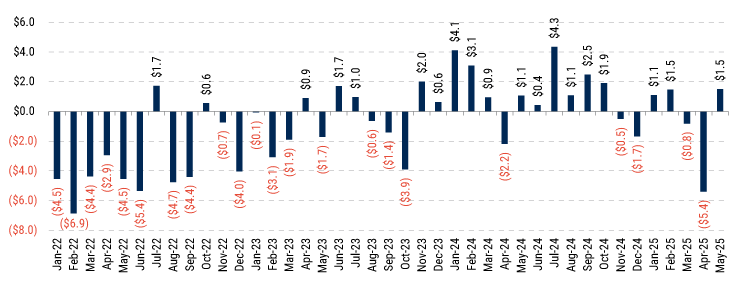
For example, monthly high yield fund flows can swing widely within a year, going from large negative outflows of tens of billions back to positive flows. So, in a short time, markets can shift from an oversold recessionary scenario to one that’s more risk-seeking in nature. This may prompt investors to consider increasing their high yield exposures when technical outflows result in highly attractive valuations and then subsequently reducing those exposures as the market reaches fair-value levels.
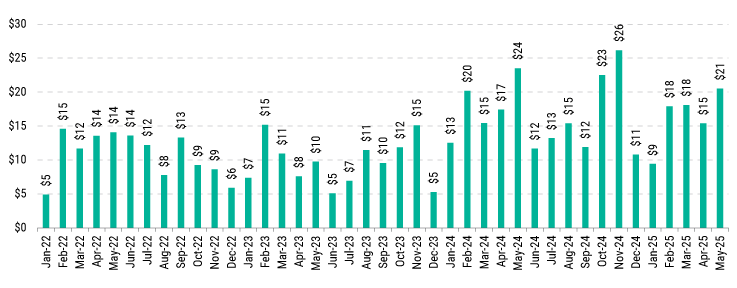
Relatedly, collateralized loan obligations (CLOs) remain significant buyers of leveraged loans, so increased CLO issuance means greater demand for the underlying loans that CLOs purchase as collateral. Periods of heightened demand can push loan prices higher and loan spreads tighter, and the opposite is true in periods of decreased demand. However, levels of CLO issuance can change dramatically month-to-month, which creates opportunities to purchase loans at attractive valuations during periods of weaker demand.
Monthly High Yield Fund Flows Can Vacillate Widely
Monthly fund flows in/out of US high yield mutual funds and ETFs ($ bil.)
Source: Morningstar Direct as of 31 May 2025.
Shifts in CLO Issuance Drive Demand for Leveraged Loans
Monthly CLO issuance ($bil.)
Source: Bank of America as of 31 May 2025.
In our view, a thoughtful MAC strategy should utilize three important “levers” to tilt the portfolio toward areas that provide risk adjusted returns, while always seeking the best opportunities among individual issuers.
1. Asset allocation. Designating a portfolio to just one segment of fixed income means the beta element of the portfolio will only be in favor during the part of the economic cycle in which that asset class benefits. A flexible asset allocation approach can respond to each phase of the cycle by either seeking or mitigating risk, with access to the entire corporate capital structure. This enables the portfolio to strategically change its beta and other active risks depending on where markets are in the credit cycle.
2. Tapping tactical opportunities. A focus on tactical opportunities allows portfolios to seek additional returns by capitalizing on short-term market dislocations that affect limited parts of the leveraged finance markets.
3. Security selection. This tactic seeks the most attractively priced opportunities regardless of their position on an issuer’s capital structure and expands the universe of issuers to a global scale. This enables the strategy to add incremental alpha through individual security selection decisions across all market environments.
Multi-asset credit offers several compelling advantages to investors.
Flexibility to navigate varied market and credit cycles. MAC is an all-season strategy designed to find opportunities in all types of markets by making shifts in allocations between credit asset classes. In uncertain markets, thoughtful multi-asset credit strategies aim to provide both yield and safety; at such times, when a defensive orientation predominates, opportunities to capture alpha will still emerge through security selection within each asset class, and active managers have the flexibility to choose the best ideas across global credit. The asset allocation decision applied in a MAC approach is based on relative valuations, and opportunities that are most prevalent during times of market disruption. Over the past 20 years, the most tumultuous periods have provided for the most attractively priced opportunities in leveraged finance markets. These include:
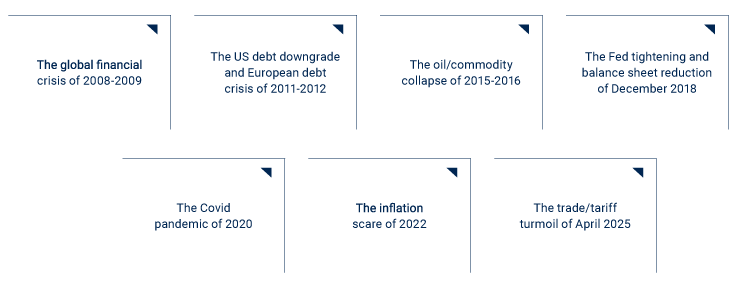
A successful MAC strategy must have the management experience, confidence, and guideline flexibility to capitalize on these opportunities.
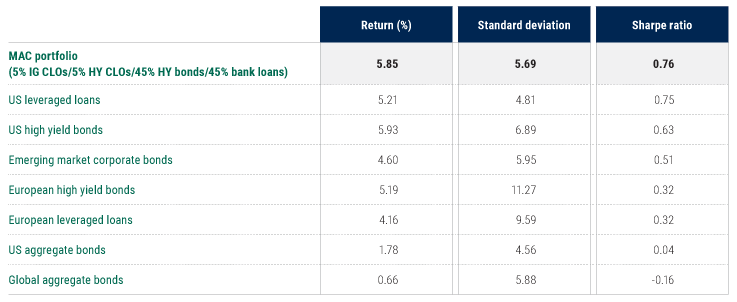
Broad credit diversification. The reason for MAC’s distinctive performance pattern, including the potential for both increased return and reduced risk, arises in part from the diversifying nature of the strategy. As the table below shows, MAC strategies have historically provided higher levels of return relative to risk compared with most fixed income asset classes.
MAC Strategies Have Provided Higher Historical Returns Relative to Risk
Sharpe ratios annualized since 2012 (common period)
Operational efficiency and ease of implementation. Investing in a single MAC strategy may provide an equivalent or superior range and diversity to what a number of different fixed income strategies could achieve within an asset owner’s strategic asset allocation framework. This may reduce the number of standalone strategies needed in an investor’s portfolio. Moreover, a MAC strategy enables the investment manager to quickly and efficiently rebalance or reallocate to take advantage of tactical investment opportunities within markets.
MAC strategies also allow investors access to commingled funds and other commingled vehicles, which pool together assets from multiple investors under the stewardship of a single investment manager, offering another way for investors to gain exposure to a diversified range of credit assets. Having broad guideline flexibility to shift the asset mix of a MAC portfolio allows the manager to capitalize on timely opportunities that arise during periods of heightened volatility. This may not be possible for certain institutional investors, given the longer lead times required due to governance or operational hurdles. For example, commingled vehicles typically have monthly or quarterly subscription and redemption schedules, making intra-month allocation shifts more challenging. Some institutional investors require board approval to make significant allocation adjustments, which can also delay implementation.
Income. MAC strategies seek to capture higher yields offered by credit assets spanning various credit markets while providing downside protection in volatile markets, thereby supporting a stable income stream. While recent spread levels have been tight relative to longer-term averages for leveraged finance asset classes, yields have been higher than longer-term averages. Income is the primary driver of fixed income total returns, and recent income levels have been relatively attractive.
Liquidity. As with most public fixed income, MAC strategies are generally liquid vehicles that do not require investors to tie up assets for long periods. Most assets held in a MAC strategy trade with an active two-way market. While the bid-offer spread can be wider for lower-rated segments and increase during periods of heightened volatility, these strategies are generally considered moderate to highly liquid in nature.
Higher total returns. By combining several asset classes that are less than perfectly correlated, MAC strategies have historically provided superior risk-adjusted returns relative to standalone allocations (refer to the Sharpe ratio table above).
Unlike with traditional fixed income, there is no standard benchmark for multi-asset credit strategies. Nonetheless, the measure of success for most is to provide better outcomes than a blended, discrete sleeve management, such as a 50/50 loan and high yield index. At the time of this writing, out of the 110 discrete strategies within the eVestment Multi-Asset Credit peer group, 54 indicated a benchmark that was based on some form of credit market exposure, to varying degrees; 31 indicated a benchmark that was a proxy for a risk-free rate, such as US Treasury bills; and 25 did not indicate a benchmark or indicated that they were benchmark agnostic.
Regardless of the benchmark, investors should be mindful of the underlying risks and asset classes/ranges allowed within a MAC strategy. MAC strategies are expected to experience reasonable drawdowns during periods when spreads are widening, as they are not pursuing an absolute return/arbitrage/market-neutral/hedge fund-type approach.
The number of securities included in MAC strategies varies widely among managers, ranging from a few hundred (or less) to over a thousand.1
A declining liquidity environment favors MAC allocations appropriately sized to take advantage of value dislocations. Strategies with larger AUM bases may find it difficult to maneuver sufficiently or to add security selection alpha, so investors need to evaluate how nimble a MAC manager is and how well it executes its strategy.
A maximum capacity of $5 billion-$10 billion seems optimal, with the rationale that for a portfolio with roughly 100 to 200 issuers, a 1% position at $5 billion-$10 billion in AUM would result in a position size of $50 million. A manager could exit a position of this size in a reasonable time frame without having a dramatic impact on the position’s price. Position sizes may need to be smaller for bonds and loans with par amounts outstanding below $500 million for liquidity purposes.
In our view, this level of assets under management offers sufficient scale for the asset manager while also resulting in an issuer count that is both large enough to offer broad diversification but small enough for the manager to add significant value via active share and issuer selection.
As with any investment strategy, there are risks to consider with multi-asset credit. Essential to navigating risk is the manager’s strategic view of where we are in the economic and credit cycle to position for drawdown periods.
In general, MAC strategies seek to invest in a countercyclical manner over a credit cycle. This means increasing credit spread duration risk when markets are adequately compensating investors for the underlying default loss risk (in the form of wider spreads), and reducing risk when spreads are not adequately compensating investors.
Seeking to Capitalize on Inefficiencies in Evolving Credit Markets by Countercyclically Adjusting Portfolio Risk Positioning
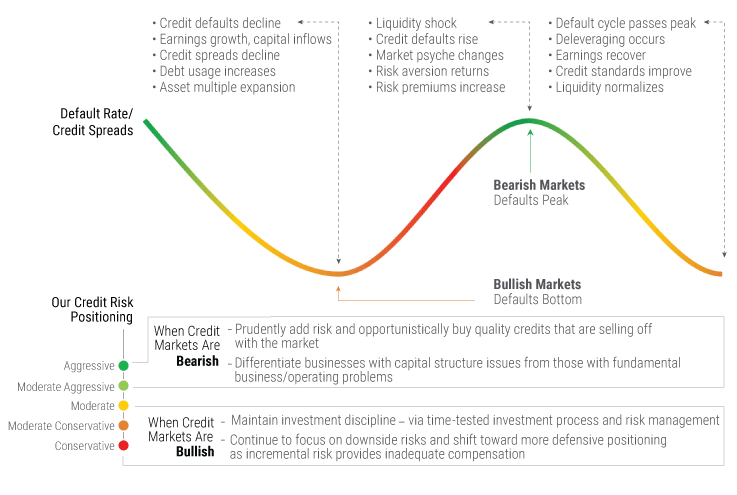
Source: For illustrative purposes only. No investment strategy or risk management technique can guarantee returns or eliminate risk in any market environment.
Credit risk. Multi-asset credit strategies typically involve assets with higher credit risk, such as high yield and leveraged loans, which are below investment grade and thus potentially more vulnerable to default.
Drawdown risk. MAC has embedded credit beta exposure and will likely experience periods of negative returns. Moreover, key components of these strategies can become highly correlated during a drawdown. For example, the correlation between high yield bonds and bank loans may increase during periods of heightened volatility, as both asset classes are likely to experience a drop in demand along with selling pressure.
Liquidity risk. Periods of relative illiquidity can also pose challenges. For example, within high yield, while the daily trading volume has increased since the global financial crisis, actual liquidity conditions have deteriorated, as the trading volume as a percentage of the high yield asset class is now about 80% of what it was pre-crisis. This decline in liquidity requires a MAC allocation to be sized appropriately to take advantage of value dislocations.
Concentration risk. When implementing a MAC allocation, investors should evaluate their potential for exposure to concentration risk. This is a key reason we believe asset owners should consider working with a skilled MAC active manager who can make nimble relative value decisions rather than different managers for each type of credit asset. In some cases, one credit may be owned by more than one manager in an asset owner’s line-up, causing them to inadvertently “double-up” on issuer exposure, and an investor who uses different managers for different credit areas might not see the concentration risk this situation can pose. Because multi-asset credit managers have a view of the entire portfolio, they can address concentration risks that might be invisible to an asset owner.
As noted, MAC offers the flexibility to move across the capital structure and geographies to mitigate risks, depending on the manager’s assessment of what stage the credit cycle is in. For example, when valuations are expensive (or spreads are relatively tight), investors might do better to migrate up the capital structure (such as higher-quality CLO debt tranches or higher-quality segments of leveraged loans) because they’re getting paid less for taking incremental risk. Yet they need to be well positioned to capture opportunities that will arise when spreads widen again. When valuations are cheap, it may be better to move down the capital structure, seeking increased credit spread duration and more positive convexity in certain segments of the high yield bond market.
Managers with global credit capabilities across all segments – and a consistent style and investment process – can help investors mitigate risk in ways that managers focused on individual “sleeves” may lack.
Despite these risks and limitations, we believe the MAC approach should still capture the interest of plan sponsors, particularly compared with traditional fixed income. Though the asset allocation decisions can be complex, the intuition behind why MAC works is simple: With MAC, diversification comes from being able to expand the universe to buy across multiple asset classes. The alpha comes from being able to pick only the best of each universe.
A MAC strategy typically serves as a substitute for the leveraged loan or high yield portion of a portfolio. It can also be used for de-risking purposes, typically as a replacement for equities. Or it can be a more optimal way to manage an existing credit sleeve but with more flexibility by combining the assets into a MAC approach.
Investors can incorporate MAC into their overall strategy in a variety of ways:
- As an alternative to equity, investors can use MAC to achieve similar return with lower risk
- As a shift away from more interest-rate-sensitive credit portfolios
- To manage a traditional sleeve approach with more flexibility
- As part of a below-investment-grade credit bucket
- As a substitute for a standalone high yield or leveraged loan bond portfolio
- As an opportunity to add more below-investment-grade credit exposure than they could with high yield exposure alone
Asset classes don’t exist in isolation. To optimize outcomes, investors should consider how their investments and risks are changing in a larger context to take advantage of opportunities across both asset classes and geographies. For instance, MAC managers who are solely focused on domestic markets are unable to take advantage of global market opportunities in both developed and emerging markets.
Investors’ investment horizon and liquidity needs will determine which of these options provides the best fit.
Manager selection is also critical. When deciding on a MAC manager, investors should consider the manager’s experience, scale, size, and track record. A successful manager should boast a strong record of performance backed by a time-tested investment process that has been demonstrated to work across market cycles.
We believe investors navigating an environment where uncertainty is the rule should look to fixed income strategies such as multi-asset credit that have the flexibility to better navigate shifting market conditions in a risk-controlled manner. MAC strategies can provide an efficient tool for implementing traditional asset classes and may offer a way to help bring volatility-spooked investors off the sidelines and keep them from missing out on critical opportunities.
Historically, MAC has offered high yield returns with less than high yield risk – an attractive draw amidst historical volatility. By encompassing a broad spectrum of instruments to diversify returns and manage risk, a MAC allocation offers opportunities to capture alpha, even under conditions that favor a defensive orientation.
MAC aims to maximize returns by identifying tactical opportunities during periods of market dislocation. Risk mitigation comes from MAC managers’ strategic view of a given economic and credit cycle and their comfort with structuring investments to create downside protection. For this approach to be effective, bottom-up security selection is key, which means it’s crucial for managers to have knowledge across asset classes and geographical areas.
Being part of a global credit platform with analysts who track industries and companies across credit cycles can facilitate this approach. MAC managers also require resources and expertise to perform due diligence – going beyond traditional credit analysis – to identify and verify the broadest range of global alpha sources.
While MAC can help investors position for the challenging environment ahead, it’s important that the strategy is paired with the right management. Compared to those who use different managers for each type of credit asset, we believe investors who employ a MAC manager are better equipped to make these quick allocation shifts – and less likely to miss out on compelling opportunities.
Our Leveraged Finance Group is a globally integrated team of leveraged loan, high yield, CLO, and emerging market corporate investment professionals, providing broad and deep coverage across the capital structure, industries, and geographies. A rigorous, time-tested investment process with disciplined portfolio construction, robust risk management, and a foundation in credit-intensive research through independent research and a proprietary credit rating system is the cornerstone of our investment philosophy to adeptly identify market inefficiency, monitor credit risk, and capture relative value opportunities. With demonstrated experience in identifying investments within a multi-asset credit approach, we apply continuous portfolio monitoring and rigorous risk management to each of our strategies and leverage our long-standing asset allocation process.