Beyond the Pitch: Private Capital Funds Sports Infrastructure and Operations
Jun 2026
View available investments in your area

Sorry, we couldn't find any results matching
Please:

Every four years, people around the world come together to watch the beautiful game at the FIFA World Cup. For institutional investors, however, the action takes place behind the scenes, in the financing that underpins modern sports.
The real investable story in sports is not game-day performance, but the contracted, diversified cash flows that power the game. Professional sports have evolved into a capital-intensive industry supported by long-dated contracts, scarce assets, and loyal, engaged audiences. Stadiums have become multi-use infrastructure platforms engineered to generate revenue 365 days a year, while clubs, teams, and leagues increasingly resemble regulated operating businesses monetizing one of the last forms of truly live media. Broadcasting rights, sponsorships, premium seating, and experiential offerings now drive economics as much as on-field performance.
Private capital has long played a role in this ecosystem, but the opportunity has changed materially as sports organizations professionalize and revenue streams expand. Private infrastructure debt and private placements offer investors access to long-duration, diversified income streams that are structurally different from traditional corporate credit, provided that risks are carefully underwritten.
Over the last few years, institutional capital has poured into sports clubs, teams, and leagues in the United States and Europe, much of it from private equity sponsors (Exhibit 1). The door to private equity opened first in Europe in 2006, when a consortium of three investors bought the Paris St. Germain football club. The industry gained a toehold in professional sports in the U.S. in 2019, when Major League Baseball allowed teams to sell minority stakes to institutional investors. The other American leagues followed.
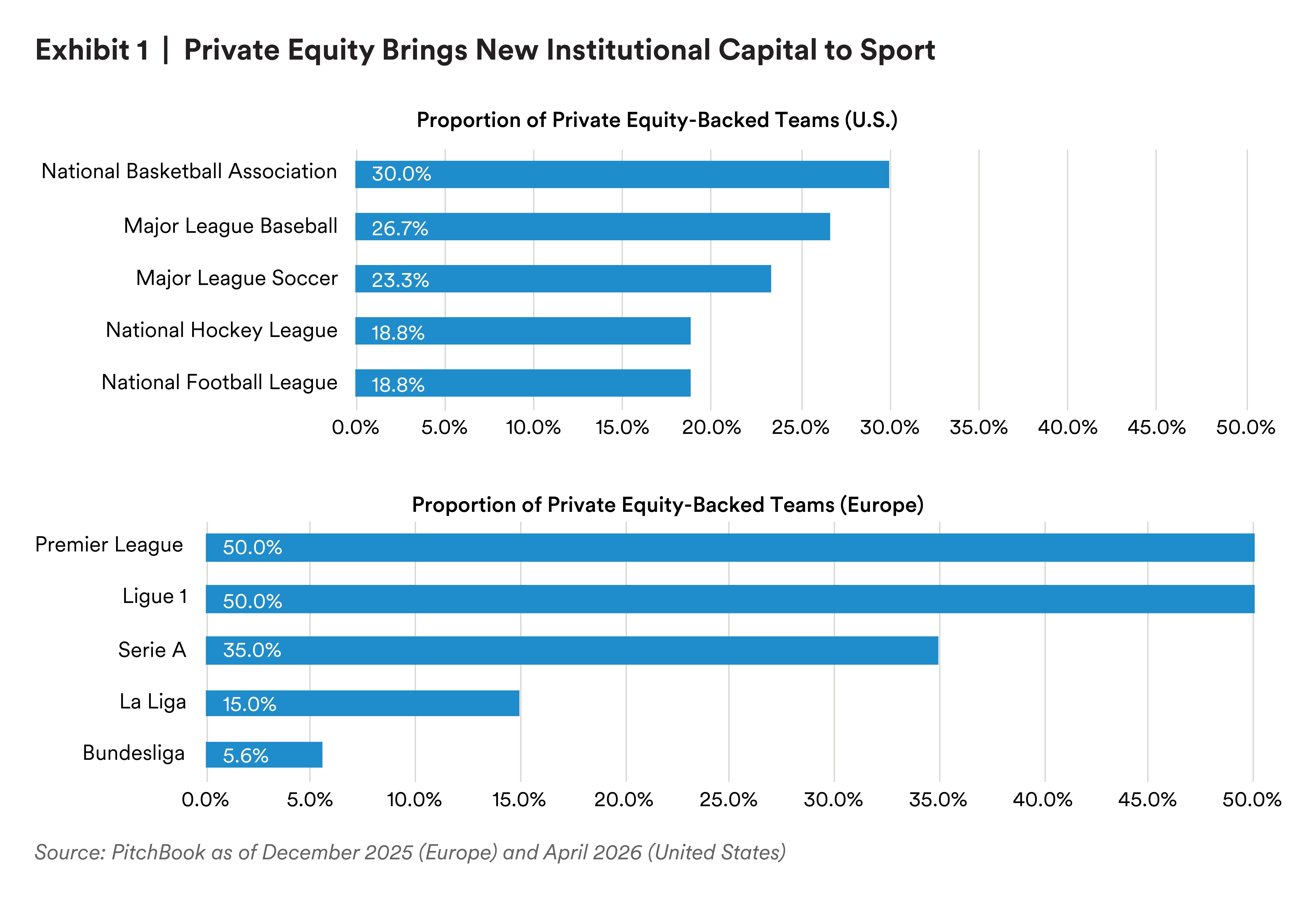
Over the last few years, most of the largest private equity players have announced dedicated vehicles for sports financing and made major purchases. To name a few examples, CVC Capital Partners launched a $14 billion private equity platform dedicated to sports in 2025, KKR acquired the institutional sports investment firm Arctos Partners in February 2026, and the U.S. investment bank William Blair announced an agreement to acquire Inner Circle Sports, an investment bank focused on sports, media, and entertainment, in May 2026.
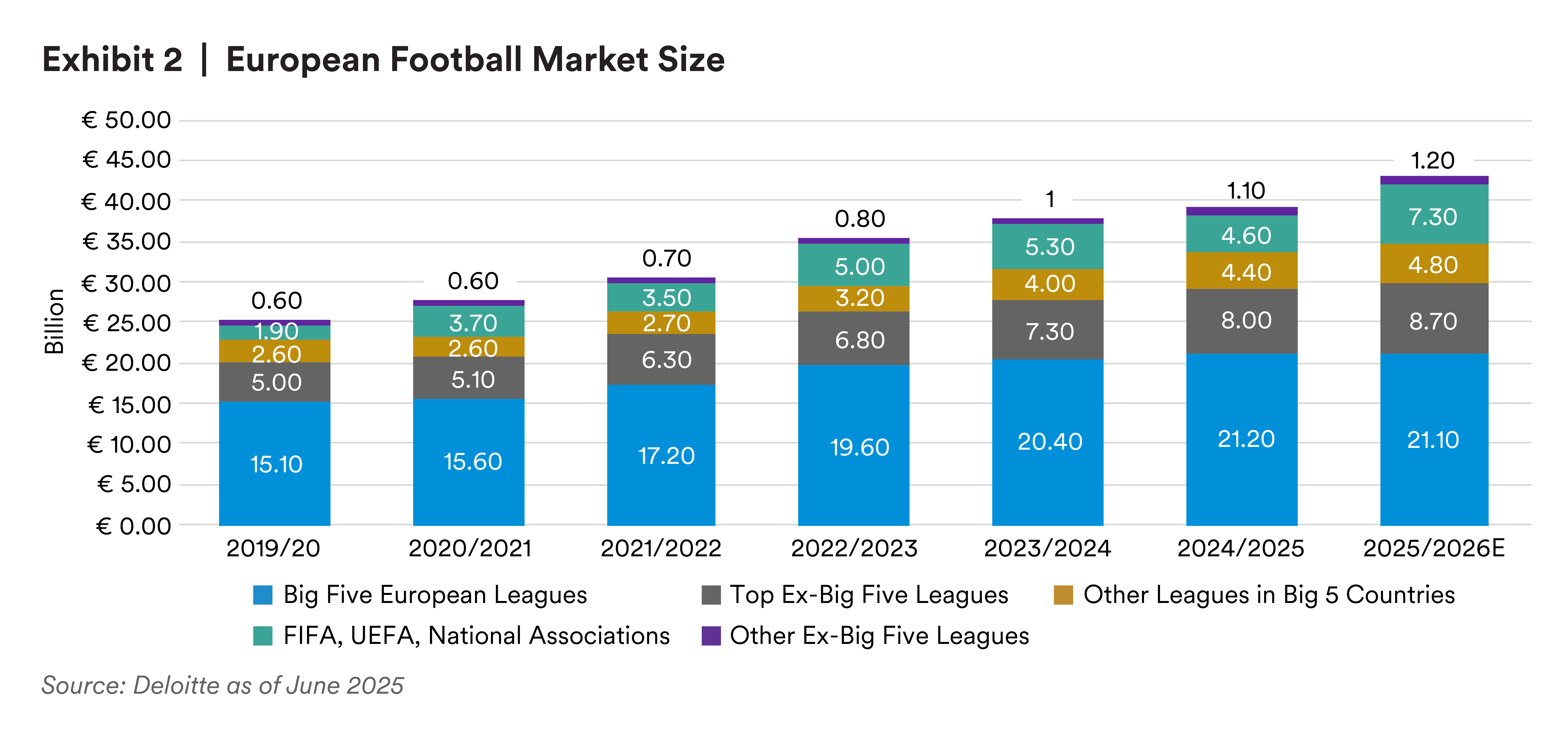
The reason for this influx is simple: Sports teams are getting more valuable, thanks to both media broadcast rights and increasingly professional operations that take every opportunity to monetize brands and slim down costs (Exhibit 2).
At a time when most people’s attention is divided across different screens and apps, television ratings are declining. In the United States, broadcast and cable viewing have declined 21% and 39%, respectively, since 2021, and streaming surpassed their combined viewership for the first time ever in 2025.1 The trends are similar in Europe, with broadcast viewership declining 4% in 2024 alone in the United Kingdom.2
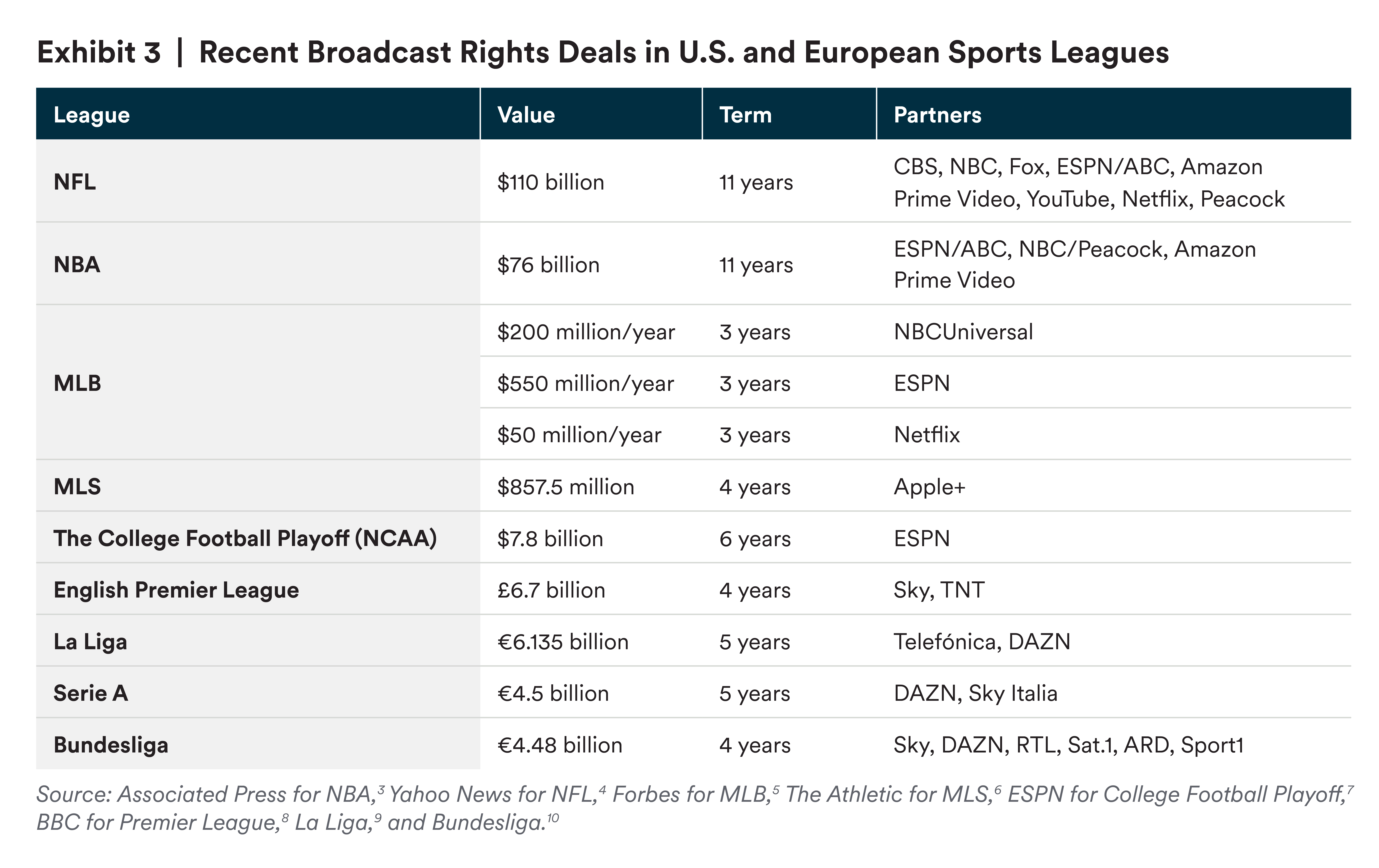
Sports events are some of the last must-see events that reliably draw a large audience. The value of broadcasting rights reflects the value that unique market position holds for advertisers (Exhibit 3).
“Sports are the last bastion of live media,” said Dillon Malandro, who covers corporate private placements for North American sports leagues on MetLife Investment Management’s Private Credit team. “The bidding wars [to air the games] have gotten so tight — not just between traditional counterparties, but also streaming services — that the intrinsic value of these contracts just soared. Everyone wants a piece of the pie.”
Private equity’s entry into sports financing is new, driven by these broadcasting streams, but private capital in sports is not. MetLife Investment Management has provided capital for teams, clubs, and leagues to refinance, expand operations, and cover expenses for at least 20 years.
For teams, clubs, and leagues, private capital may offer greater speed and certainty of execution than traditional bank lending. Private lenders may also be able to offer more bespoke terms based on the needs of the organization.
For debt investors, the potential advantages are myriad:
There are also risks and considerations. Relegation, in which the worst-performing European football clubs are demoted to lesser leagues, can materially impact the club’s broadcasting, commercial and matchday revenues, and ultimately their ability to service debt. Sporting performance is ultimately a key credit consideration both in Europe and the United States.
Assessing downside risk includes considering the long-term appeal of a team’s brand alongside performance, however. For instance, global institutions such as Real Madrid or the New York Yankees are viewed as more resilient commercial propositions, relative to lesser-known teams in smaller markets. That doesn’t mean lending to teams in newer sports or smaller markets is impossible, but a creditor would typically set stricter terms for doing so. “We are disciplined in where we put money to work,” said Alex George, a Director on the MetLife Investment Management Private Infrastructure Debt and Project Finance team in London. “While you want to get money out the door in a competitive lending environment, you also want to get it back.”
While aided by increasing professionalization across global sports, MIM’s underwriting teams pay close attention to governance risks, which remain a feature of some markets. Ensuring that a strong management team is in place, with transparency into funding and operations, is a critical consideration across all transactions.
For those who think of infrastructure in terms of the electrical grid, airports, and toll roads, stadiums might seem an odd fit at first. However, they meet our Private Infrastructure Debt team’s definition of infrastructure: discrete physical assets that generate contractual, inflation-linked cash flows, have high barriers to entry, and perform an essential service.
Those who would debate the last point better not do so in Barcelona, home of the renovated, 95,000-seat Camp Nou stadium. “There’s a saying that families go to church on Sunday morning and to watch football on Sunday evening,” said Kashif Khan, a Senior Director of Infrastructure and Project Finance at MetLife Investment Management. From Chelsea’s Stamford Bridge stadium in West London to the San Siro stadium in Milan (also due to be demolished and redeveloped this summer), European stadiums are often centrally located or easily reached by public transit—integral to cities geographically as well as emotionally.
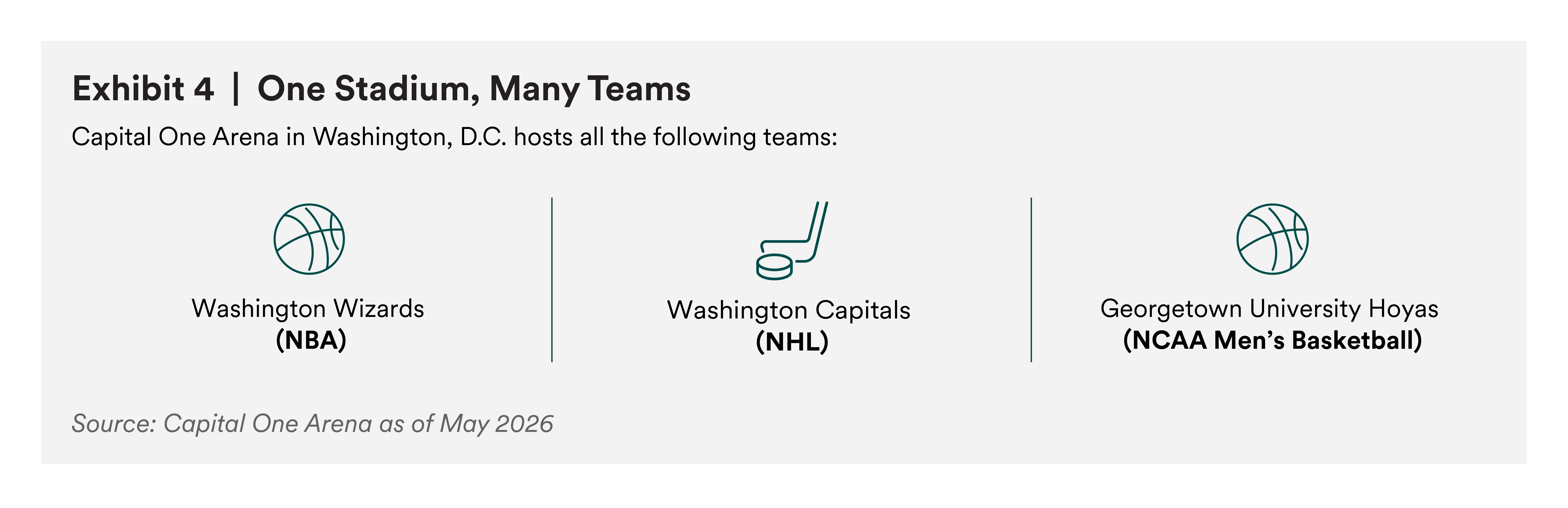
In the United States, stadiums are often the linchpins of large, mixed-use development projects. Los Angeles Rams owner E. Stanley Kroenke is developing the area around the state-of-the-art SoFi Stadium, which will hold eight FIFA World Cup games this year, into a 289-acre sports and entertainment zone, with luxury apartments, stores, a movie theater, and a concert hall. U.S. municipalities hoping to attract jobs and visitors often contribute public funds to finance stadiums or the infrastructure around them. The City Council in Washington, D.C., invested $515 million in a public-private partnership to expand and improve the Capital One Arena and the surrounding area, for example.
Many stadiums in Europe and the United States are more than 20 years old – with some over 100 – and due for a refresh. New and renovated stadiums are designed to maximize revenues as multi-use buildings that host multiple teams and non-sports events throughout the year, with every possible square inch monetized.
Year-Round Stadiums Look Beyond Game Day
Today’s stadiums often play host to multiple teams, increasing the number of game days (Exhibit 4). In Europe, many stadiums built primarily for men’s football clubs also host women’s football matches.
Concerts and other entertainment events have become increasingly important revenue streams. “There has been huge a surge in demand for live music post-Covid,” said Kathryn Bai, a Director on MetLife Investment Management’s Infrastructure and Project Finance team. “When top artists including Beyoncé and Taylor Swift were on tour, event revenues at some stadiums even doubled.” Stadiums host family events, monster truck rallies, corporate conferences and more to maximize stadium usage and keep the concessions flowing.
Unique, on-site experiences also attract visitors. The Bernabéu Tour at Real Madrid’s new stadium will feature a bigger museum with interactive virtual reality technology and a panoramic tour. At Tottenham Hotspur Stadium in London, visitors can drive “F1-inspired karts” or strap on a safety harness for a walk out on The Dare Skywalk 46.8 meters above the pitch.
The importance of attractions and non-sports events to overall revenues varies by stadium. Its location in Las Vegas, one of the entertainment capitals of the world, affords many opportunities to host non-sports events at Allegiant Stadium, including multi-day megaevents such as WrestleMania. Credit teams at MetLife Investment Management factor all of this in when considering a stadium’s revenue streams.
Corporate Sponsorships and Naming Rights
MetLife Stadium in East Rutherford, N.J., is home of the New York Giants, New York Jets, and eight FIFA World Cup games (including the final) this year. It’s also a close-to-home example of how stadiums earn revenue from selling their names. Typically, naming rights deals last a decade or more, offering years of predictable revenue streams that can reach into the hundreds of millions of dollars. Stadium lenders often have claims on these cash flows in the event the team or club defaults.
In Europe, only one-third of the 36 clubs profiled in a recent study had sold naming rights to their stadiums, though this is changing fast, Khan says. All but four Bundesliga stadiums in Germany have corporate sponsors, for example, including the Allianz Arena where Bayern Munich plays and Deutsche Bank Park in Frankfurt.
Companies also pay to name pavilions, hospitality suites, and premium seating areas. Exhibit 5 shows how this breaks down at the Climate Pledge Arena in Seattle, Washington.
Exhibit 5: Named Hospitality Sponsorships at Climate Pledge Arena

Priority Seating, Hospitality Lounges, and Personal Seat Licenses
New and renovated stadiums usually seek to add more VIP lounges, luxury boxes, corporate suites, and club seats. These premium seats, which are often locked in by multi-year contracts, can generate millions of dollars in sales. They’re also important to creditors, who often have recourse to these cash flows.
Barcelona’s new stadium will hold 9,400 VIP locations when fully completed, more than tripling hospitality capacity from the previous stadium. VIP seat licenses sell for €20,000-€80,000 each, plus annual fees, for a period of 15-30 years.12 In May 2026, the club’s website said suites, boxes, and the VIP ring of seats had already sold out, months before the stadium is fully opened.
Structuring Stadium Debt to Account for Project Finance Risk
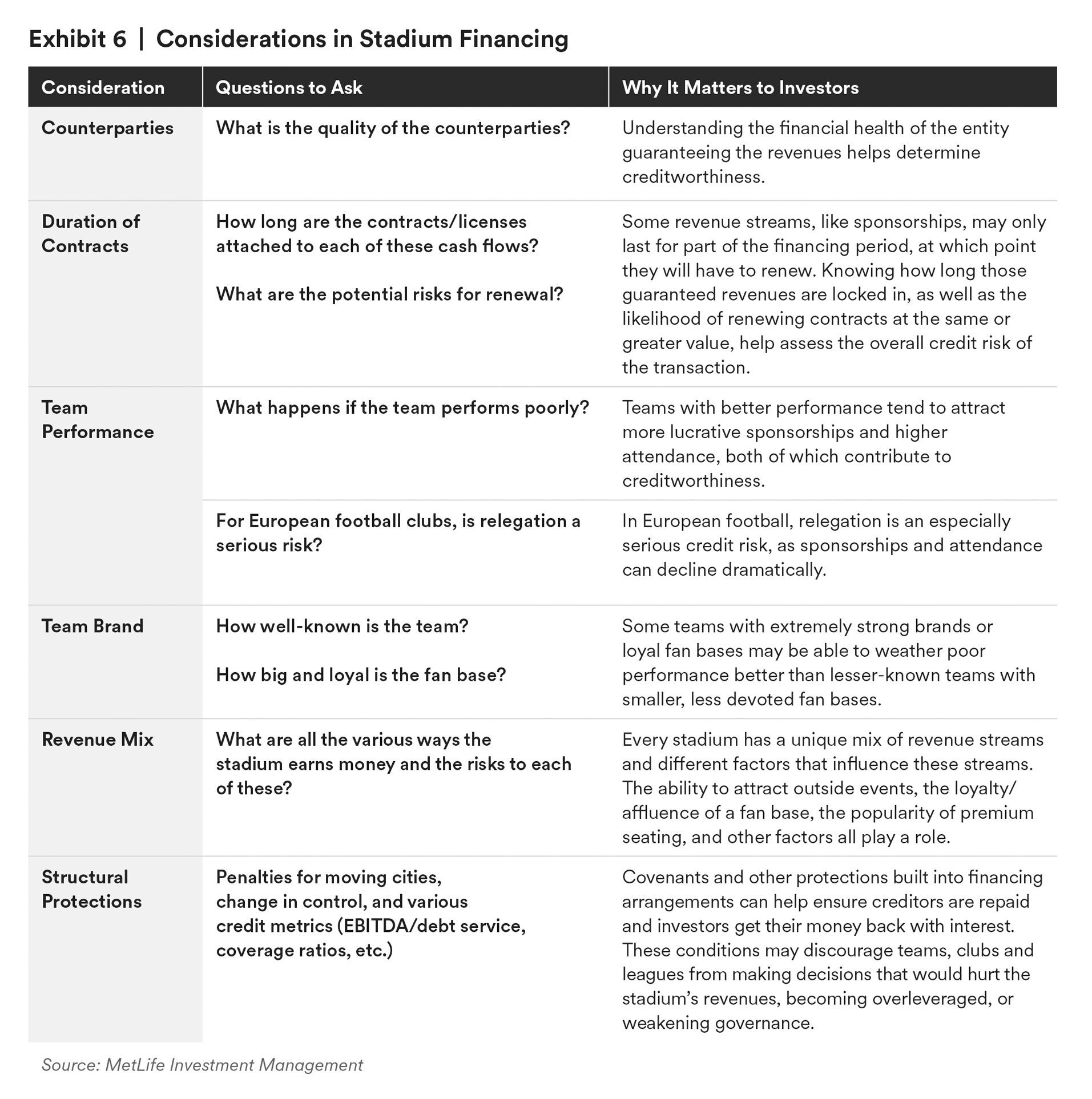
Financing a stadium has different risks than lending money to a more traditional corporation. Stadiums are infrastructure investments, and like most infrastructure investments, debt is secured by specific contractual cash flows. These might include naming rights, sponsorships, luxury suite premiums, club seat premiums, concessions, merchandise, event rent, ticket fees, parking charges, attraction revenues, and so on.
In assessing the risks and potential benefits of an investment, our team looks closely at the durability of these contractual cash flows in many different ways. (Exhibit 6).
Exhibit 6: Considerations in Stadium Financing
As the business of sports expands around the globe and into newer sports and leagues, our Private Infrastructure Debt team expects financing to follow. MetLife Investment Management recently completed a $40 million loan backed by a sponsorship agreement to support the construction of a new stadium for Denver Summit FC, a U.S. National Women’s Soccer League team.
The business of sports has outgrown the traditional narratives that once defined it. What appears from the outside to be driven by passion, performance, and fandom is increasingly sustained by long-dated contracts, diversified revenue streams, and institutional-grade governance. Stadiums now function as year-round infrastructure assets, while clubs, teams, and leagues operate as scarce, regulated platforms monetizing one of the last forms of truly live media.
For institutional investors, stadium financing and corporate private placements potentially provide access to predictable cash flows, structural protections, and senior positioning in capital structures that have in some cases demonstrated a degree of resilience as capital has flowed in. For lenders with the specialized expertise and discipline to underwrite the economics beneath them, sports potentially represent a durable and evolving source of long-term value.
MetLife: A Long-Term Partner to Sports Organizations
With more than $2 billion in stadium loans and over $3 billion in corporate private placements outstanding, MetLife Investment Management is one of the largest private debt providers in professional sports.
Our parent company, MetLife, sponsors the Japan Futsal National Team and the Men’s, Women’s and Youth National Football Teams in Mexico.