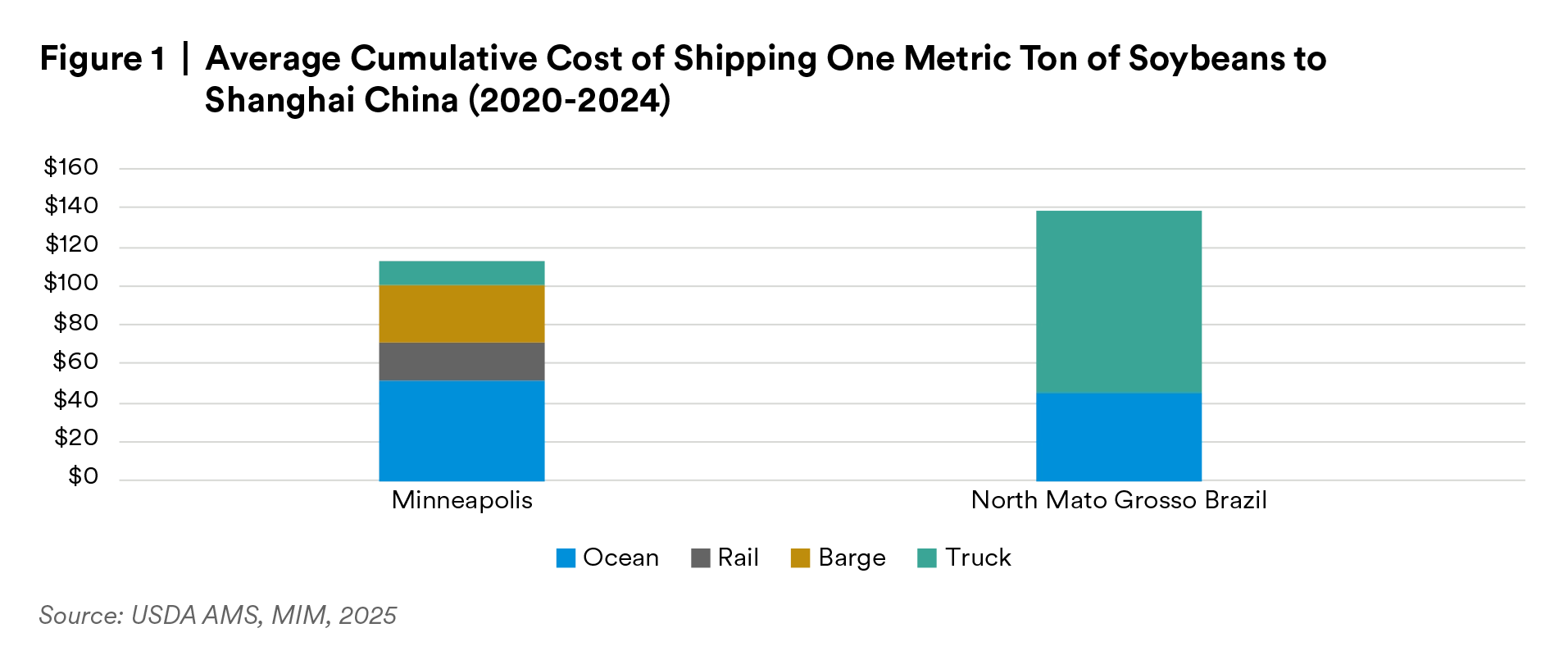
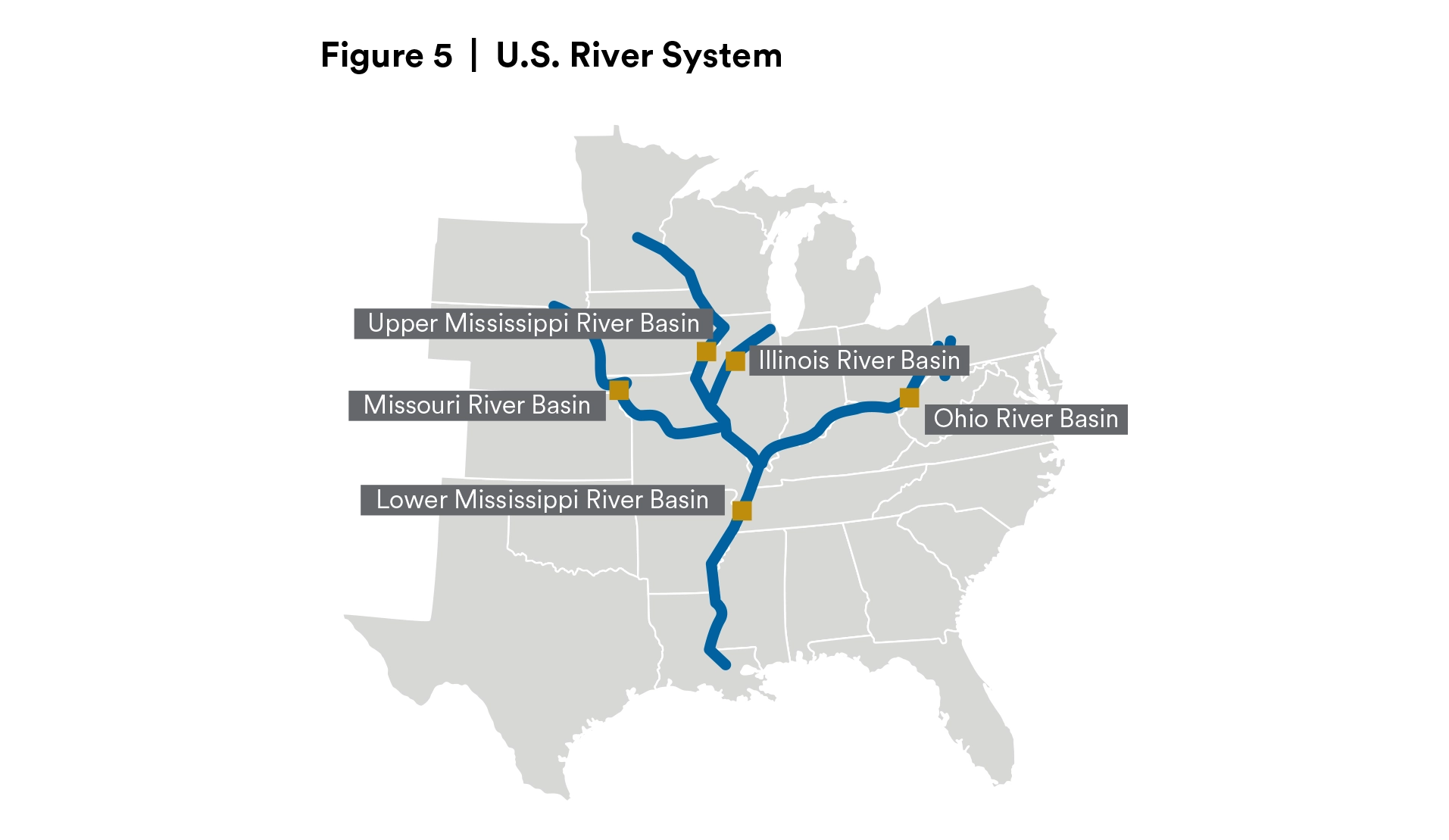
The Mississippi River is a vital artery for the U.S. agricultural sector, moving much of the grains and oilseeds produced in the nation’s heartland to bulk vessels on the Gulf Coast, and ultimately to their destination in foreign export markets around the globe. This crucial waterway carries 60% of U.S. grain exports1 and gives agricultural producers in the U.S. an advantage over their competitors in South America by offering a means of bulk transportation that is significantly more efficient than trucking2. Figure 1 highlights the advantages that U.S. agricultural producers have over Brazilian producers due to the lower cost of transportation granted by the cost effectiveness of the river system. However, seasonal fluctuations in water levels can impact navigability3, affecting barge transportation costs and influencing basis4. Basis is the difference between the local cash price and the futures price. When producers use futures contracts to hedge, fluctuations in basis can cause the futures price to move differently than the local spot price, resulting in imperfect hedging, known as basis risk. Understanding how river levels impact basis helps producers execute effective marketing and hedging strategies.
The Law of One Price theorizes that in efficient markets identical goods should all have a single price regardless of where it is sold. If the price were higher in location A than in location B, an arbitrage opportunity would exist, and someone could purchase it in location A to sell it in location B. They would do so until they’ve bid the prices back into equilibrium, and the prices in both locations were perfectly equal. In the real world, however, prices can and do differ between locations, and the difference in price should be (theoretically) entirely explained by the cost to transport the good from one location to the other. Therefore, the basis at the farmgate will fluctuate with transportation costs, and this can have real impacts on a farmer’s ability to hedge against price fluctuations.
More recently, the navigability of the Mississippi River has been challenged by seasonally low water levels. Shallow conditions provide physical constraints on barge loading capacity that can result in higher transportation costs5. Figure 2 demonstrates the relationship between low river levels at Baton Rouge and the spikes in cost of a barge headed downriver.
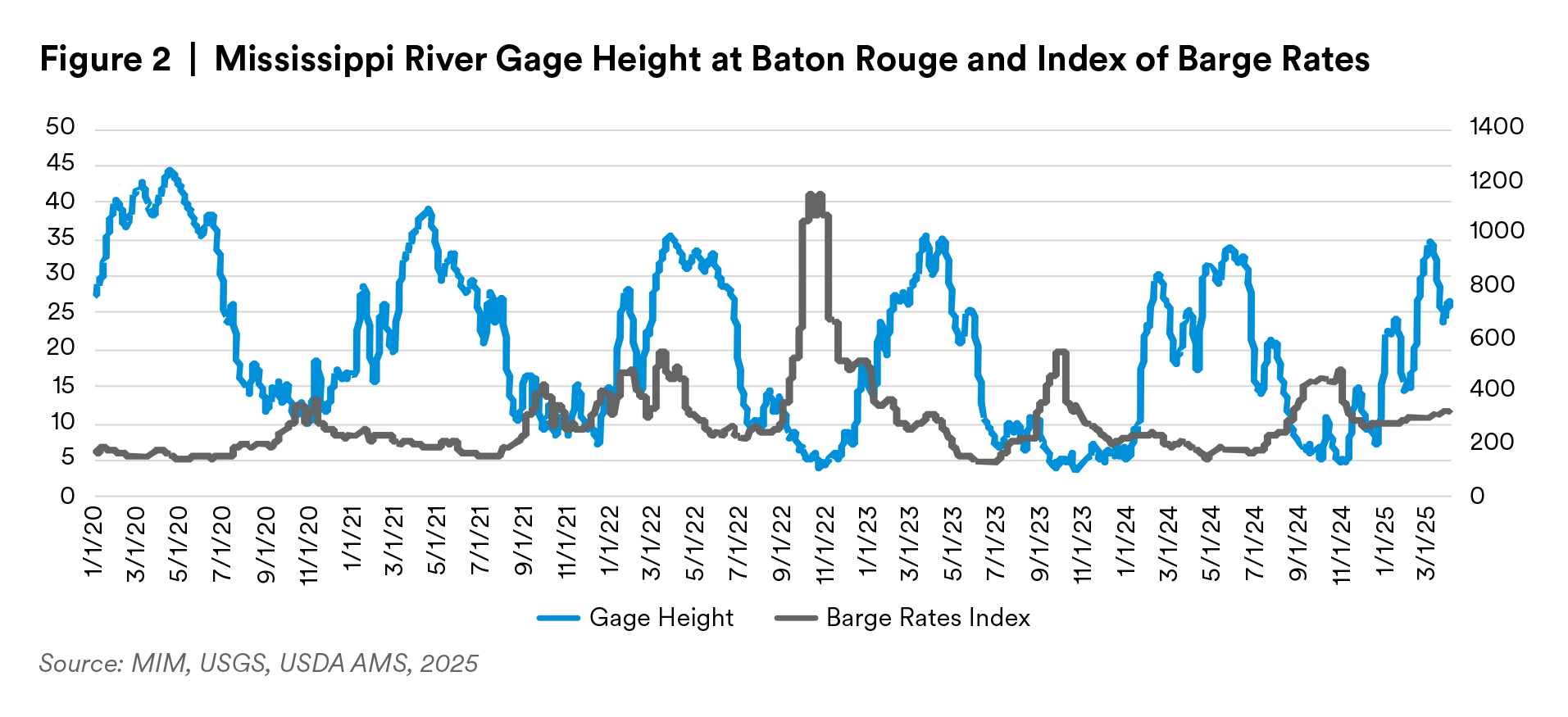
When water levels drop, the navigable channel becomes narrower and shallower, forcing barges to lighten their loads to reduce their draft and prevent running aground. Instead of operating at full capacity, barges carry less grain per trip, increasing cost per ton of grain transported. Typically, barges are loaded to a 11–12-foot draft during the fall, but the U.S. Coast Guard and the U.S. Army Corps of Engineers may impose 9-foot barge draft restrictions, which can lead to a reduction of 10,000–15,000 bushels per barge and may also restrict the number of barges allowed on a single tow6. Because a single 15-barge tow can transport as much grain as 870 large semitrucks7, barge restrictions can result in a substantial increase in the price of transporting grains and oilseeds downstream.
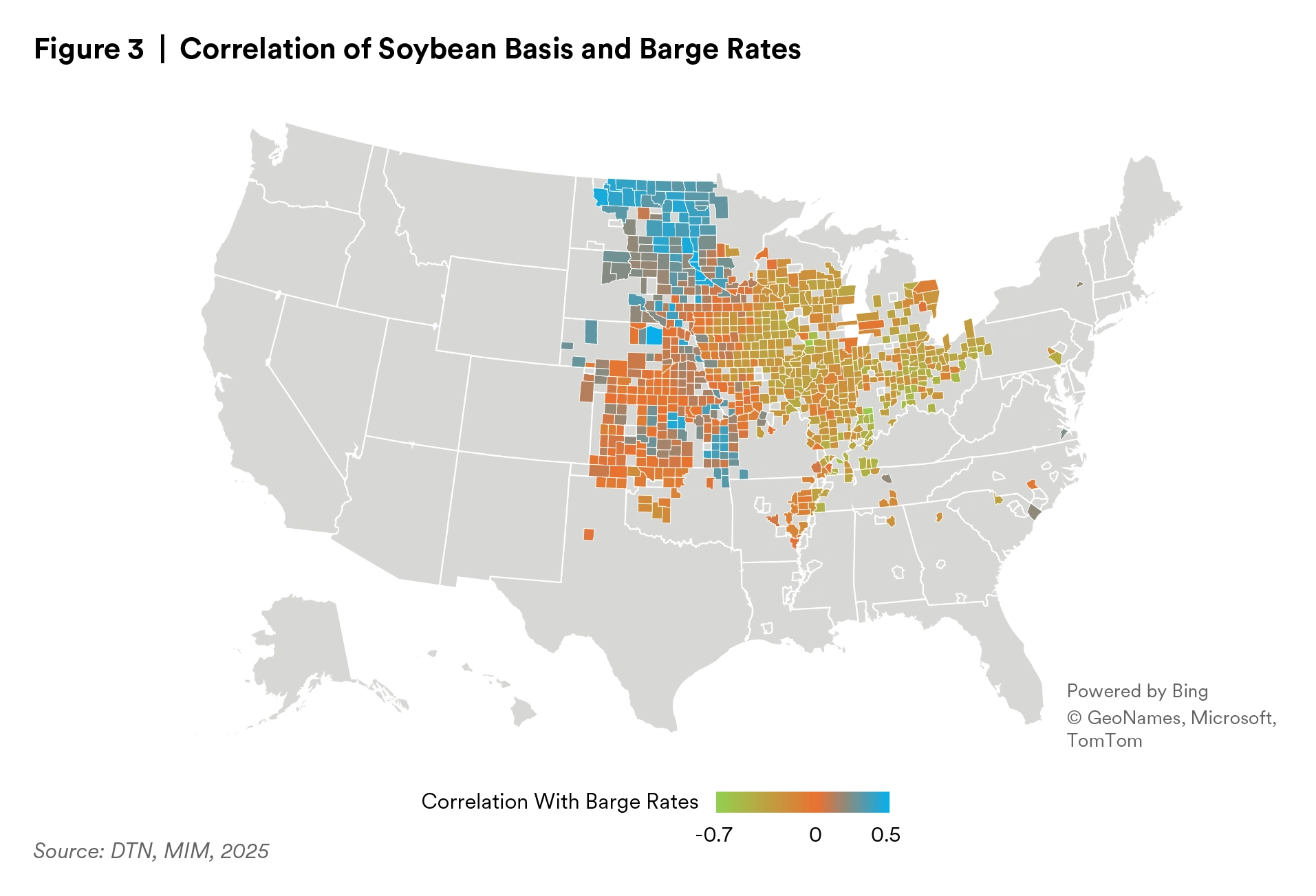
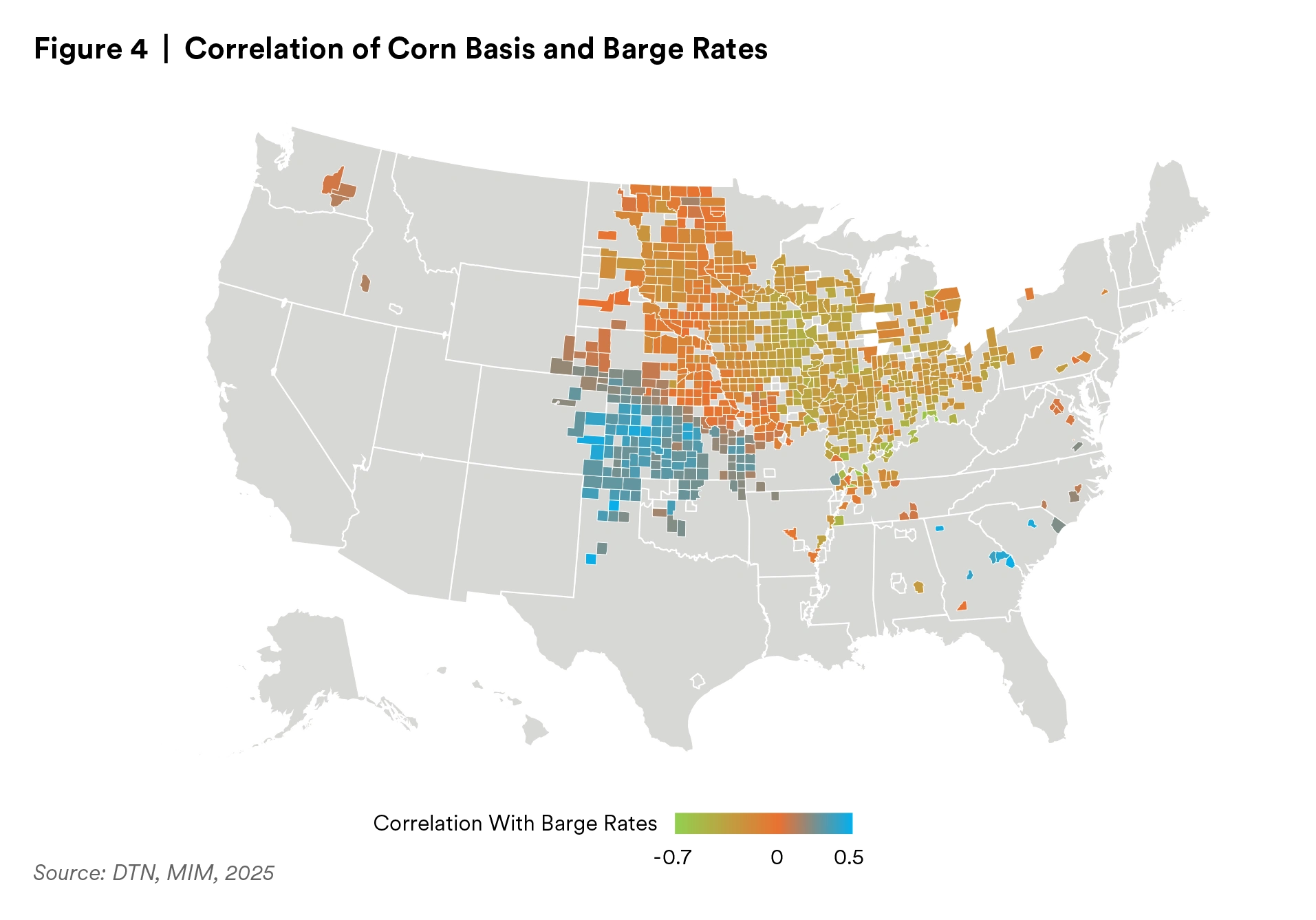
The impact that fluctuating water levels and barge rates have on basis varies across geography. Understanding the local basis relationship helps producers and their advisors to make marketing decisions. For counties with a negative correlation, low river levels and elevated barge rates can increase their basis (reducing local price relative to the futures price). For counties with a positive correlation, the opposite is true. A county with a near-zero correlation means that fluctuating water levels and barge rates don’t play a major role in explaining that county’s basis risk but doesn’t necessarily mean that the basis risk is zero.
While the correlation between barge rates and basis is similar for corn and soybeans in states surrounding Lake Michigan, the correlations differ in the upper and lower Great Plains. For soybeans (figure 3), counties in the upper Great Plains tend to have a positive correlation between average basis and barge rates — when barge rates increase, basis increases. In the lower Great Plains, this correlation is near zero. For corn, the pattern is reversed: Northern Great Plains counties have a near-zero correlation, while southern Great Plains counties show a positive correlation. For corn (figure 4), this geographic relationship is reversed, with the northern Great Plains counties having a near-zero correlation and the southern Great Plains counties having a positive correlation.
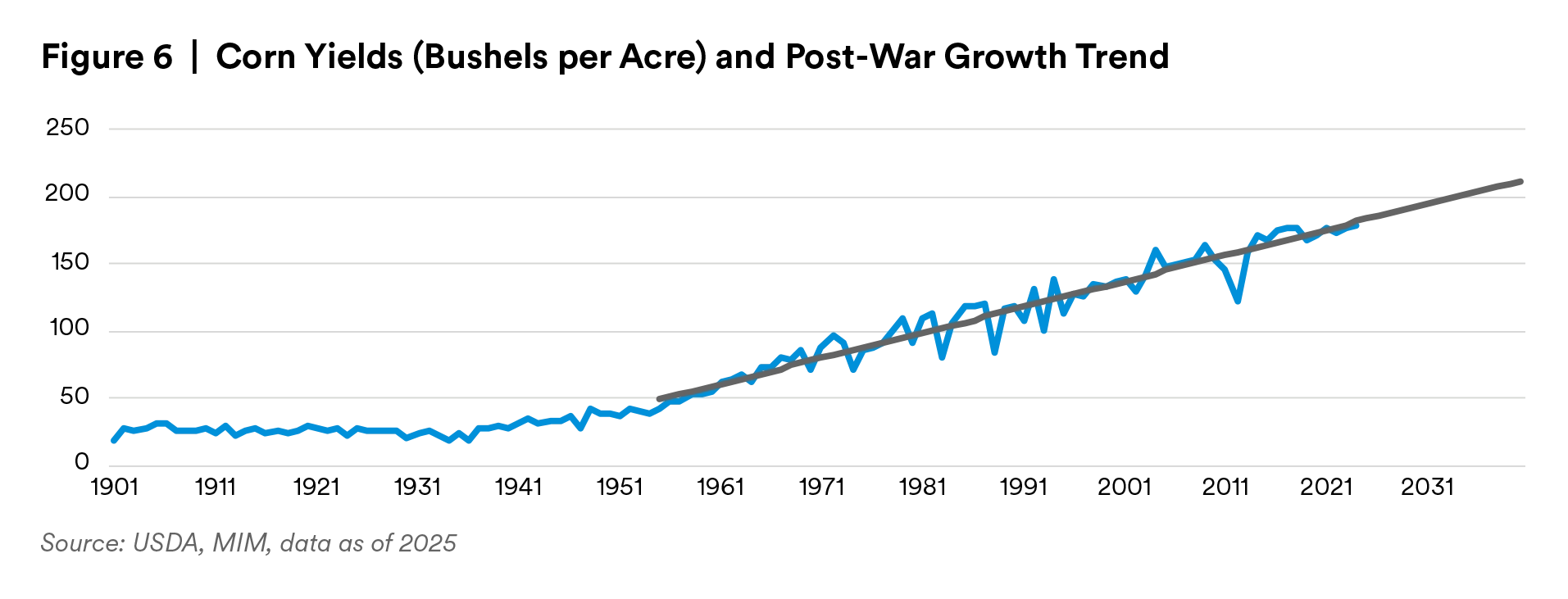
The U.S. farmer’s advantage on the global stage is one of efficiency, constantly adopting more advanced technologies and sophisticated strategies to maximize yields and lower per-bushel costs. Crop yields and overall production in the U.S. will continue to increase (figure 6), and much will need to flow down the Mississippi River. As the congestion in barge traffic increases, so too will the transportation cost, potentially exacerbated by low river levels. Should increasingly volatile weather patterns and seasonally low river levels become more commonplace, these seasonal fluctuations in basis caused by barge congestion may become more frequent and more extreme.
Grain will always migrate to the highest return, whether for export or domestic consumption. Increases in domestic consumption of grains and oilseeds from renewable diesel, ethanol and sustainable aviation fuel, or an expansion of domestic livestock production to meet rising global demand for meat, may very well help mitigate many of the risks facing the agriculture sector, including barge congestion on the river system. Increased domestic consumption of grains and oilseeds could reduce reliance on foreign export markets. This shift would allow exports to act more as a release valve, sending product overseas only when global prices and river conditions are favorable, thereby reducing the impact of river congestion on marketing strategies. If increases in domestic consumption are not enough to offset the future increases in grain and oilseed production, increased infrastructure investment such as improving the lock and dam system on the Mississippi river and its tributaries could allow the system to better handle the increased barge traffic.
The Mississippi River is a cornerstone of U.S. agricultural competitiveness, enabling efficient movement of bulk grains and oilseeds to global markets. However, seasonal fluctuations in river depth introduce marketing and hedging challenges. Increasing crop yields and weather volatility underscore the importance of the river system and the benefits of expanding domestic consumption of agricultural commodities.
The importance of the river system is perhaps most evident when compared to Brazil, where costly overland trucking drives up transportation costs. Increasing trends in crop yields and weather volatility highlight the importance of our river system and its infrastructure as well as the benefits of expanding domestic consumption of agricultural commodities.
Endnotes
1 National Park Service, 2025
2 USDA AMS Soybean Transportation Guide: Brazil, 2023
3 Associated Press, “The Mississippi River is running low again. It’s a problem for farmers moving beans and grain”, 2024
4 Arita, S., V. Breneman, S. Meyer and B. Rippey. “Low Mississippi River Barge Disruptions: Effects on Grain Barge Movement, Basis, and Fertilizer Prices.” farmdoc daily (12):164, Department of Agricultural and Consumer Economics, University of Illinois at Urbana-Champaign, November 2, 2022.
5 Bloomberg, “Mississippi River Dries Up Again at Worst Time for US Farmers - Bloomberg”, 2024
6 Southern Ag Today, “Barge Traffic Restrictions on the Mississippi River and Bulk Agricultural Exports”, November 17, 2022
7 U.S. Army Corps of Engineers, “Inland Waterway Navigation Brochure”, 2000