Zoomer Boom: Why the Youth Job Market Is Stronger Than It Looks
Nov 2026
View available investments in your area

Sorry, we couldn't find any results matching
Please:

Key takeaways
Are the kids OK?
Many people are worried about youth unemployment. AI adoption, along with the low-hire, low-fire labor market, is seen as making it more difficult for young people to find jobs. Statistical agencies categorize youths as those aged 16-24. While not a full match, the data covers the bulk of Gen Z, who are aged 14-29. Even though youth unemployment remains low in historical terms (indicating a tight youth labor market), the current Gen Z cohort has been slower to enter the labor market, with many enrolling in college instead. The unusually large size of the Gen Z cohort may be a partial explanation for the perception of a difficult labor market.
The youth unemployment rate is relatively low
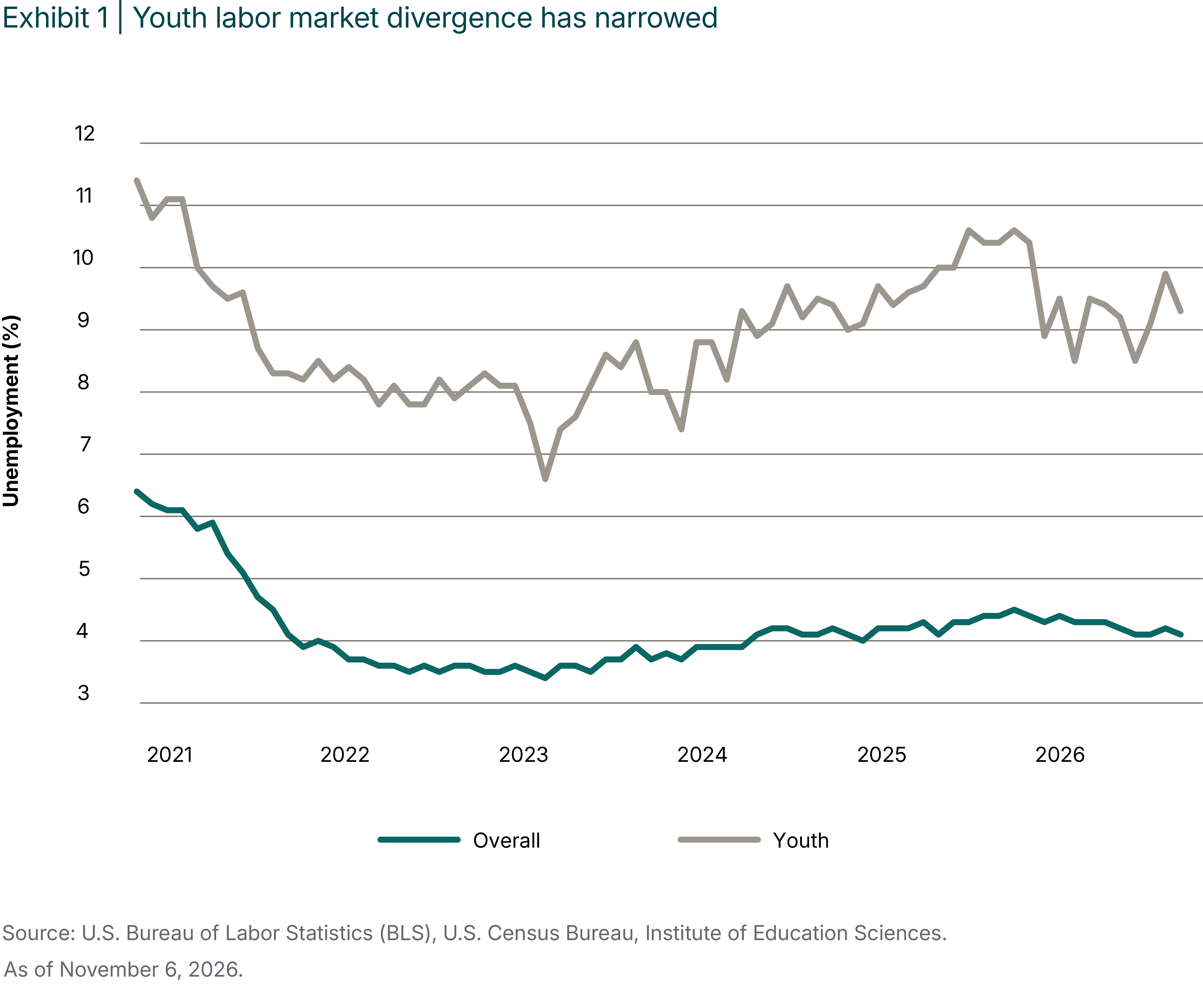
Youth unemployment tends to be higher than overall unemployment and was trending in a worrying direction through 2025. The period coincided with several stressors, including the Liberation Day tariffs (2025), general policy uncertainty and the start of serious use of AI in corporations. These had a chilling effect on the labor market in general and youth employment specifically.
However, more recently, the trend of increasing youth unemployment has flattened out, and the differential between youth and overall unemployment has normalized and was at a benign 5.2 percentage points in October.
It is also worth noting that historically, there have been very few periods in the last 40 years when youth unemployment was below 10%. In that historical context, the youth labor market is in fact tight.
A big cohort
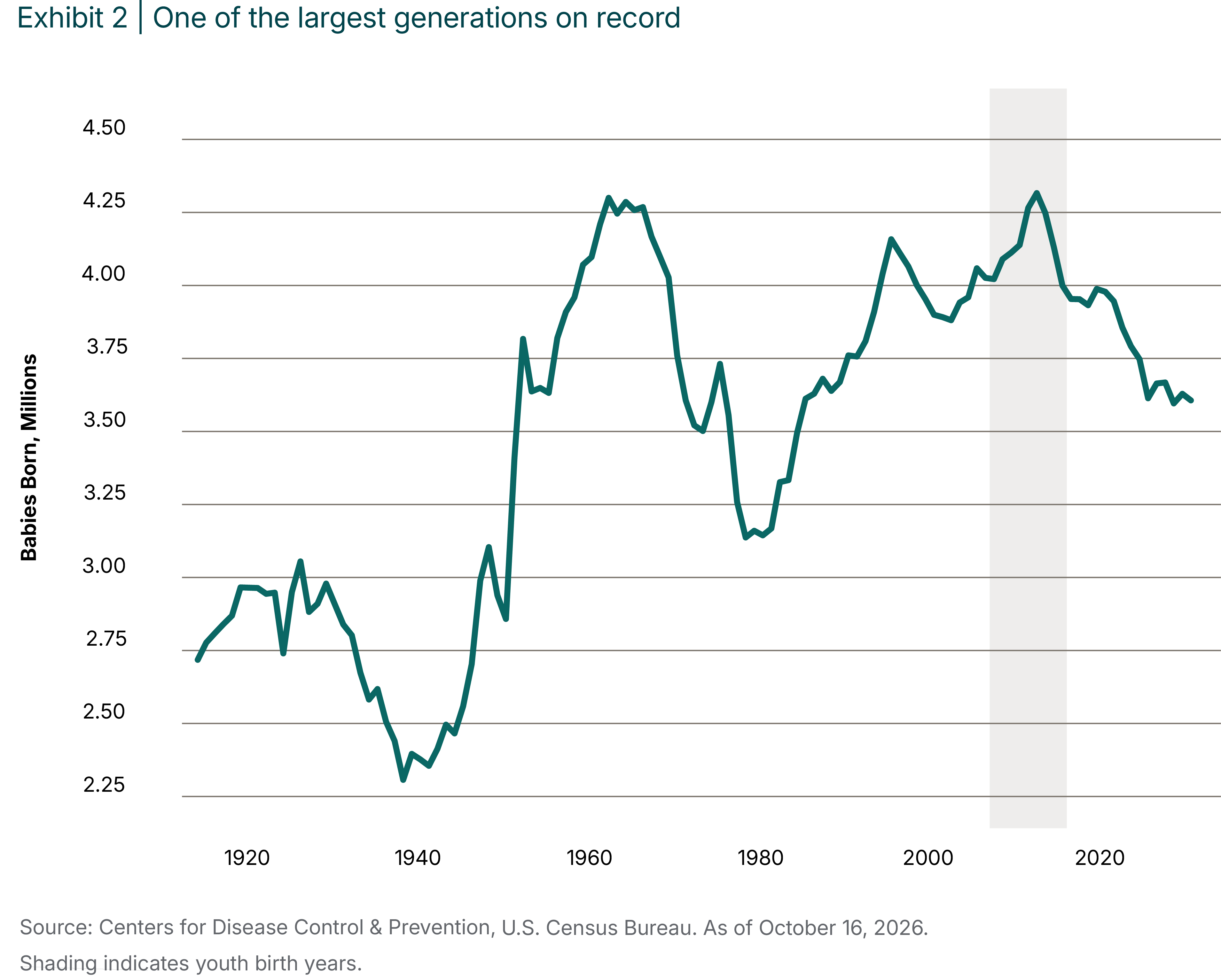
The relatively large Gen Z cohort may help explain why some young people cannot find jobs.
In terms of births, the cohort of young people today (those aged 14-29) is quite large, rivaling the Millennial generation in size. Census data showed that the number of babies born in the Gen Z period peaked at 4.3 million in 2007, a record high for the U.S. Although this excludes immigration, as a first pass, it tells us that Gen Z is a large cohort, likely one of the largest we will see in the near future. The labor market is taking time to absorb a cohort this large.
Youth labor force: recovering?
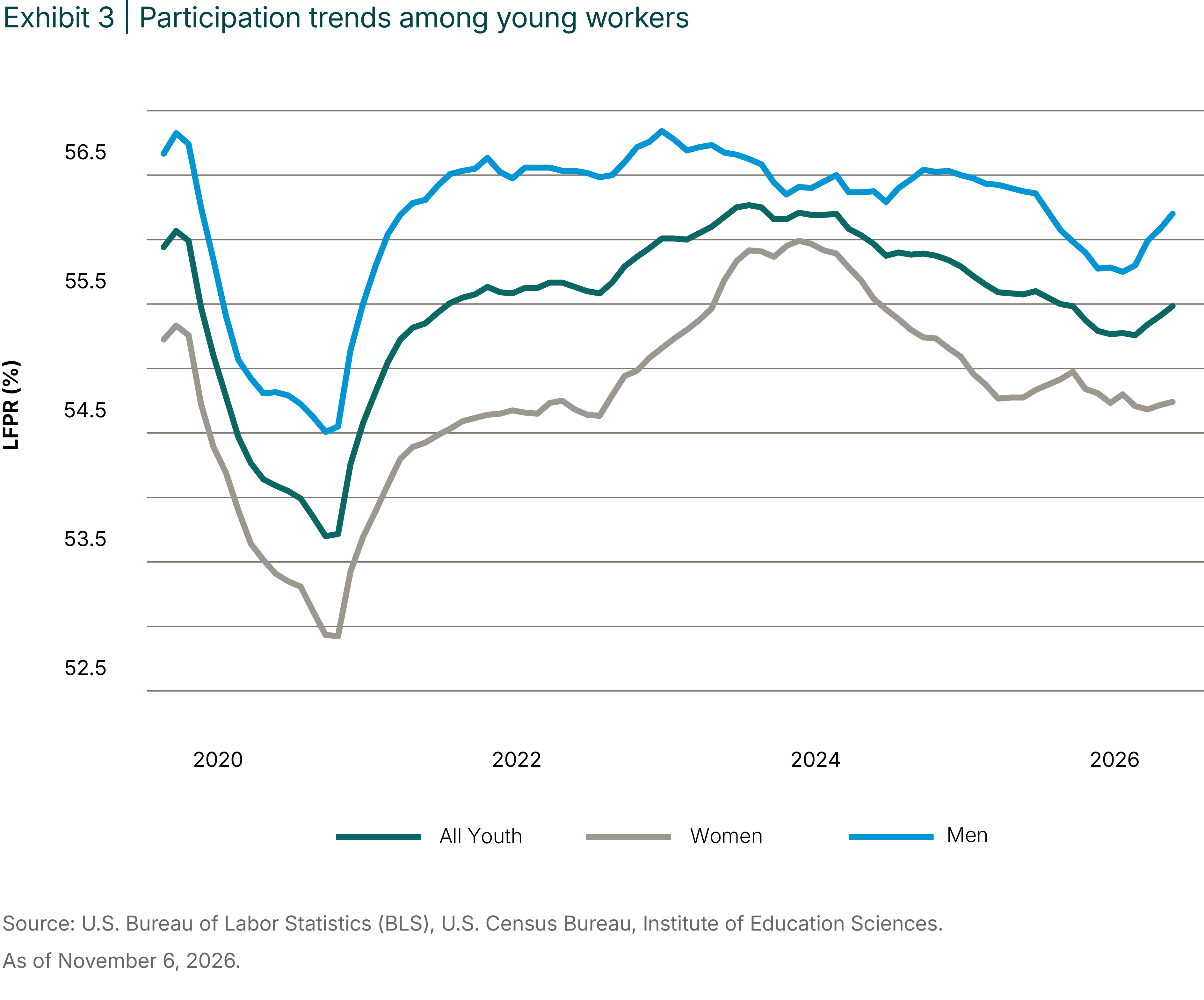
The youth labor force participation rate peaked at 56.9% in February 2023 and dropped to as low as 54.4% in August 2025. The youth labor force shrank by 627,000 over that period, even as youth population rose by nearly half a million.
There has been an increase in post-secondary school enrollment, as more young people turn to schooling rather than work. The share of the youth population enrolled in college has increased from 44.7% in 2023 to an estimated 48.8% in 2025, or nearly 1.8 million more students.1
However, the most recent three months have shown a sharp recovery to 55.5%, with a seasonally adjusted 653,000 young people entering the labor force from August to October 2026.
Outlook
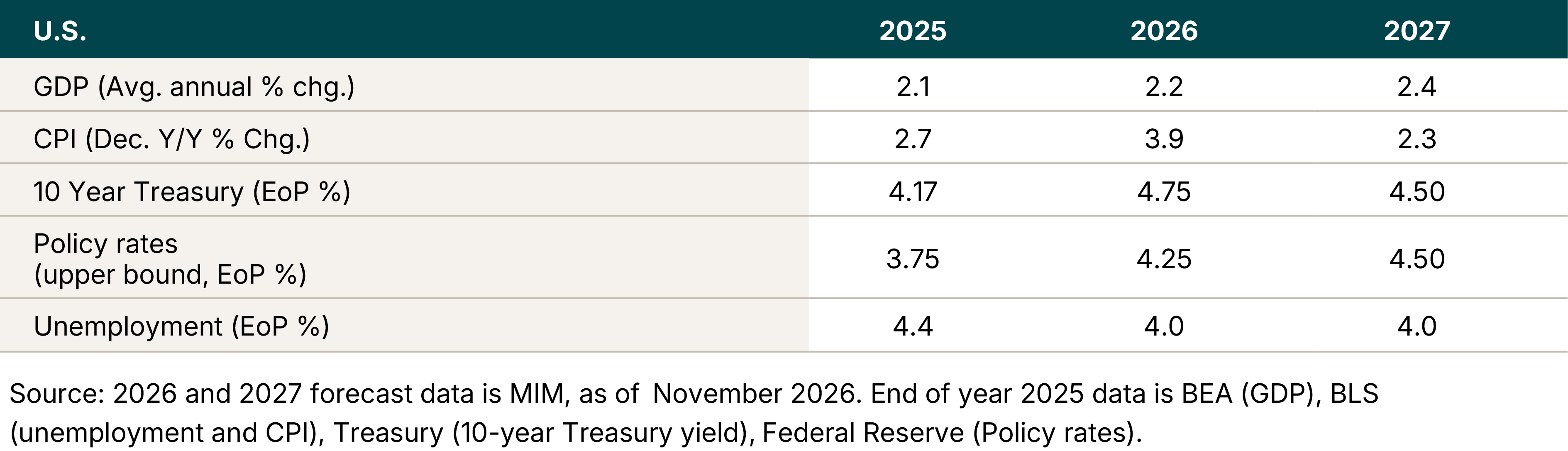
We have adjusted our headline inflation forecast to 3.9% for 2026 and 2.3% for 2027. Uncertainty around a resolution to the Iran conflict has pushed up our headline forecast for 2027. Although peace talks continue, the effects of high prices will likely continue into next year.
We continue to expect a 25-bp hike in December, with another one in Q1 2027. The latest October inflation report along with a stronger-than-expected payrolls number set the stage cleanly for a December hike.
Risks
The Iran conflict is a key risk. Sharp swings in oil prices can rapidly alter forecasts. Even if oil prices remain stable at a higher level, firms are having difficulty navigating the higher costs, presenting a growth risk if labor markets–and subsequently consumers–were to falter.
The capital expenditure requirements of the AI build-out are coming under increasing scrutiny by citizens and politicians. Large hyperscaler firms are guiding for even higher CapEx in 2027, while it remains to be seen how much appetite the market has for more data center funding. The new Congress is expected to put more governance policies in place to restrict the AI build-out, and state and local governments are also likely to work to slow the pace of expansion. We expect such policies to slow investment growth modestly, but risks to a sharper decline are now elevated. Investment growth outside of AI is not nearly as robust.
Our forecast is also vulnerable to a pullback in consumer spending. Consumers have been contributing more to growth due to booming financial markets and an improving labor market. A collapse in AI-related equity valuations could hurt consumption and thereby growth.