Amber Waves of Change: U.S. Wheat Past, Present, and Future
Oct 2026
View available investments in your area

Sorry, we couldn't find any results matching
Please:

Key takeaways:
The evolution of U.S. wheat
In 2026, fewer acres of wheat were planted in the U.S. than ever before. U.S. wheat production has been steadily declining since a resurgence in the early 1980s, despite increases in yields, as acres moved out of wheat and into corn and soybeans. We expect the trend to continue for the foreseeable future.
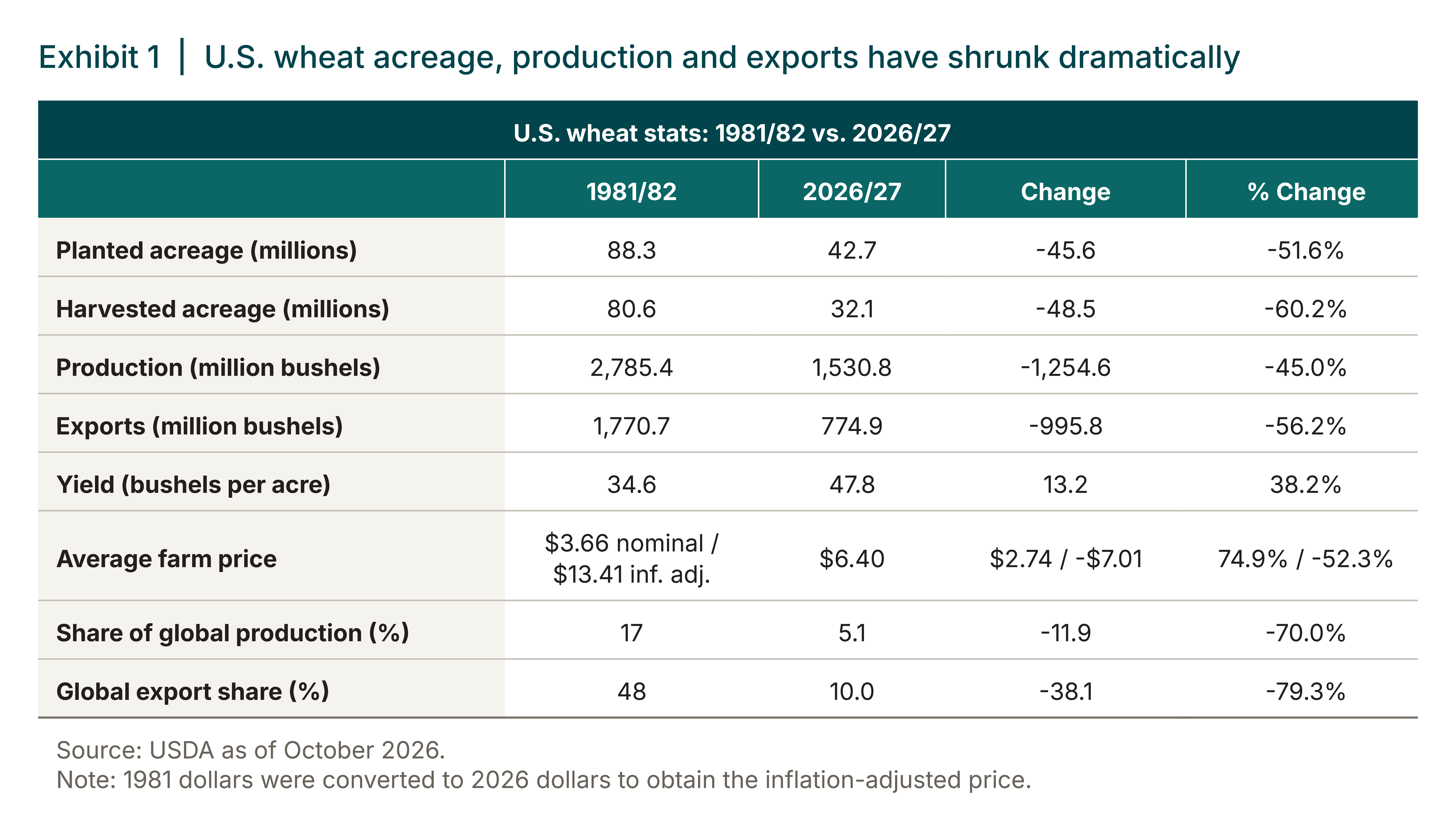
The decline has meaningfully diminished U.S. wheat’s presence on the global stage. In the 1981/82 marketing year, the U.S. produced 17% of the world’s wheat and accounted for 48% of wheat exports. Today, the U.S. accounts for 5% of production and 10% of exports (Exhibit 1).
Over the last half-century, U.S. wheat has transitioned from a dominant, broadly competitive crop to a more specialized role, driven by internal competition from corn and soybeans, risingglobal competition and government policy.
Drivers of change
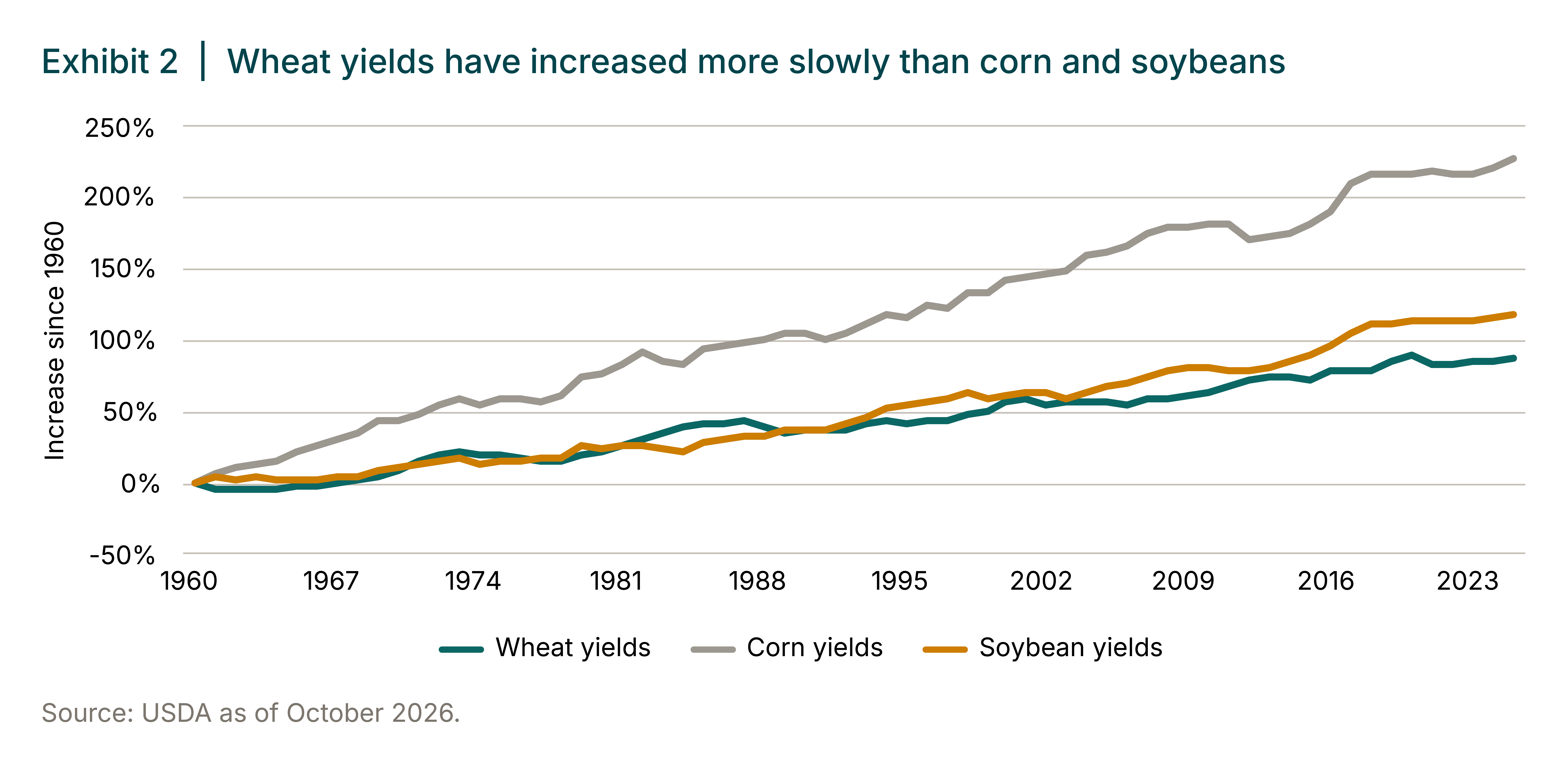
Corn and soybeans have outpaced wheat in both supply and demand. Although wheat yields have more than doubled since 1960, corn and soybean yields have risen faster; farmers now produce 3.5 times more corn per acre than in 1960 (Exhibit 2). Genetic modification has widened this productivity gap by allowing corn and soybeans to combine beneficial traits–including herbicide tolerance, insect resistance and drought tolerance–within a single plant.
Advances in wheat genetics have lagged because of the crop’s complex genome, lower returns on R&D and weaker response to inputs. GMO corn and soybeans are widely accepted, but adoption in wheat has been slower because it is consumed directly by humans. To avoid disrupting domestic and export demand, the U.S. wheat industry voluntarily keeps GMO traits out of the supply chain; no genetically modified wheat is currently produced commercially in the United States. Limited adoption of the drought-tolerant HB4 trait has begun in Argentina and Brazil, but market acceptance remains far below that of GMO corn and soybeans.
Wheat’s biggest challenge is flat consumption. Unlike corn and soybeans, wheat has not benefited from meaningful new sources of demand and remains primarily tied to food use. Policy mandates have widened this gap: Ethanol accounts for approximately 83% of the net increase in U.S. corn demand since 2000. Without a comparable growth driver, wheat must compete largely onagronomic fit, rotational benefits and quality premiums.
Foreign competition is also driving the shift in U.S. acreage, specifically from the Black Sea region. Russia went from a minor wheat exporter in 2000 to becoming the world’s largest exporter by 2016/17. As a result, the U.S. has lost export share, shifting from price-setter to price-taker. This shift in market position has diminished the influence of U.S. supply shocks on global wheat prices, with global supply conditions now largelydetermining price outcomes.
Despite this loss of global market share, U.S. wheat exports have proven relatively resilient to bilateral disruptions. Although China sharply reduced purchases in 2025, total U.S. wheat exports still exceeded 2023 and 2024 levels, as shipments were redirected to other markets, underscoring wheat’s role as a fungible global commodity.
Supply-side outlook
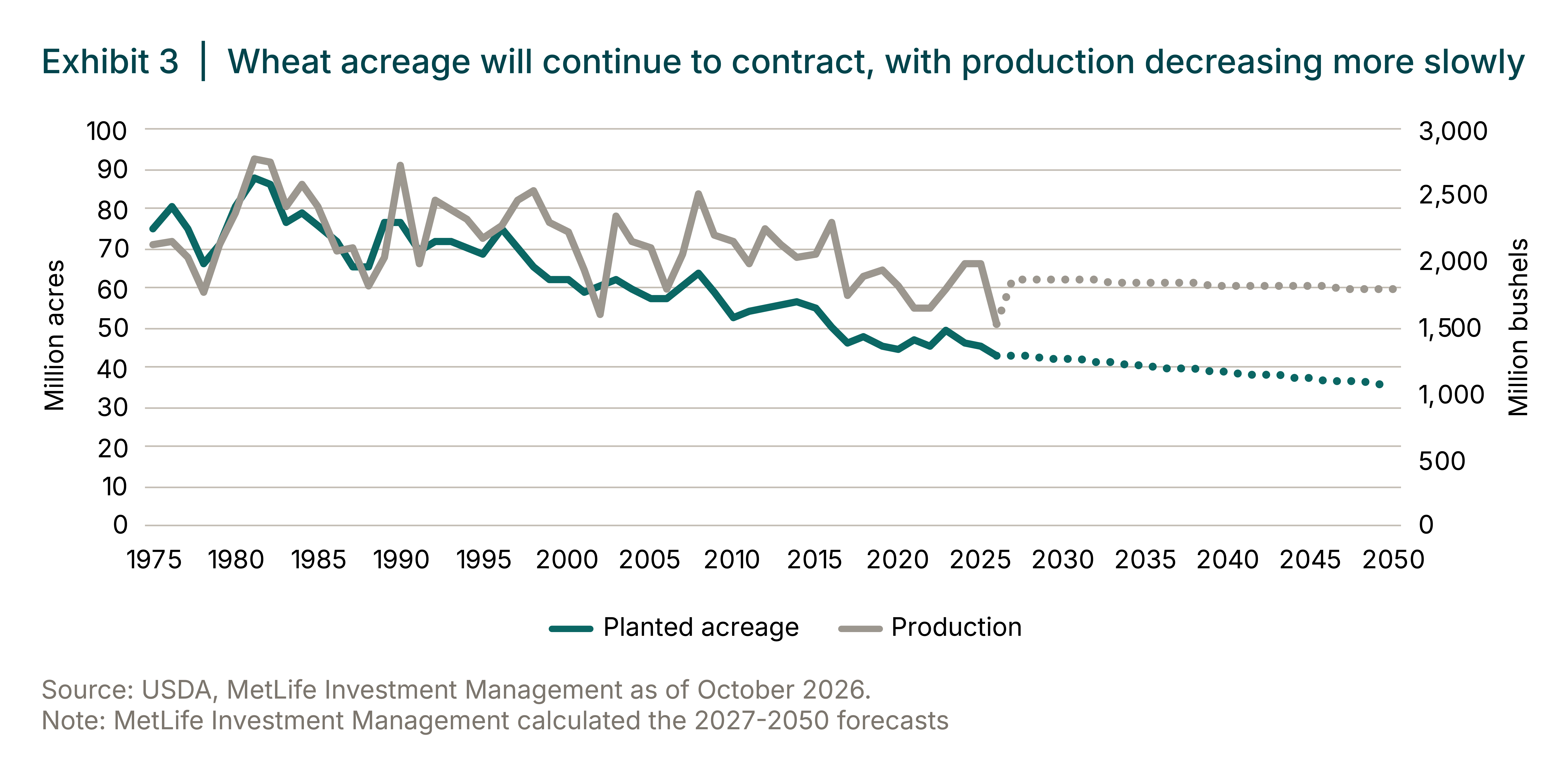
Under current economic conditions, we expect U.S. wheat acreage to continue its gradual decline as competing land uses become more economically favorable. Over the next five years, planted acreage is projected to fall by 800,000 acres (1.9%), from 42.7 million acres in 2026/27 to 41.9 million acres in 2031/32. Yield gains are expected to partially offset the acreage decline, allowing production to decrease more modestly than planted area over the forecast period (Exhibit 3).
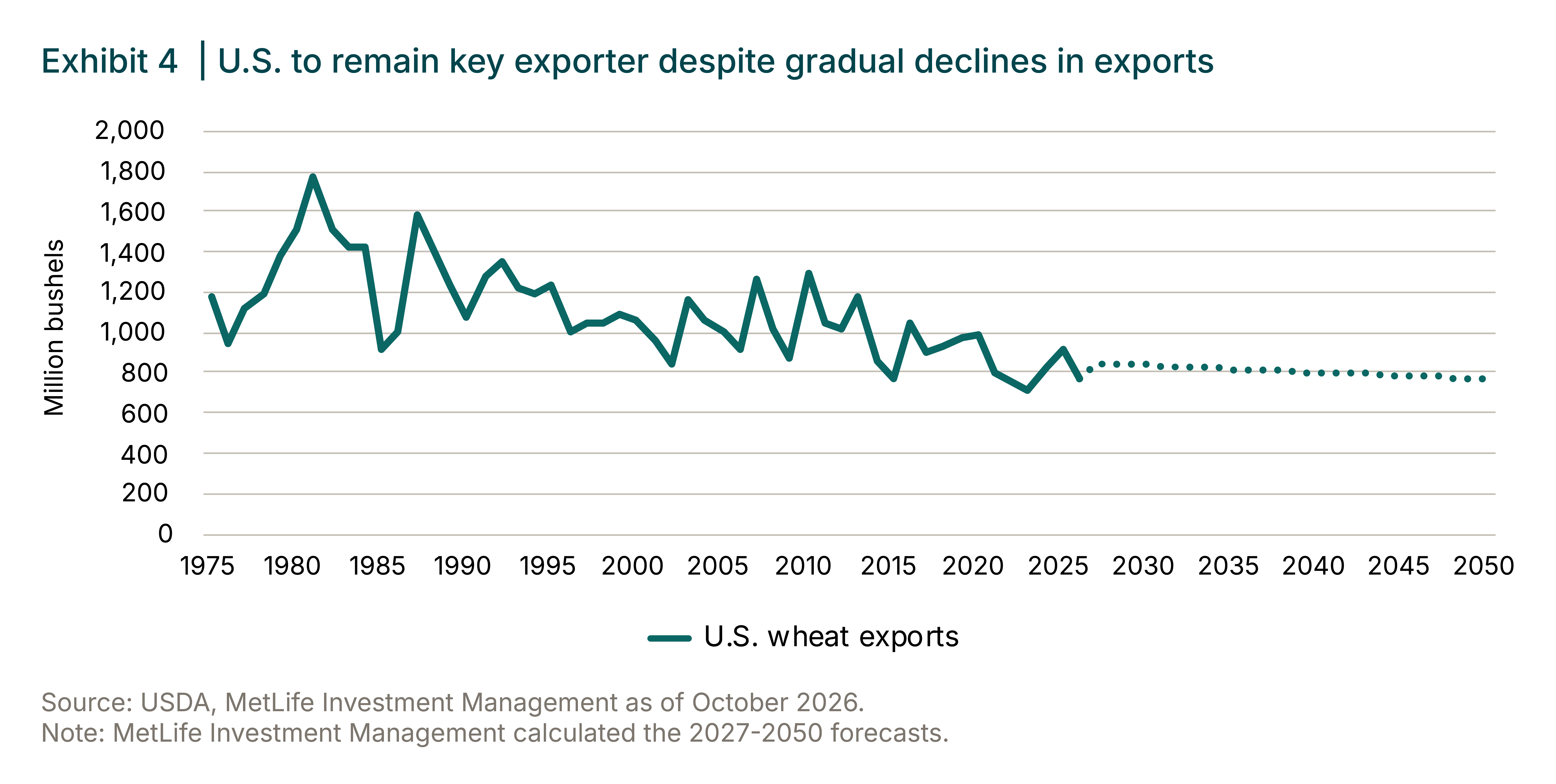
Annual production will remain volatile and largely driven by weather. Because of severe drought-driven crop losses in 2026, production and exports are projected to be higher in 2031/32 than in 2026/27 despite the downward trend in acreage. Exports are projected at 834 million bushels in 2031/32, slightly above 2024/25 but below 2025/26, with the U.S. share of global wheat exports remaining near 10% (Exhibit 4).
Over the longer term, we expect production to become more concentrated in areas that can produce higher protein products. Of the acreage exiting wheat, we expect roughly two-thirds to go into corn or soybean production and 20% to sorghum or canola. We expect the U.S. will remain a critical exporter of high-quality, high-protein wheat for the foreseeable future.
Soft red winter wheat and winter canola
Of the different classes of wheat, we believe soft red winter (SRW) wheat is the most vulnerable to future acreage losses. SRW wheat has a lower average protein content and fewer opportunities to earn quality premiums than harder (higher-protein) wheat classes. It also faces greater competition from corn and soybeans because much of its acreage is concentrated in regionswell suited to those crops.
Historically, SRW has often occupied winter acreage that would otherwise remain fallow, but growing demand for biofuels is creating incentives for growers to adopt harvestable winter oilseeds. For example, Bunge, Chevron and Corteva are collaborating to commercialize intermediate winter canola[i], a winter oilseed designed to fit between summer crop rotations while generating an additional harvest and biofuel feedstock stream. While canola is unlikely to displace SRW wheat on a broad scale, it could erode its traditional role as the default winter crop in parts of the Midwest and Mid-South, adding another source of competitive pressure on acreage over time.
Conclusion
The long-term outlook for U.S. wheat will be primarily shaped by competition from corn and soybeans, persistent export competition from the Black Sea region and relatively weak demand growth. Even so, we expect the U.S. to maintain its role as a global exporter of high-quality, high-protein wheat products, and we do not expect further declines in domestic wheat acreage to materially affect prices, farmer profitability or land values. For producers, expected margin per acre in the local delivery market, net of rotation benefits and quality premiums, matters more than the national acreage trend.