Sustainable Aviation Fuel: A Growth Engine for U.S. Agriculture
Sep 28, 2026
View available investments in your area

Sorry, we couldn't find any results matching
Please:

Key takeaways
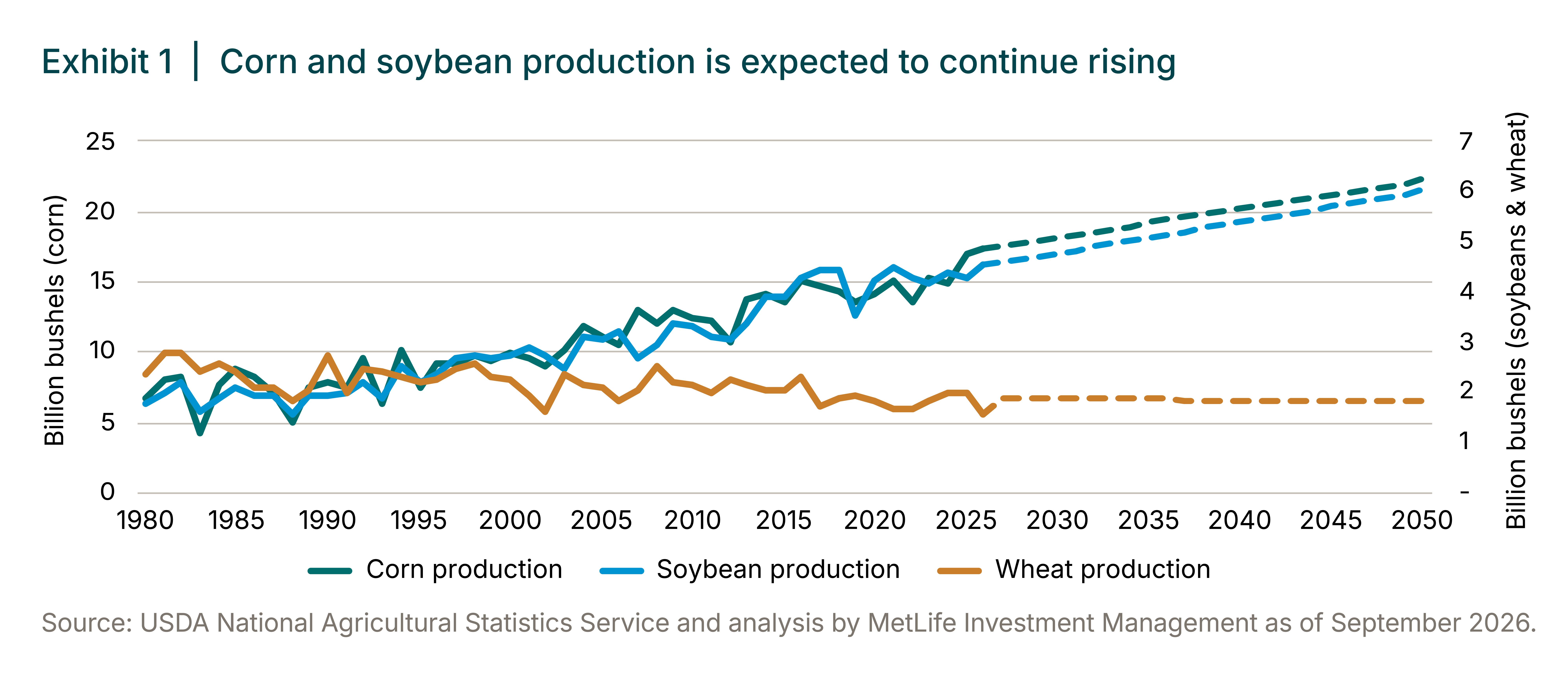
The good news: U.S. farms have enjoyed dramatic productivity gains in recent years. Corn and soybean yields have been increasing approximately 1.9 and 0.53 bushels per acre annually for the last half-century. The bad news: Demand growth isn’t keeping pace, placing agricultural commodity prices under consistent pressure.
We expect advances in technology, genetics, and research and development to expand U.S. agricultural production capacity even more in the future. Annual corn production is projected to rise from roughly 18 billion bushels to approximately 22 billion bushels by 2050, and soybean production is projected to increase from approximately 4.8 billion bushels to 6.0 billion bushels over the same period (Exhibit 1).1 If traditional demand channels such as feed, food and exports remain relatively stable, rising production would place additional downward pressure on commodityprices–unless, of course, new sources of demand emerge.
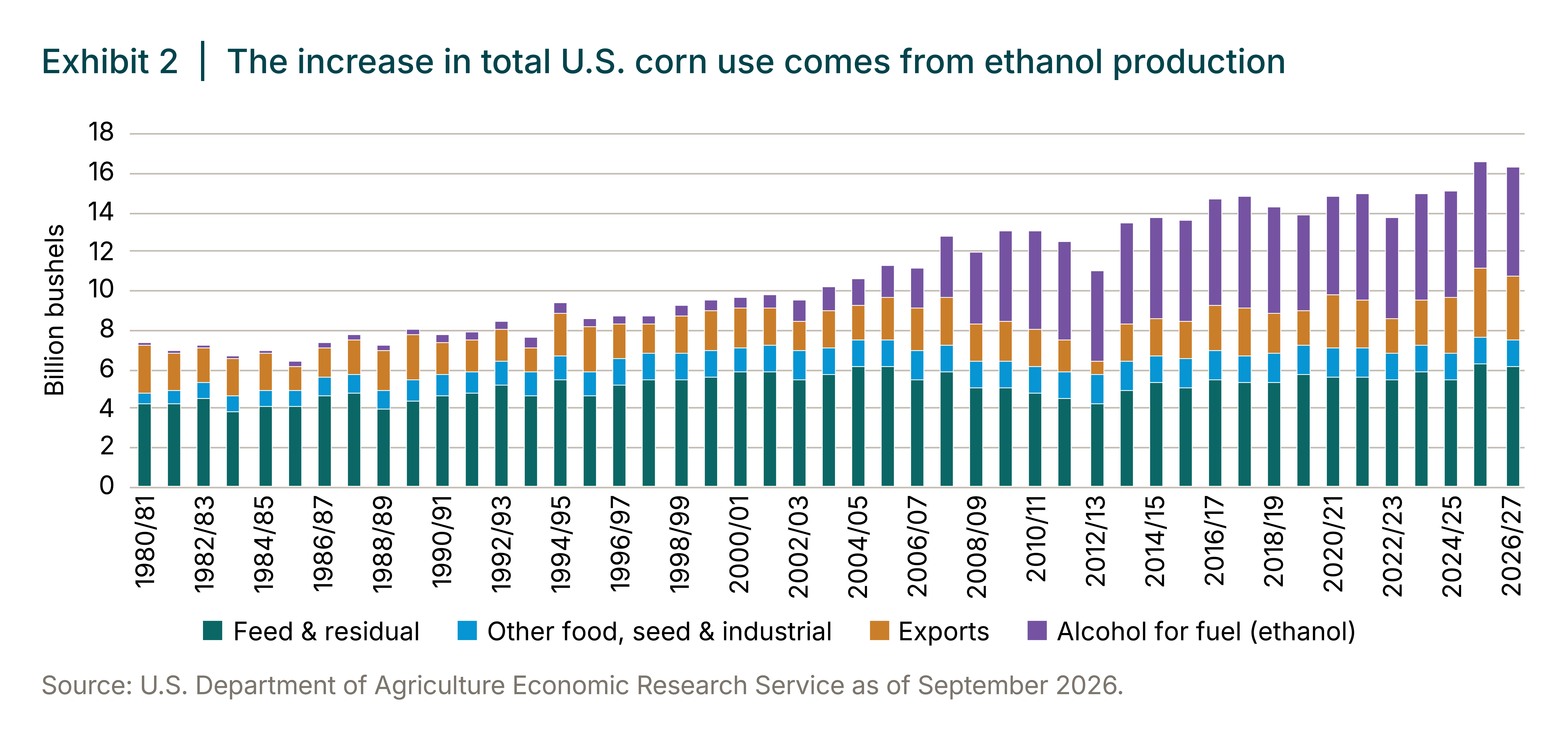
Domestic usage of grains and oilseeds for animal feed or seed has grown modestly compared to productivity gains over the past half-century, while only about 1% of corn is grown for human consumption. While the growing, global middle class will continue to increase the demand for animal proteins and therefore animal feed for decades to come, export markets remain highly sensitive to geopolitical dynamics and trade policy uncertainty. Biofuels, on the other hand, have proved to be a stable source of domestic consumption and incremental demand growth with the potential to reshape agricultural markets. For example, ethanol is responsible forapproximately 83% of the net increase in U.S. corn demand since 2000.
While there are numerous other segments of potential increases in biofuel production, we find sustainable aviation fuel (SAF) particularly interesting. The U.S. government has set ambitious production targets over the next few decades–3 billion gallons of annual SAF production by 2030 and 35 billion gallons by 2050.2 Also, many major airlines have publicly announced goals to achieve net-zero carbon emissions by 20503 with explicit references to SAF, and major tech companies are now pursuing carbon offtake agreements with airlines that use SAF,4 making SAF the most likely source of a new phase of biofuel-driven demand growth, in our view. SAF could provide a new domestic outlet for agricultural production while supporting broader decarbonization goals and reducing the depletion rate of exhaustible energy sources. For U.S. agriculture, the opportunity is not only tied to fuel production, but also to the potential for additional processing, transportation and co-product demand to remain withinthe domestic supply chain.
SAF could absorb a significant amount of U.S. agricultural production
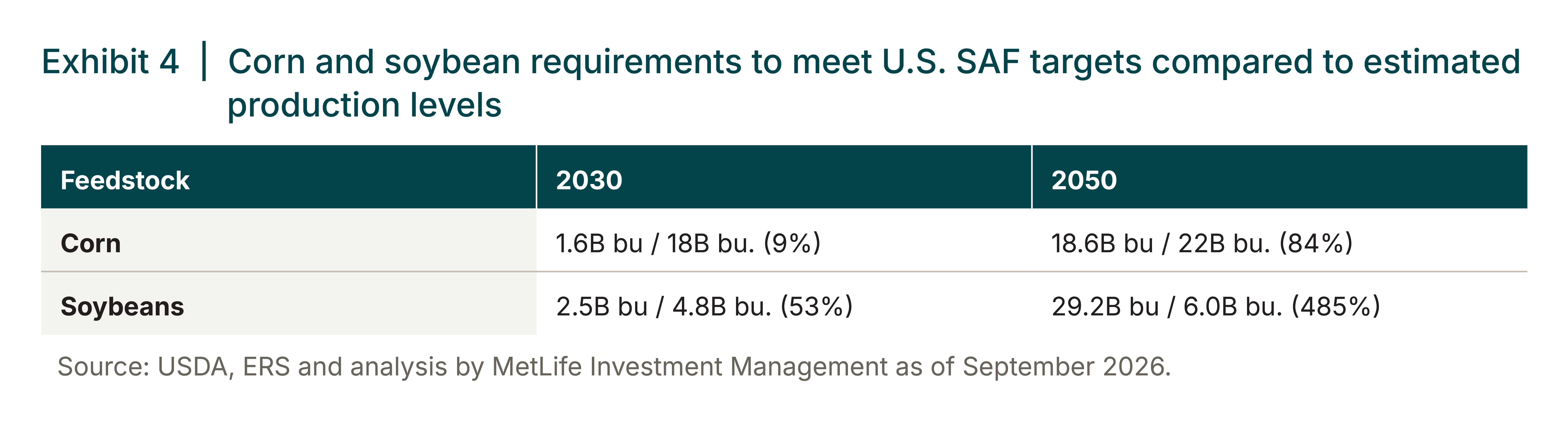
While the 2030 SAF production target appears achievable using existing and projected agricultural production capacity, the 2050 target presents a much larger challenge. The ambitious target foreshadows the potential demand impacts on feedstocks such as corn and soybeans if SAF production increases as hoped. We estimate that meeting the 2030 goal would require roughly an additional 1.6 billion bushels of corn or 2.5 billion bushels of soybeans a year, equal to approximately 9%and 53% of projected 2030 production, respectively.
In the near term, soybeans may be better positioned for SAF growth because hydroprocessed esters and fatty acids (HEFA) production pathways can use existing oilseed processing capacity, established logistics networks and more developed regulatory frameworks. Over the longer term, corn appears more scalable because current conversion assumptions imply substantially higher SAF output per acre than soybeans, reducing the acreage required to produce a given volume of fuel.
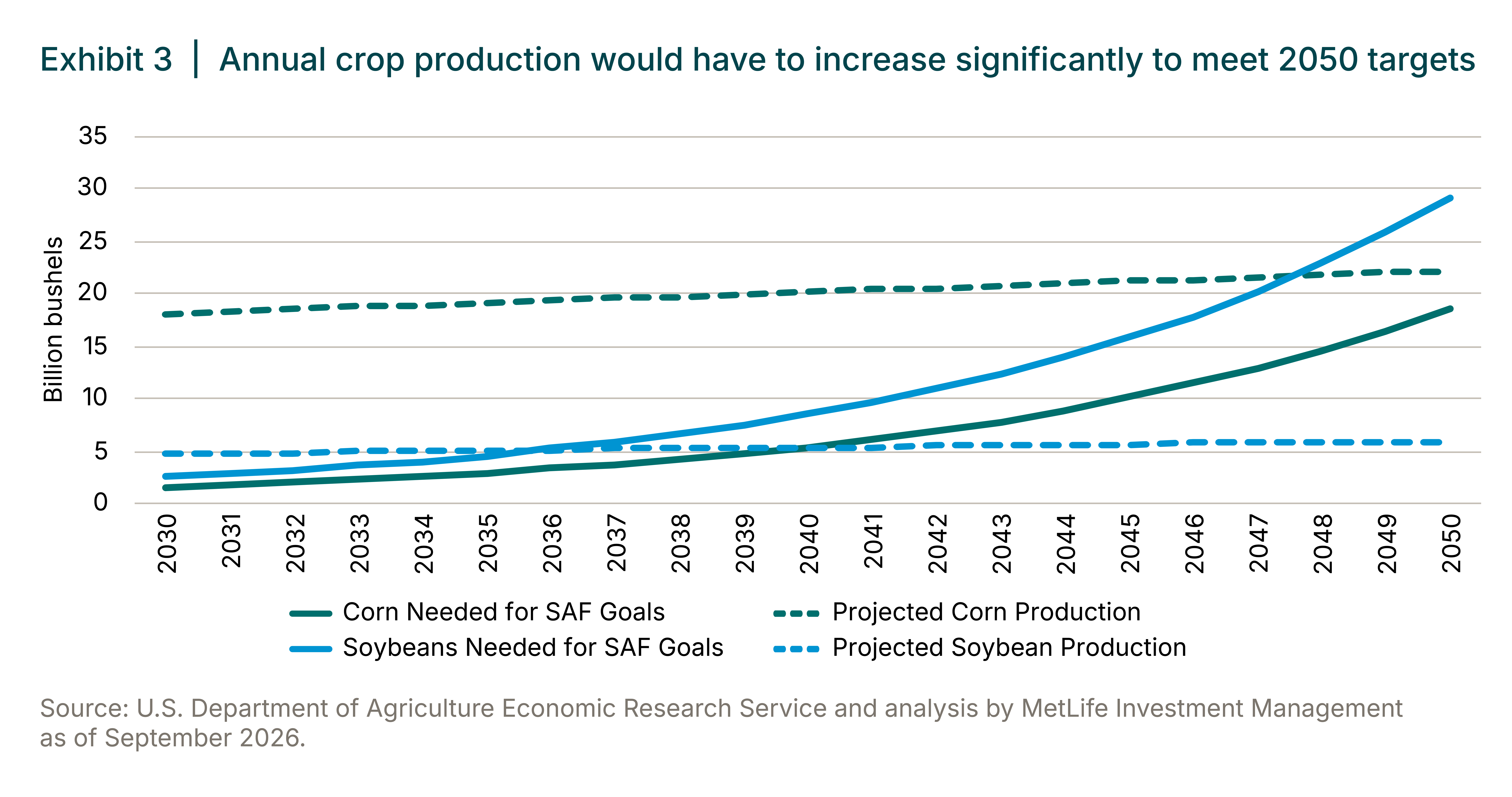
Theoretically, the U.S. could produce enough corn to meet most of the 2050 SAF target under current conversion assumptions,5 but doing so would absorb approximately 85% of projected corn production. At that scale, SAF demand would directly compete with existing ses such as ethanol, livestock feed, exports, and food and industrial demand. As a result, SAF could become a major source of incremental demand for U.S. corn, but would require a substantial increase in corn acreage beyond our base-case forecast, most likely at the expense of soybean acreage.
Soybean production is even more unlikely to meet SAF targets under current conversion assumptions. Instead, achieving the 2050 target will likely require multiple feedstocks, a change in crop rotation toward oilseeds with a higher oil-to-meal ratio, improved conversion efficiency, expanded processing capacity and durable policy support.
As opposed to exporting surplus corn and soybeans, domestic SAF production would keep more value within the U.S. agricultural supply chain, supporting U.S. processing, refining, transportation and feed markets. The domestic availability of co-products from corn and soybean processing, including livestock feed ingredients and soybean meal, would increase, allowing SAF demand to benefit both fuel and feed markets.
The impact on livestock producers would likely vary by operation and feed ration. Higher corn demand could increase feed costs for operations that rely heavily on corn, while greater availability of co-products such as distillers’ grains and soybean meal could benefit operations able to incorporate those ingredients into their rations. As a result, the net impact on feed costs would depend on the balance between higher grain demand and increased availability of feed co-products.
Reaching the 35-billion-gallon target by 2050 would require substantial industry coordination, policy certainty–whether through production subsidies for SAF, carbon taxes or both–and continued technological advances that improve feedstock conversion rates. SAF remains more expensive than conventional jet fuel, and that gap is unlikely to close for the foreseeable future; subsidies, taxes and a liquid market for carbon credits will therefore remain necessary for SAF to displace conventional jet fuel at any significant scale. As a result, the long-term outlook for SAF depends less on feedstock availability than on whether policy, infrastructure and economics evolve quickly enough to support commercial-scale production. Shouldthey do so, the implications for the agricultural sector would be significant.
Conclusion
Even if SAF production gains amount to only a fraction of the 2050 production targets, the positive impacts to the agricultural sector are likely to be significant. The production of SAF and other biofuels has the potential to offset rising crop yields and provide a consistent domestic source of demand which would support commodity prices, grower profitability and land values, all while reducing the susceptibility of the sector to geopolitical tensions or other trade-related risks.