Can Asia Fixed Income Resilience Continue?
Sep 2026
View available investments in your area

Sorry, we couldn't find any results matching
Please:

Our Co-Heads of Asia Fixed Income, Omar Slim and Andy Suen, recently sat down to discuss the resilient performance of Asia’s fixed income markets despite the geopolitical tensions and energy price shock. Can this resilience continue? Find out why they think it can and where they’re finding value in the markets for the rest of the year.
Could you walk us through how Asia bond markets performed in the first half of the year?
Omar Slim: There has been a disconnect between headlines and the lack of volatility in the market. The Iran war had a big impact on energy commodity prices and supply chain disruptions, but a benign impact on Asia credit markets. The investment grade (IG) market had slightly positive performance in the first half, and high yield (HY) performance was even stronger.
The rates market was the transmission mechanism for volatility, given the expected inflation pickup because of commodity prices. Credit spreads, on the other hand, remained generally well behaved. Liquidity has been, except for a few days, generally okay.
Andy Suen: Let me add a couple of data points on that as well. Asian HY delivered 4% total return in the first half of the year, outperforming the global HY market by roughly 1%-2%.¹ - Spread compression in the Asian HY market has offset the higher interest rates we’ve seen in the U.S. Treasury curve. And in IG, it’s quite notable that the asset class continued to deliver lower volatility given its shorter duration compared to the global IG market.
What factors contribute to that performance?
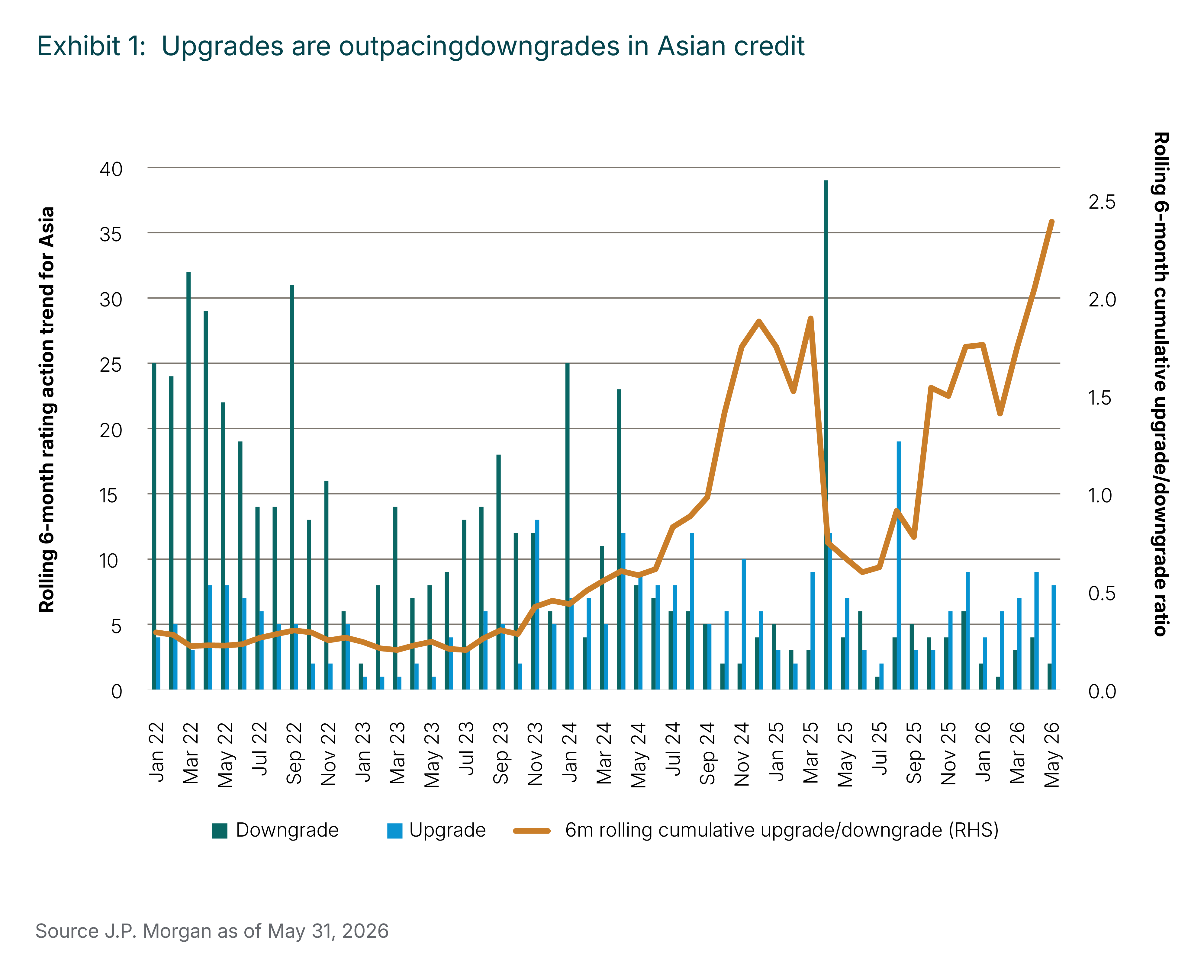
AS: I attribute the resilience to positive fundamentals. Credit ratings across the region continue to improve. Exhibit 1 shows the rating upgrade-to-downgrade ratio in Asian credit across both IG and HY. As you can see from the orange line, it has been improving in the last couple of years. This year, for every rating downgrade, we have 2.5 rating upgrades. That’s an indication of strong corporate fundamentals across the region, despite the energy price shock.
Second, net leverage has been in the range of 1-2x.2 As of the beginning of this year, the net debt/EBITDA ratio on average has declined to 1x, which is both at the lower end of the historical range and lower than in the U.S. or Europe, where it is about 2.7x or 2.8x.³
Defaults, which are more relevant for HY, continue to be very low. If we exclude the China property sector, the YTD default rate is only 0.1%,⁵ which is negligible. Over the past two years, that default rate has been below 1%, which is significantly lower than other major HY markets, including the U.S. We expect it to decline for the fourth consecutive year this year.
Turning to the macro picture, trade tensions have faded, but investors now face a different set of challenges: geopolitical fragmentation, elevated energy prices and policy uncertainty. What is your outlook going forward?
OS: As a heavy importer of oil and other commodities from the Middle East, the general impact of the energy shock in Asia has been generally negative, but uneven. Countries such as Malaysia, an energy exporter, and Singapore, an oil trading center, are more immune. China and Japan have very strong energy reserve management and strategic energy reserves and can go a long time without imports. Other countries, such as the Philippines and, to an extent, Indonesia, have been impacted more directly. However, we have not seen a major uptick in inflationary concerns just yet.
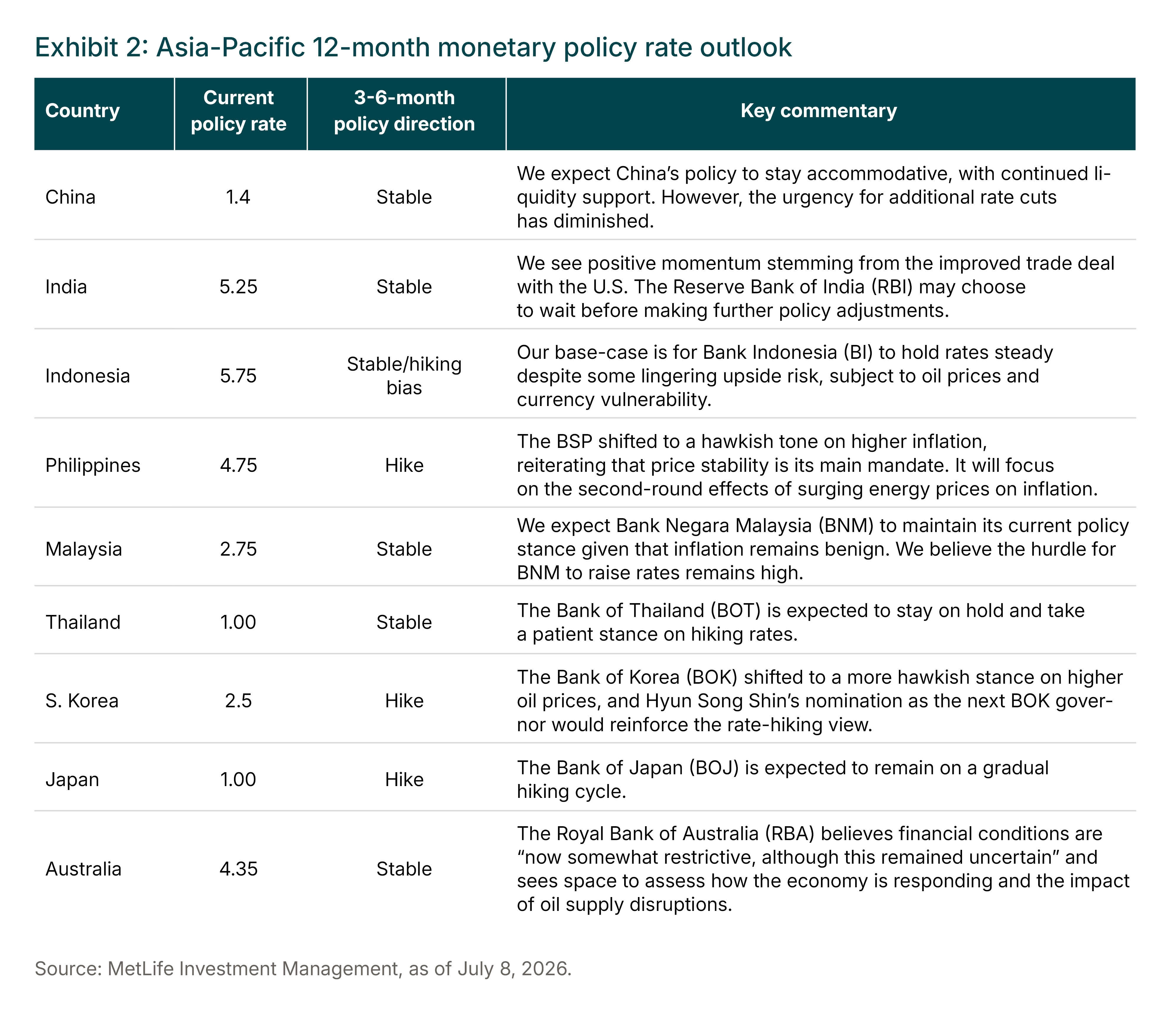
The war also caused a monetary policy repricing globally, including by the Fed (Exhibit 2). Some central banks, including Australia, the Philippines and Indonesia, adopting a more hawkish stance, while others have adopted a hawkish posture without hiking. Japan has been on a gradual tightening bias that is likely to continue for some time, while China is trying to use interest rate policy to spur consumption.
AS: On the corporate side, we’ve seen uneven effects on individual sectors and companies as well. For sectors more exposed to energy price shock and companies with less pricing power, we would tend to be more conservative in terms of pricing the spread premium. In general, we think corporates in North Asia have more flexibility and a stronger balance sheet to withstand an energy shock.
Can you comment on the valuations in the asset class?
AS: Globally, credit spreads have been moving tighter and are close to the tighter end of the historical range. In June, Asia IG spreads were roughly 90-95 basis points (bps), very close to historical tights. But all-in yield is still reasonably attractive at 5.25%, which is around the 75th percentile over the past 10-20 years.⁶ We think a valuation premium is justified relative to other markets due to improving fundamentals, with lower leverage, and a shorter duration profile than many developing markets and emerging markets outside Asia.
Even though the HY market has outperformed quite a bit in the past 2-3 years, the absolute yields are attractive there, too, with a yield-to-maturity (YTM) around 8% in an asset class with an almost zero default rate outside the China property sector.⁷
AI has become a central theme in investment discussions globally. How do you expect AI to shape Asia’s fixed income markets?
OS: AI-related issuance in Asia is not comparable to the U.S., where we are seeing heavy issuance from hyperscalers, other tech players, and utilities. That is positive from a technical perspective.
AS: The Asian AI ecosystem is less of a hyperscaler story than in the U.S. We have companies in semiconductor manufacturing, memory, electronic components, network infrastructure, and so on that are benefiting from stronger demand and improving cash flow and profitability. We think AI-related issuance in Asia can increase, but nowhere close to the scale of the U.S. market. The potential issuers typically have very good access to low-cost domestic funding, so they don’t need to access the U.S. dollar bond market that much.
Speaking of issuance, how would you describe activity so far this year, and what is your outlook for the second half?
AS: Issuance was steady in the first half: $160 billion, up roughly 5% year-over-year, driven primarily by the Japanese market.⁸ Asia ex-Japan declined moderately year-on-year. Issuance was well-covered by bond maturities and coupon payments, so net supply moderated in the first half.
Looking at the second half, assuming no major geopolitical eruption and steady U.S. interest rates, we think issuance activity can increase moderately. We assume gross supply to be around $300 billion, including Japan and Australia. After netting coupon and maturity from issuers, net supply most likely should stay negative, creating a healthy technical backdrop that contrasts with the supply pressure in the U.S. market.
How do you view dollar bond markets compared to local currency markets?
AS: In general, we prefer the hard currency U.S. dollar to other local currency markets. U.S. rates are still higher than most economies, and the growth outlook is strong. But we do see opportunities in select local currency markets. For instance, we think AUD-denominated bonds will continue to provide an opportunity for participation away from the U.S. dollar. We have seen strong issuance across very high-quality IG issuers, and Australia is both one of the few AAA-rated countries and the only AAA-rated country with higher rates than the U.S.
The yen has reached its lowest level in decades against the U.S. dollar. As an investor in Japanese bonds, how do you view the implications for the Japanese fixed income market and the spillover impact on the broader Asia fixed income market?
OS: Headlines about the interest-rate differential between the U.S. and Japan and concerns about fiscal risks get a lot of attention, but don’t give the full picture. The fiscal situation is not new, and the debt-to-GDP ratio in Japan has been declining. The interest rate differential has been shrinking as the Fed has cut and the BOJ hiked.
I think a shift in how Japanese financial institutions, especially some of the large money pools, are allocating assets explains a significant amount of yen weakness. Dollar strength and yen weakness have been a positive for at least some Japanese issuers because of their exposure to non-yen currencies.
Over the past few quarters, Japanese policymakers have tried to jawbone the market more aggressively. I don’t think interventions like these usually work, however. Recently, there has been a discussion about large Japanese allocators being invited to increase their Japan onshore exposure, but that also has had a limited impact. I think the yen will strengthen when yield levels are high enough to bring flows back to Japan.
In terms of spillover to the broader Asian fixed income markets, Japanese dollar issuance has a life of its own. It has a large investor base outside Japan, particularly in the rest of Asia and the U.S. It’s the biggest part of the market at about 25%,⁹ and that share is growing.
What is your current positioning? What are the biggest opportunities and risks ahead?
AS: We’re constructive on the fundamental outlook, both in terms of the credit rating trajectory and default rates. We feel comfortable to take selective credit risk to enhance carry, particularly at the short end of the credit curve, where we think repayment risk is quite manageable across IG and HY. In general, we are also comfortable to move down the capital structure for high quality issuers in IG and selectively in HY. We’re underweight very long-dated credit, purely because spread is at the tighter end of range.
From a regional perspective, we prefer developed Asia-plus-China over emerging Asia, where some countries are more vulnerable to higher energy prices. Sector-wise, we continue to like the financial sector, which is very well capitalized.
OS: In IG, we still see value in some of the financials, both broadly and specifically in certain Korean and Japanese insurers. We see China as fully valued.
Do you see Asian U.S. dollar IG bond delivering positive returns in the second half of 2026?
AS: Yes. It would take roughly 60-70 bps of yield-widening to wipe out the carry component for 6 months, in our view. The market would have to move very aggressively, with a larger number of rate hikes than what have already been priced in, to achieve that, which we don’t expect. In terms of yield per unit of duration, Asia IG compares quite favorably against global bond market indexes.
What are the main risks for the rest of year?
AS: A lot also depends on the Iran situation. If it’s too prolonged, we could see more volatility in the rate market. Rate, instead of spread, will continue to be the key source of volatility for Asia credits, as both credit fundamentals and technicals are quite favorable.
OS: We’re seeing some stress related to either excessive exuberance or substandard, suboptimal lending standards in some market segments globally. That’s still localized and contagion has been limited, but it’s an area we’re watching. Markets are also concentrated and incredibly focused on a few investment themes. A challenge in these key areas could cause a wobble in the market. All told, however, we expect Asia fixed income to stay resilient for the rest of the year.