Emerging Market Equities: A More Resilient Growth Story
Oct 2026
View available investments in your area

Sorry, we couldn't find any results matching
Please:

Key takeaways:
For much of the 2000s and early 2010s, equities in the emerging markets ran in tandem with China’s economic expansion. China’s demand for iron ore, copper, energy, construction equipment and intermediate goods benefited commodity producers from Brazil to Russia, as well as manufacturers across Asia. If China’s growth outlook strengthened, emerging markets equities often rose in tandem. If a single data point suggested that Chinese growth might slow, a broad sell-offcould ensue.
China remains an important part of emerging markets equities, but the asset class is no longer “China plus everything else.” It increasingly represents a heterogeneous group of companies, industries and economies with distinct growth drivers. This transition has been most visible in Asia, where investment in research and development, rising incomes, deeper regional trade relationships, and the emergence of globally competitive companies have altered the character of the asset class.
In their more mature form, emerging markets equities have recently appeared less vulnerable to global shocks. U.S. tariffs, armed conflicts and higher-for-longer interest rates in the United States have all failed to derail the investment case. Earnings growth in emerging markets is expected to top that of developed markets in 2026, while companies trade at a significant discount. In our view, this dynamic offers an attractive entry point for investors seeking diversification, access to powerful long-term themes and an evolving growth story.
Moving up the value chain
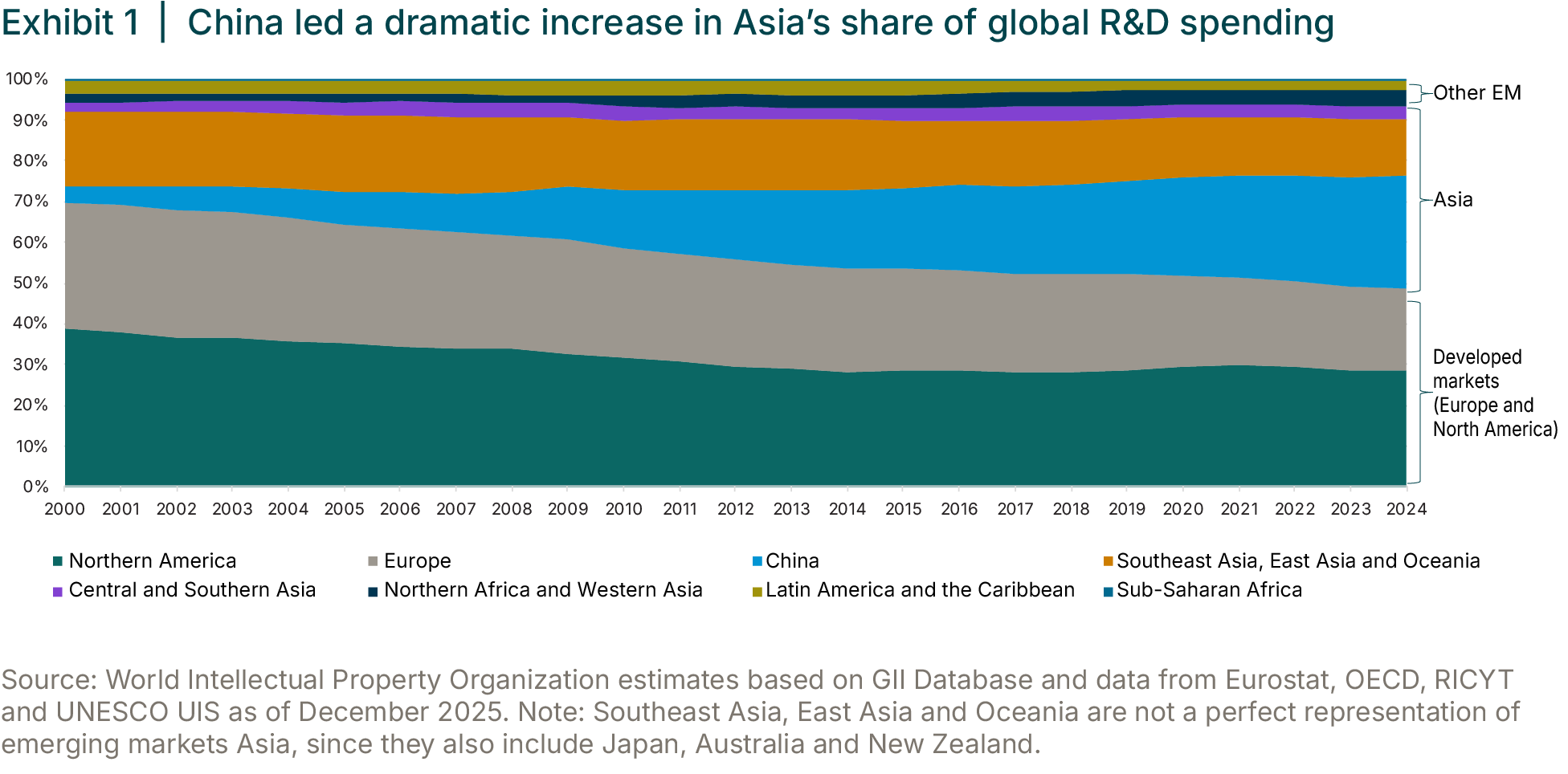
Many factors contributed to the shift that China, Taiwan and South Korea have made from large-scale production of relatively inexpensive goods to making some of the world’s most advanced semiconductors, manufacturing equipment, electric vehicles and renewable energy technologies. One factor is research and development. Asia’s share of global R&D spending increased from 23% in 2000 to 45% in 2024 (Exhibit 1). China accounts for much of that increase, but the trend extends across the region, including recent gains by Indonesia and Vietnam. Conversely, several developed economies have lost share of global R&D spending over the same period.
Partly due to this investment, North Asian companies now occupy critical positions in the AI supply chain. Taiwan’s TSMC began as a low-cost manufacturer of mid-level chips and is now the world’s dominant chip foundry, followed by South Korea’s technological powerhouse, Samsung Electronics. South Korea’s SK Hynix is one of the world’s largest memory chip manufacturers, while Wiwynn, a Chinese company, makes AI servers, cloud-computing hardware and data center infrastructure. These companies’ capabilities are difficult to replicate and essential to theexpansion of artificial intelligence infrastructure.
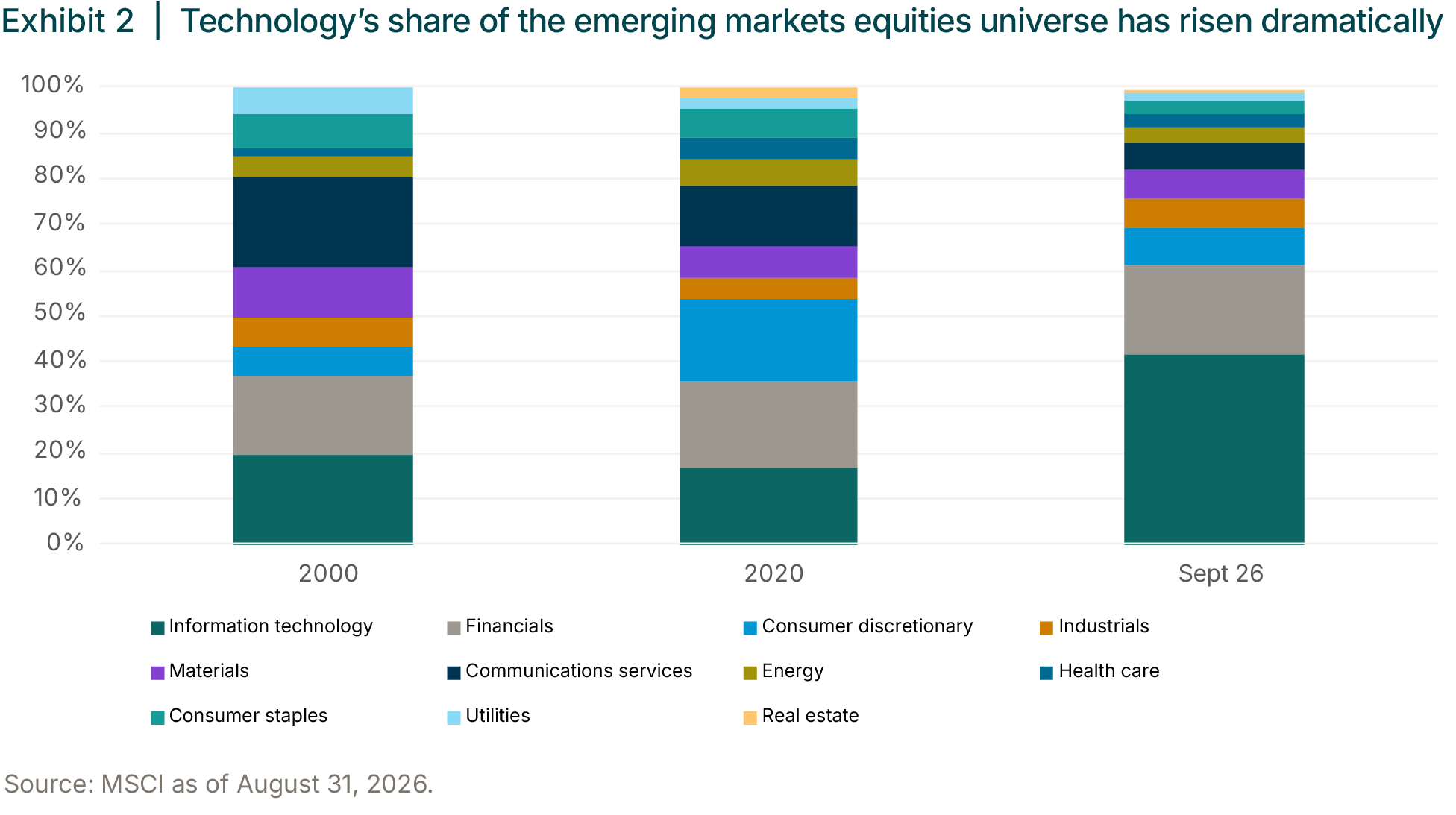
The composition of the MSCI Emerging Markets Index reflects this change. Information technology represented 41.5% of the index in September 2026, up from 16.9% in 2020 (Exhibit 2). Just as a relatively small number of AI-related companies have driven equity returns in the United States, North Asian companies in the AI supply chain now exert an outsized influence on emerging market indexes. Yet the underlying roles of many companies in the two regions are different. Many North Asian companies are producing the chips, memory, precision tools and equipment required to build the infrastructure, giving investors access to a layer of the AI ecosystem beyond U.S. hyperscalers and AI software companies.
Likewise, heavy investment has helped China dominate the renewable energy supply chain. According to BloombergNEF,1 China controls more than 70% of manufacturing capacity in every major clean-tech production segment except for hydrogen electrolyzers. Some three-quarters of global investment directed toward building plants tha manufacture batteries, solar modules, wind turbines and other renewables staples goes to China. Meanwhile, Chinese companies sold the world 60% of its electriccars in 2025.2
China’s changing role in emerging markets
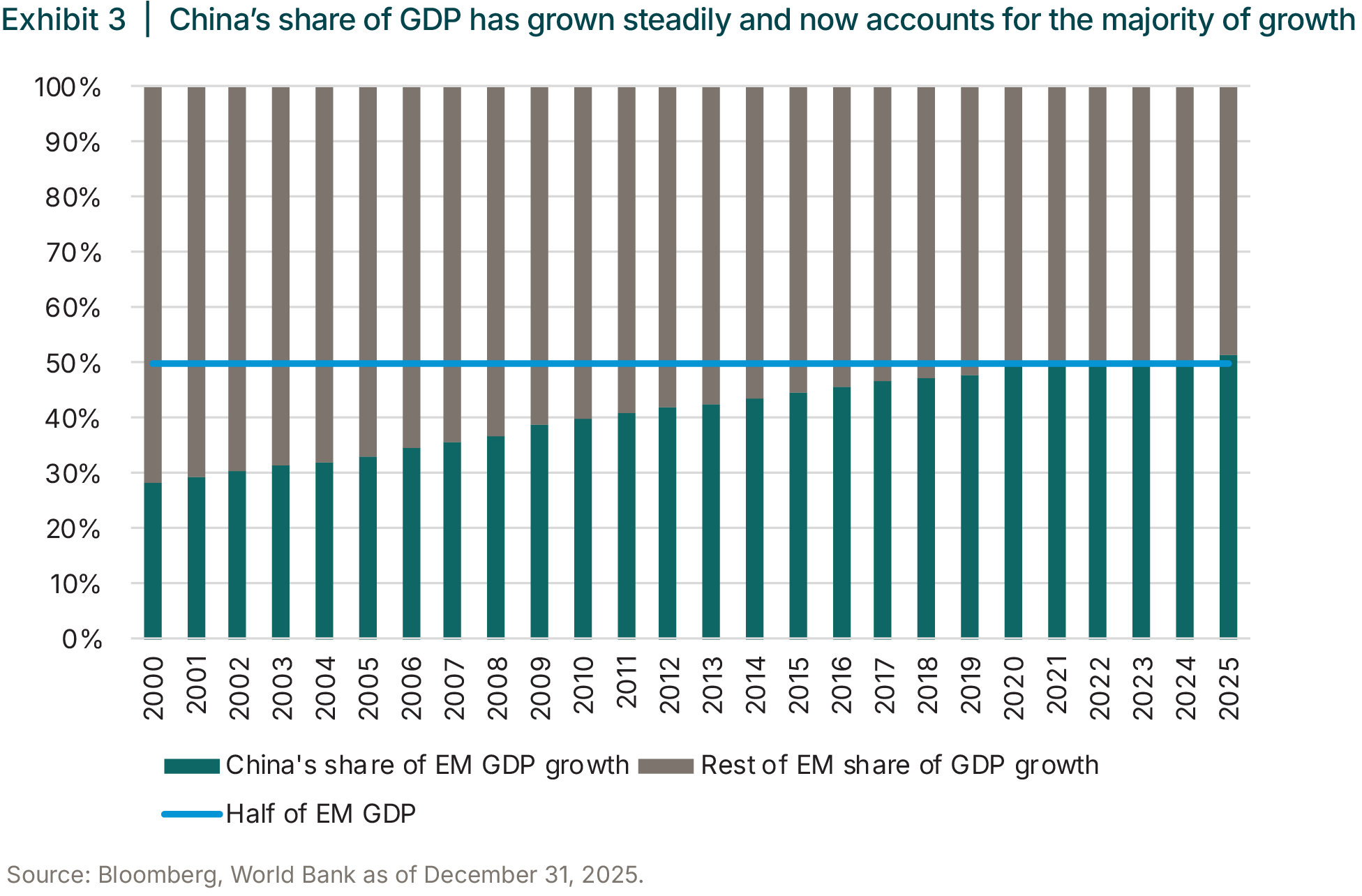
China still plays an outsized role in emerging markets equities. The country’s GDP growth accounts for 51% of overall growth in emerging markets (Exhibit 3), and its companies represent nearly 21% of the MSCI Emerging Markets Index.3 A severe Chinese downturn would still affect commodity demand, regional trade and investor confidence. However, China’s trend growth is lower than it was during the infrastructure boom, and changes in the global economy mean that fluctuations in Chinese growth no longer translate as directly into the performance of every emerging market. Trade within Asia has also expanded, giving regional economies a broader set of end markets and making them somewhatless dependent on any single developed economy or trading partner.
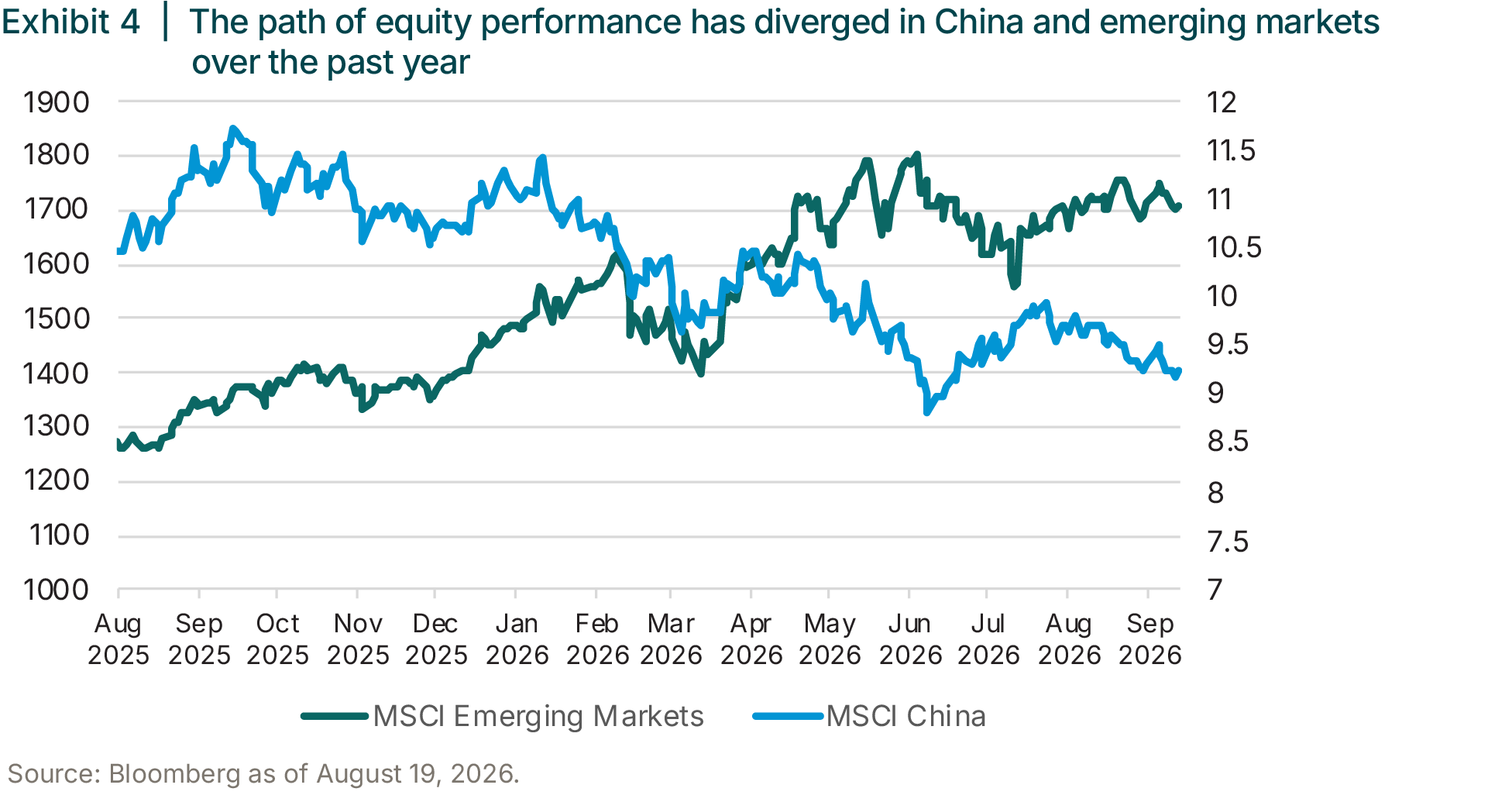
The equity market relationship has weakened accordingly. From 2000 through 2020, the MSCI China Index had an average 80% correlation with the broader MSCI Emerging Markets Index. After the pandemic, that correlation declined to 64.3%, as China’s property downturn and regulatory uncertainty weighed on its market, while other parts of emerging markets followed different earnings and economic paths. Over the past year, Chinese earnings revisions have lagged those of the broader emerging markets, but emerging markets investors largely looked past the lackluster performance. As a result, the paths of the MSCI Emerging Markets Index and the MSCI China Index have diverged sharply, and the year-to-date correlation between the two indexes is only 57% (Exhibit 4).
Dispersion is also rising among Chinese companies, as the market becomes less dependent on a single macroeconomic tide lifting or lowering every company together. Results increasingly reflect company-specific execution, just as they do in developed equity markets, with performance diverging because of differences in strategy,cost discipline, capital allocation and competitive positioning.
The same principle applies across emerging markets. Taiwan’s semiconductor cycle, India’s domestic consumption, Indonesia’s income growth and Korea’s technology and defense exports do not move in perfect unison. Nor are they identical to the commodity, banking and energy opportunities found in Latin America or emerging Europe. The result is greater dispersion among and within countries, sectors and individual securities, expanding the potential opportunity set for active investors.
Emerging markets are better positioned to weather globalshocks
Tariff increases, geopolitical conflict, delayed U.S. rate cuts, currency volatility and repeated concerns about global growth have offered a demanding test of emerging markets maturity over the past several years. These shocks have hurt individual economies and companies, but emerging markets equities as a whole have avoided the systemic crises and indiscriminate capital flight that characterized earlier periods.
Trade flexibility has played an important role. Asian economies had been strengthening regional commercial relationships well before the latest tariff escalation. Over the past 40 years, intra-Asia trade increased by 43% and now accounts for half of all the region’s trading activity, according to the International Monetary Fund.4 The ability to shift to different trading partners explains how China's exports grew approximately 6% in 2025, despite U.S. tariff increases in the same year, and more recently surged over 20% year on year in June and July 2026, 5 partly driven by AI-related demand. A European Central Bank study showed that Chinese exports to the eurozone, Africa and Latin America increased in 2025, helping to offset a 20% drop in shipments to the U.S.6
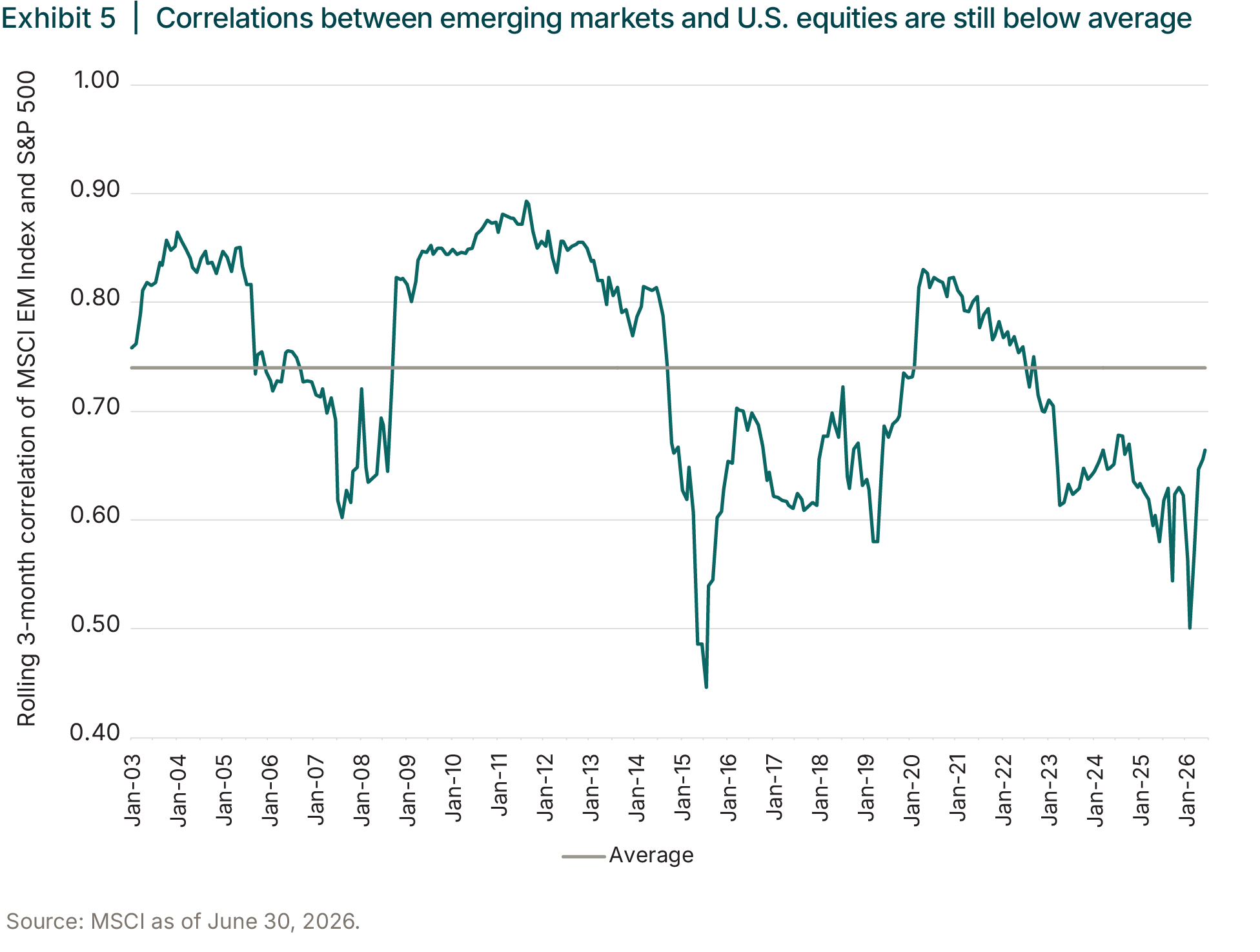
The region’s industrial composition has also provided a buffer. AI-related demand helped support technology-heavy exporters, such as Taiwan and South Korea, even as tariffs pressured other industries. Paradoxically, it has also increased the MSCI EM Index’s three-year rolling correlation with the S&P 500 of late (Exhibit 5), as U.S. AI capex drives the performance of large, AI-related emerging markets stocks in Taiwan and Korea, which transmits directly into APAC earnings. Correlations still remain below the post-2000 average, however, and emerging markets growth drivers, such as commodity cycles, domestic consumption and intra-regional trade, are less tethered to the U.S. than equity correlations suggest.
Corporate balance sheets provide another source of resilience. Approximately 38% of MSCI Emerging Markets constituents have net-cash balance sheets, meaning they hold more cash than debt. The proportion rises to roughly 66% in health care and 59% in information technology, supported by cash-rich pharmaceutical, biotechnology, semiconductor and hardware companies across China, India, Taiwanand Korea.
Emerging markets banks are also substantially better capitalized than the sector’s historical reputation might suggest. Among 144 MSCI Emerging Markets banks with available data, the average Tier 1 capital ratio was 15%,7 well above the applicable Basel III minimums. Stronger capitalization does not eliminate credit or political risk, but it increases the sector’s capacity to withstand volatility and helps explain why recent global disruptions have not produced a broader banking crisis.
Asia remains a long-duration growth opportunity
While the emerging markets story has broadened from macroeconomic growth to encompass innovation, corporate quality and financial resilience, long-term economic convergence remains an important part of the opportunity, especially in Asia.
Between 2015 and 2025, GDP per capita increased at a compound annual rate of 5.4% in China, 4.8% in India and 3.3% in Indonesia.8 Those rates exceeded the figures for the United States, Japan and major European economies. Income convergence has been far less consistent across Latin America and Africa.
Rising incomes support demand for financial services, health care, travel, premium consumer products, appliances and digital services. Increasingly, that demand is met by companies based in emerging markets. Chinese consumers have shifted toward domestic brands in areas ranging from jewelry to furniture. South Korean cosmetics companies have built global followings, while Indian and Southeast Asian companies are developing around their own expanding consumer bases. This creates a more self-sustaining growth model in which domestic and regional demand complement exports to developed markets.
EM’s evolution is not fully reflected in valuations
Despite stronger balance sheets, improving earnings trends and increasing exposure to some of the world’s most important growth themes, emerging markets equities continue to trade at a substantial discount to developed markets. Consensus estimates place the forward price-to-earnings ratio of emerging markets at approximately 9.2x earnings, compared with 17.5x for developed-markets peers, a discount approaching 50%.9
Part of that discount reflects legitimate concerns. Investors continue to worry about geopolitics, governance, regulation and currency volatility. China’s prolonged property downturn has also weighed heavily on sentiment toward the broader asset class.
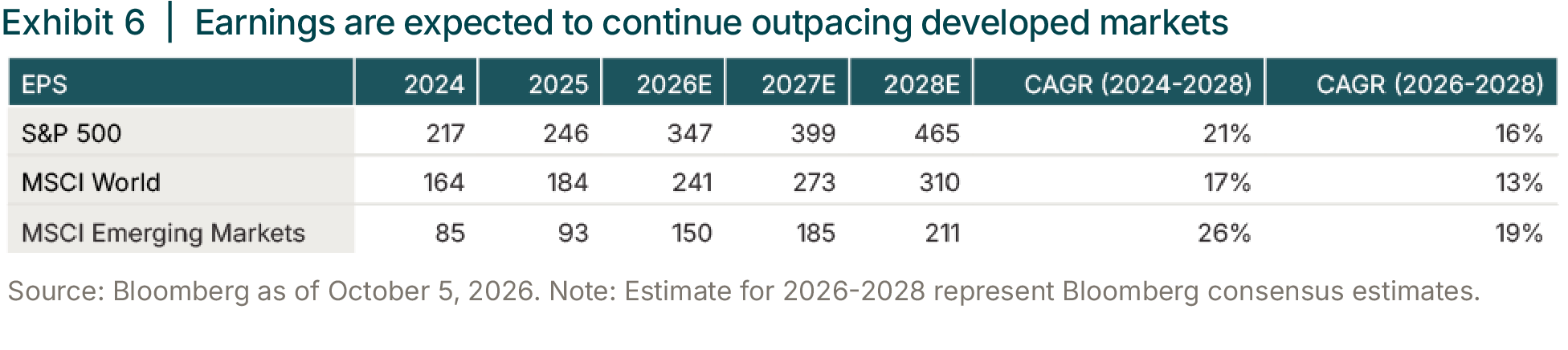
Still, earnings expectations remain supportive. Consensus forecasts indicate that emerging markets earnings will continue to grow faster than those of developed markets through 2026 and 2027 (Exhibit 6).
In our view, that disconnect between valuations and forward earnings creates an attractive opportunity. The market appears to recognize many of the risks associated with emerging markets but may not fully appreciate how much the underlying companies and economies have evolved over the last two decades.
Conclusion
Emerging markets are not immune to geopolitical shocks, policy mistakes, weak governance or abrupt regulatory change. The increasing weight of AI-related companies in the emerging markets index raises concentration concerns similar to those in the United States. Investors must distinguish between durable profitability and thematic enthusiasm, and between companies capable of funding growth internally and those dependent on favorable external conditions.
Nevertheless, today’s emerging markets equity universe is fundamentally different from the one investors encountered 20 years ago. It is less dependent on China’s infrastructure cycle, less uniformly exposed to developed market demand and better equipped to absorb external shocks. Its leading companies are no longer simply low-cost challengers. Many are well-capitalized global leaders occupying critical positions in technology, renewable energy, advanced manufacturing and consumer markets, or they are high-quality domestic players well positioned to cater to local and regional markets.
The central investment question is no longer simply whether China or the emerging markets will grow. It is which countries, industries and companies are best positioned to convert that growth into sustainable earnings and shareholder value. In our view, active managers with on-the-ground expertise and deep fundamental research capabilities are best positioned to answer these questions moving forward.