Financing Water Infrastructure for a Thirsty World
Sep 2026
View available investments in your area

Sorry, we couldn't find any results matching
Please:

Key takeaways:
The world is increasingly thirsty, and the need for investment in water and wastewater infrastructure is vast. With government budgets stretched, private infrastructure debt can play a key role in financing the systems that keep industry, agriculture, technology and the general public hydrated.
Our Head of Infrastructure Debt for the Americas & Asia Pacific Patrick Manseau and Jeff Nelson, CEO of Colorado-based water/wastewater infrastructure developer PERENfra, recently appeared together on a panel at MetLife Investment Management’s Insurance CIO Summit. Ahead of that appearance, they provided us with their views on a few of the top questions investors should keep in mind about financing water infrastructure.
What’s driving the need for water and wastewater infrastructure?
Aging water and wastewater systems serve other types of industry, agriculture, and public water consumption, and they’re in need of repair and replacement. In 2025, the American Society of Civil Engineers gave U.S. drinking water infrastructure a C- grade and a near-failing D+ to wastewater infrastructure, noting that even after funding increases, 80% of water utilities reported that their revenues did not cover the cost of providing drinking water. The U.S. Environmental Protection Agency estimates that the United States needs $625 billion in water infrastructure investment over the next 20 years for replacing aging or deteriorating pipelines, as well as treatment and storage infrastructure.1
Between the years of 2010 and 2020, the United States Geological Survey showed that crop irrigation and thermoelectric power generation each accounted for about 43% of U.S. water usage,2 by far the lion’s share of all water use. Since then, of course, AI has come onto the scene and changed the picture. The United Nations estimates that global data center electricity use could nearly double from 448 terawatt hours (TWh) in 2025 to 945 TWh in 2030 as AI gains more traction, which equates to a need for an additional 9.3 trillion liters of water.3
Data centers use water to cool the semiconductors powering AI inferencing, or day-to-day calculations, as well as the more water-intensive process of training. The amount of water used depends on the system. Closed-loop systems that run water through pipes near the equipment and recycle it thereafter are more efficient than immersion systems, in which more water evaporates. Likewise, data centers in cooler climates can pipe in air from the outside, reducing the need for water.
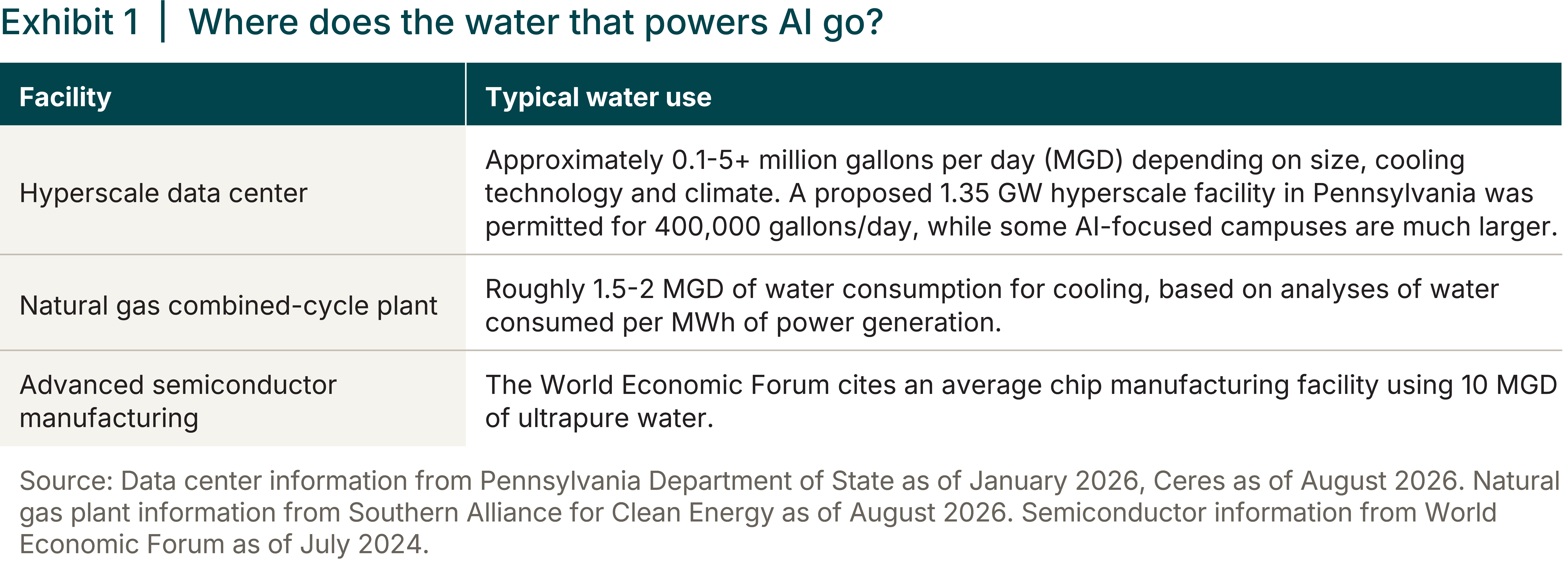
Yet, Bank of America estimates that only 25% of the water use attributable to a particular data center happens at the data center itself.4 The rest occurs during power generation and semiconductor fabrication (Exhibit 1). Increasingly, policymakers and the public are looking past data centers to focus on total water usage, which at times can result in inflated estimates of usage, Nelson said.
What role can private credit play in financing water and wastewater infrastructure?
With local, state and federal budgets stretched both in the U.S. and many parts of the world, government funding is almost certainly insufficient to build infrastructure at the scale anticipated. Private capital, including both private debt and private equity, is likely to play a key role in upgrading existing infrastructure and developing new assets.
Just as investors can finance a data center, its computing equipment and the power generation behind it separately, private infrastructure debt can finance water supply, treatment and reuse assets with their own contracts, collateral and risk profiles. Yet, as the public and policymakers grow increasingly concerned about the water supply, lenders must carefully consider how to properly underwrite risk.
What water and wastewater infrastructure assets can investors finance?
A wide range of investable assets will be needed to meet the growing demand for water. Some of these are directly related to data centers, such as closed-loop cooling infrastructure or new water supply systems specifically for data centers or co-located power plants.
Other assets may address rising water and wastewater demand not only for data centers, but also for communities, including:
Within these types of assets, investors can find financing opportunities to fit a range of risk-return profiles. Funding operating regulated utilities is a core opportunity, while core-plus opportunities may include contracted projects with limited construction or ramp-up risk. Investors searching for higher yields may focus on development opportunities that depend on customer hookups (i.e., providing a private water source to a new neighborhood) or financing smaller, unrated utilities.
What makes private infrastructure investments in water and wastewater systems potentially attractive to investors?
Ultimately, water and wastewater infrastructure have the same characteristics that make financing other kinds of infrastructure attractive to institutional investors, Manseau says. These include long-duration cash flows, providing an essential service, revenues that tend to be regulated or have long-term contracts, the potential for inflation linkages or cost passthroughs, and the structural protections that are often available in private debt, such as covenants and seniority in the capital structure.
Yet, water is also different. Because of its direct tie to the AI infrastructure build-out, water and wastewater infrastructure provides exposure to AI growth without lending directly against a data center or rapidly evolving computing technology. Investors in projects that rely directly or indirectly on data center demand should pay careful attention to who the data center counterparties are, contractual protections such as covenant and offtake agreements and whether the infrastructure would be useful if the data center it serves becomes obsolete or goes offline.
How can investors manage supply risks and reputational risks associated with water projects in particular?
Nelson says that in the race to build new data centers, many developers are using the first available water source or water sources they inherited when they bought a property or piece of land. Some hyperscalers are increasingly interested in “behind-the-meter” water systems similar to the “bring-your-own-power” systems that allow them to access water directly from (or nearby to) their data center locations, rather than through a local municipal utility provider.
In the end, water risk is a hyperlocal issue that depends on the condition of specific aquifers, watersheds and local utility systems. But infrastructure investors concerned about stable supply, permitting and public opinion should carefully consider a few factors, first among them being the source of their water.
Using surface water such as reservoirs and rivers is controversial, and supply may be unpredictable. In the hot, sunny U.S. Southwest, for example, the Colorado River is both prone to evaporation and a critical source of water for both farms and households, spurring both state and federal scrutiny of how its flows are used.
A better option, he noted, may be an underground aquifer filled with non-potable groundwater. That water may have suspended solids or other minerals that would require extensive treatment to make it drinkable, but water infrastructure owners can use minimal treatment to avoid scaling, or mineral build-up, while the water is being used to cool the data center equipment.
A water infrastructure investor’s diligence may also include which other users are drawing from the same water source and how access will be monitored and controlled in the future. Nelson says it’s in an infrastructure owner’s best interest to pull water from aquifers in places with groundwater conservation authorities or districts that “keep track of how many straws are sucking water out of the ground,” he said. “There are places where you can drill as many wells as you want and literally suck an aquifer dry. It’s not sustainable.”
Finally, investors must consider the rights to the water they plan to draw on.
Ultimately, water is one of the most precious resources a community has — and whether the AI investment boom continues or not, the infrastructure that manages both fresh water and wastewater treatment and disposal is aging. As private infrastructure investors look to provide the water and wastewater infrastructure that makes the future possible, they must also make responsible and sustainable investments that fully consider the risks to supply.