Going Global in Leveraged Loans
Oct 2026
View available investments in your area

Sorry, we couldn't find any results matching
Please:

Key takeaways:
In an increasingly unpredictable global environment, institutional investors are reassessing their geographic allocations across credit markets. We believe a multi-regional leveraged loan strategy offers a compelling way to potentially diversify sources of return, enhance portfolio resilience, manage risk and access a deeper, more flexible credit universe to weather market shocks – which is especially important against a fragmenting global backdrop.
Deglobalization is in motion
Recent shifts in U.S. geopolitical policy have challenged perceptions of U.S. exceptionalism and prompted other nations to reassess their strategic priorities and policy frameworks. Governments are reexamining trade policies, restructuring supply chains, strengthening domestic industries and pursuing new strategic partnerships. As a result, the outlook for economic growth, inflation and monetary policy has become increasingly uncertain, raising the potential for greater macroeconomic divergence across regions. What appears increasingly clear is that the global economy is deglobalizing, with rising trade barriers, accelerating reshoring efforts and a renewed emphasis on economic nationalism.
The appeal of going global in loans
In a more fragmented global economy, uncertainty about policy and geopolitics is higher, while inflation, growth and trade outlooks are cloudier. In an environment where dynamics can shift quickly among countries, a global view on asset allocation becomes more critical.
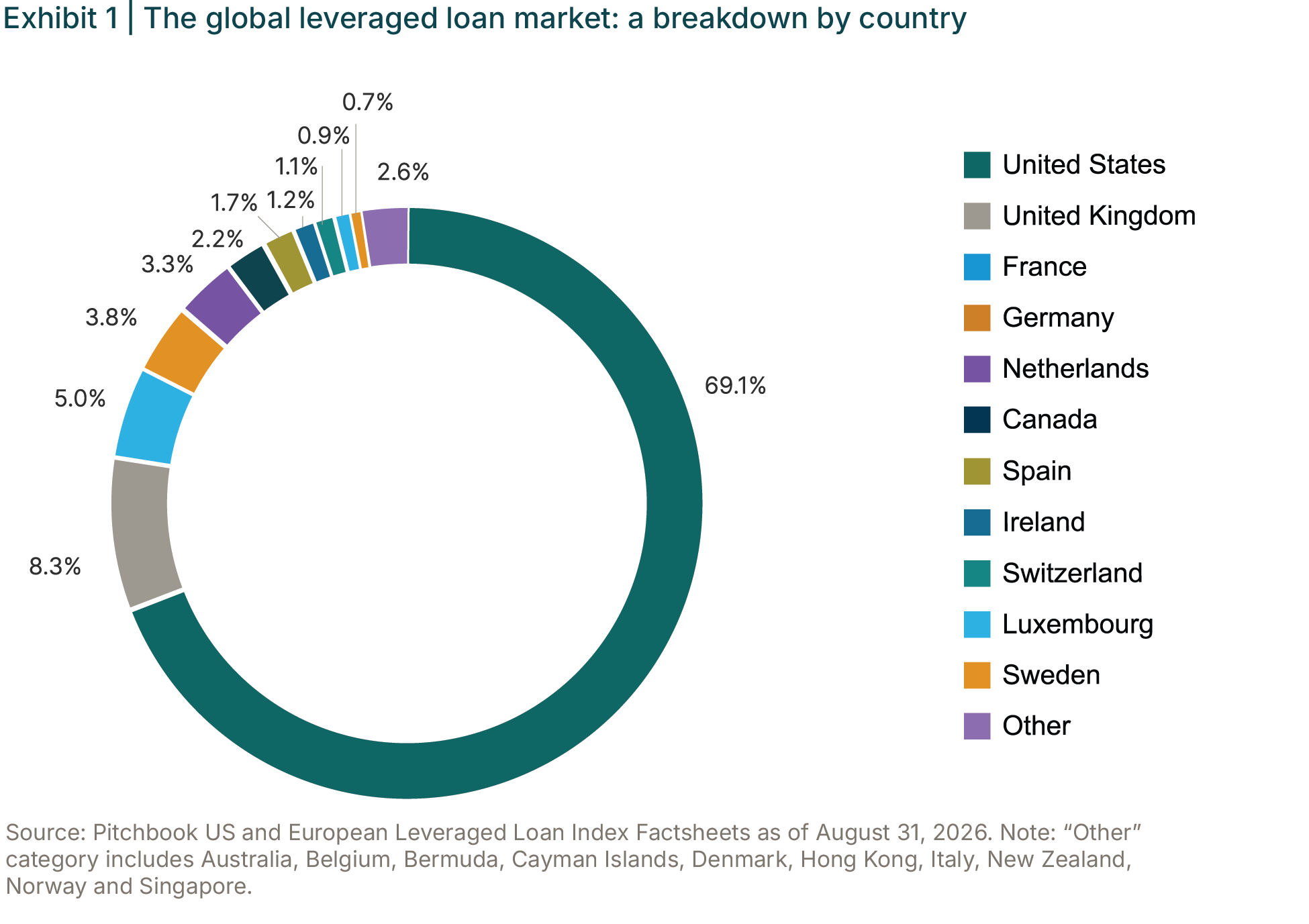
Going global with a loan allocation (Exhibit 1) has many potential benefits for investors, including healthy carry prospects and relative resilience to market volatility anchored by demand from a stable CLO buyer base. Loans historically also have had a strong risk-return profile, seniority within the capital structure and a moderately contained default outlook.
A large and growing loan market
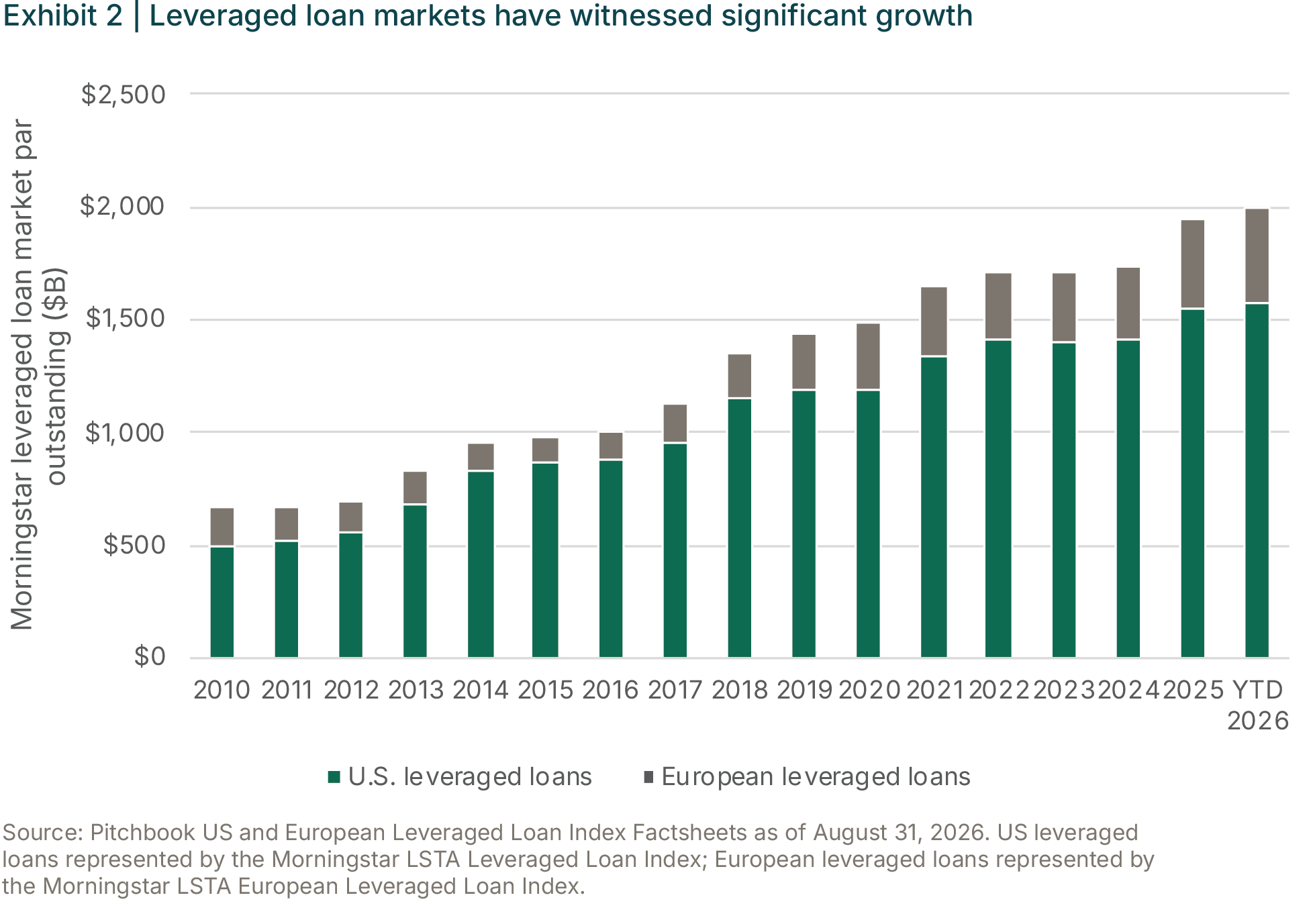
Both the U.S. and European loan markets have grown significantly over the past decade, supported by strong expansion in the CLO market and healthy demand for loans to finance transactions from the private equity industry, which continues to view the market as an attractive, flexible source of capital (Exhibit 2).
Widening the opportunity set allows for greater flexibility in building portfolios
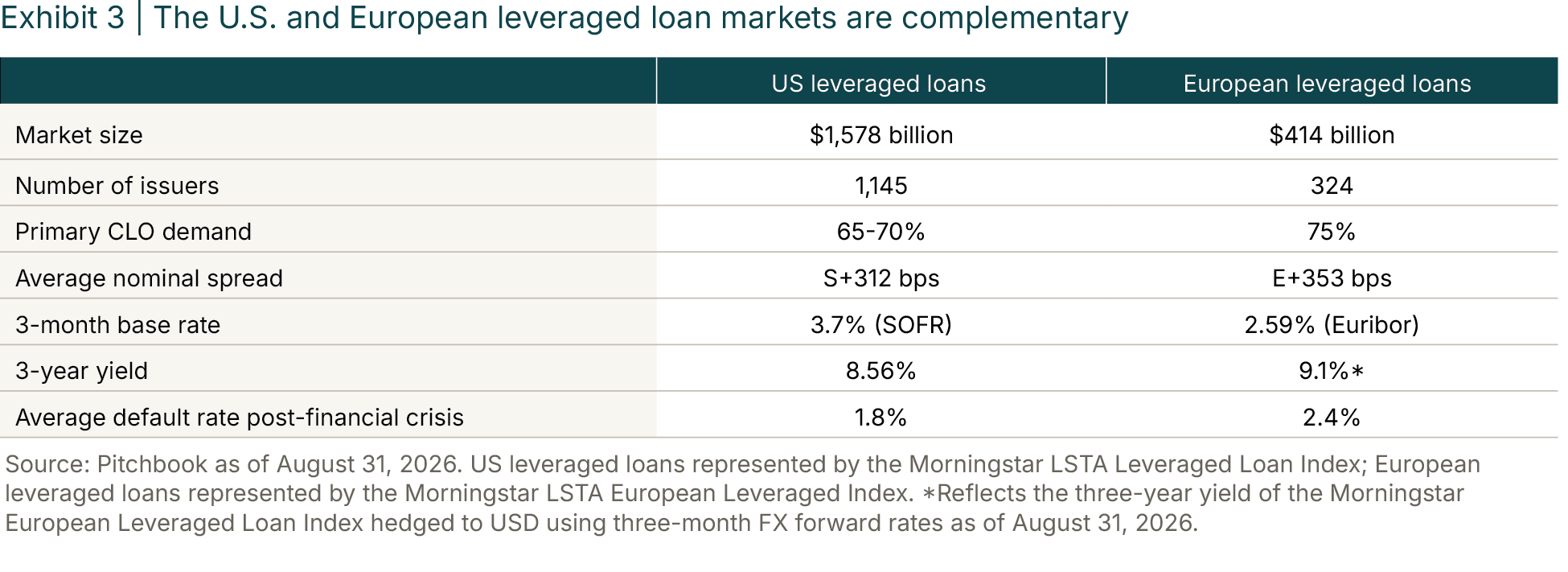
Combining the U.S. and European loan markets expands the overall investable universe by over four times in terms of both size and issuer count versus the European market alone. Compared to a U.S.-only loan focus, a global loan approach expands the investable universe by over 25% in terms of size and issuer count. Expanding the investable market allows for greater choice and flexibility in structuring portfolios and thereby improves diversification, durability and risk-return potential (Exhibit 3).
Both the U.S. and European markets exhibit diversity across industries. For example, while healthcare is one of the largest sectors in both markets, underlying credit quality varies significantly between the regions. The U.S. healthcare sector faces a number of headwinds, including reimbursement challenges stemming from Medicare cuts, changes in revenue cycles, high labor expenses and steeper funding costs. Conversely, Europe’s healthcare market benefits from more stable reimbursement because it is made up of multiple distinct markets, many of which receive strong public funding. A global investor can benefit from the stable characteristics the sector has to offer while adjusting for the cross-border nuances in credit fundamentals.
Geographic diversity provides alpha potential and enhances portfolio resilience to volatility in a given region
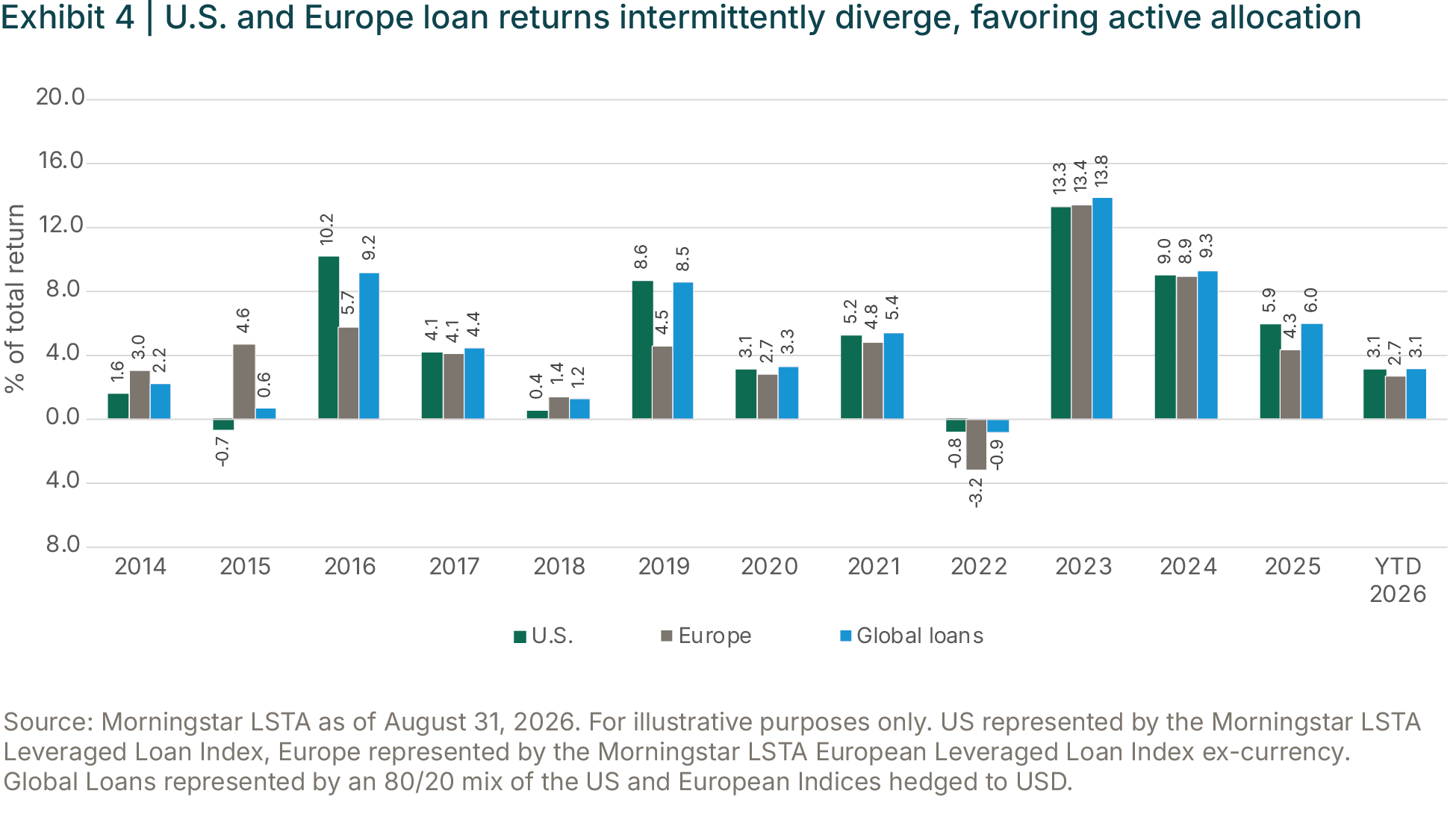
While credit selection should be viewed as the overriding source of alpha, the ability to tilt portfolios on the margin depending on geographic views can also contribute, as the two regions can experience periods of outperformance and underperformance at different times (Exhibit 4). For example, in February 2022, when Russia invaded Ukraine, European loans underperformed through October 2022, returning -6.1% (-4.7% USD-hedged) compared to -2.7% for U.S. loans, on fears that higher commodity prices would drive the European economy toward a recession. Once it became evident that these fears were overdone, European loans outperformed from November 2022 through May 2023, returning 9.4% (11.1% USD hedged), compared to 5.8% for US loans.
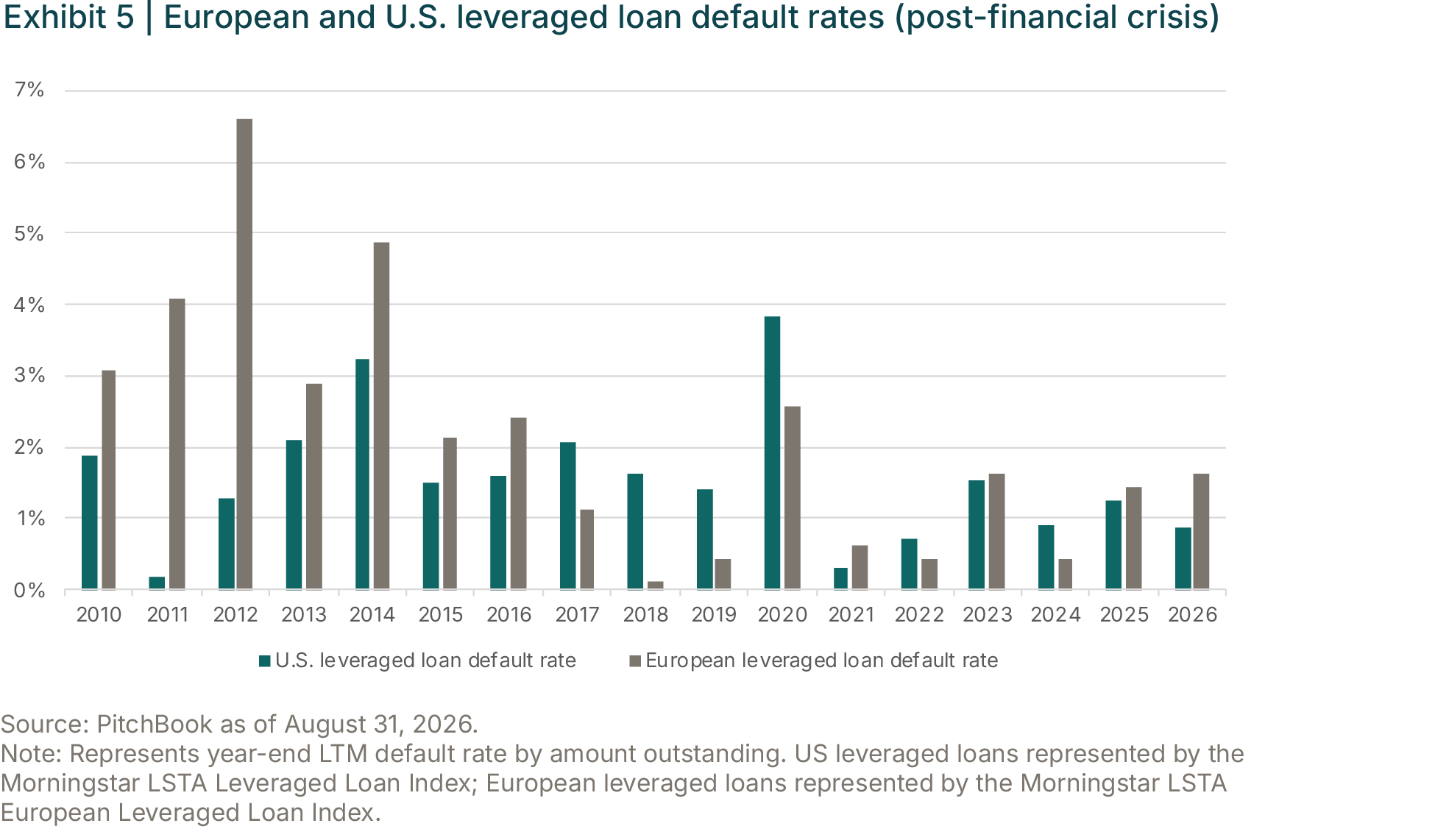
We have similarly seen default rates diverge in these markets during select periods. For example, the eurozone debt crisis led to notably higher default rates in Europe from 2010-2014. In contrast, defaults in the U.S. outpaced those in Europe from 2017-2019, when U.S. borrowers faced rising interest rates and reduced fixed-charge coverage ratios while their European counterparts saw an extended period of negative base rates and cleaner balance sheets (Exhibit 5). A global allocator with expertise in both markets can capitalize on such dislocation opportunities.
A global loan allocation can lead to a better risk-return profile
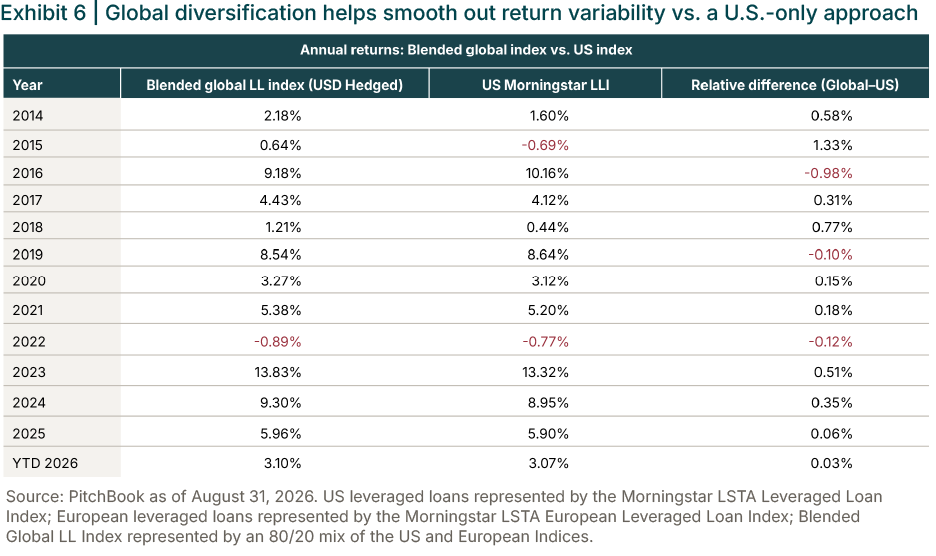
Over time, a globally diversified approach to loans has been shown to help smooth out the variability in total returns compared to a U.S.-only approach. Moreover, although current base rate differentials between the two markets offer a carry advantage to U.S. loans in local currency terms given SOFR’s higher rate relative to Euribor, USD-denominated asset allocators can largely compensate for this by currency hedging. Additionally, European loans currently offer a spread advantage relative to USD-denominated loans. This difference in spread, coupled with the benefits of hedging the base rate, adds incremental relative value to a globally diversified portfolio.
Key risks to consider
While global loan allocations offer a number of potential benefits, leveraged loans do come with risks that investors should take into consideration.
Default risk: Though investing in most forms of credit carries some level of default risk, leveraged borrowers with lower credit ratings carry a higher risk of default than their investment grade counterparts. This risk can be managed by utilizing a robust underwriting process and placing a rigorous, continuous focus on credit selection.
Market liquidity risk: While the leveraged loan market benefits from secondary trading, not all loans are equally liquid. This risk can be managed by targeting larger loans, which are often the most liquid.
Currency risk: Investing in global loans can carry foreign exchange risk, which may affect the value of returns. This risk can be managed using currency-hedging strategies.
Diversification reigns in a deglobalizing world
Recent developments indicate that we are entering a new period of deglobalization in which policy uncertainties and fracturing trade relationships are likely to keep disrupting the status quo. For these reasons, we believe that now more than ever, global diversification is a key component in investors’ risk management toolkit.
Loans remain an attractive asset class, with total return opportunities underpinned by strong carry appeal, stable technicals and a relatively contained default outlook. We believe a global loan approach is compelling and has proven to offer attractive risk-adjusted returns. The U.S. and Europe together offer broader sources of alpha, combining regional asset allocation, issuer selection and arbitrage of relative value between markets. Active managers with global investment capabilities in both the U.S. and Europe and a track record of investing through economic cycles are positioned to react to dislocations and capitalize on this dynamic.