Investment Grade Spreads: Tighter for Longer?
Nov 20, 2024
View available investments in your area

Sorry, we couldn't find any results matching
Please:

Governments, businesses and consumers all took advantage of a decade of free money. Bond markets are now multiple times larger than before the Great Financial Crisis (GFC), having soared to record levels. Economic activity and most financial markets benefited. As central banks around the world swiftly raised interest rates to fight inflation, significant challenges are emerging, especially concerning the ability to refinance or repay substantial volumes of maturing debt.
Looking ahead, ‘debt overhang’ may act as an ongoing economic headwind to GDP and productive capacity. As government debt servicing costs rise as a percentage of GDP, political tensions could rise further, especially given the rapidly shifting geopolitical landscape. The shift in the cost of capital may also impact business decisions, R&D, social spending, government deficits, supply and demand of securities, the shape of the yield curve and central bank policy decision making.
Our ongoing series will continue to explore key trends across various sectors of the financial markets. In this installment, we focus on the overheating stage of the credit cycle and its potential impact on investment grade (IG) spreads. While some outcomes can be anticipated, the dynamics of tighter spreads could present new challenges and opportunities for investors. Understanding how these market conditions could evolve will be crucial for shaping investment strategies in the months ahead. Stay tuned as we provide further analysis on other areas of the credit markets, offering insights into how these trends may help inform your investment analysis moving forward.
Our ongoing series will continue to explore key trends across various sectors of the financial markets. In this installment, we focus on the overheating stage of the credit cycle and its potential impact on investment grade (IG) spreads. While some outcomes can be anticipated, the dynamics of tighter spreads could present new challenges and opportunities for investors. Understanding how these market conditions could evolve will be crucial for shaping investment strategies in the months ahead. Stay tuned as we provide further analysis on other areas of the credit markets, offering insights into how these trends may help inform your investment analysis moving forward.
Spreads on IG bonds have been tight for most of the past year. Are we finally going to see a widening out of spreads? Even though spreads have been unusually tight for a long time, we expect that spreads will remain tight until markets become convinced about either a recession or a soft landing before we see material and persistent spread widening.
Based on an analysis of a set of economic and credit indicators, we have developed an index defining the various stages of the credit cycle — downcycle, recovery, expansion and overheating.1 These indicators provide us with a detailed view of where the economy stands in the credit cycle. According to this methodology, we are currently in the “overheating” stage.
In our view, several economic factors have led to the overheating and tight spread environment. First, inflation expectations remained anchored while disinflation continues. Second, the Fed has been restrictive. Third, corporate balance sheets have been healthy, with strong earnings and liquidity, reducing the likelihood of a sharp contraction in corporate investment. Finally, the labor market continues to show resilience, with low unemployment and steady wage gains.
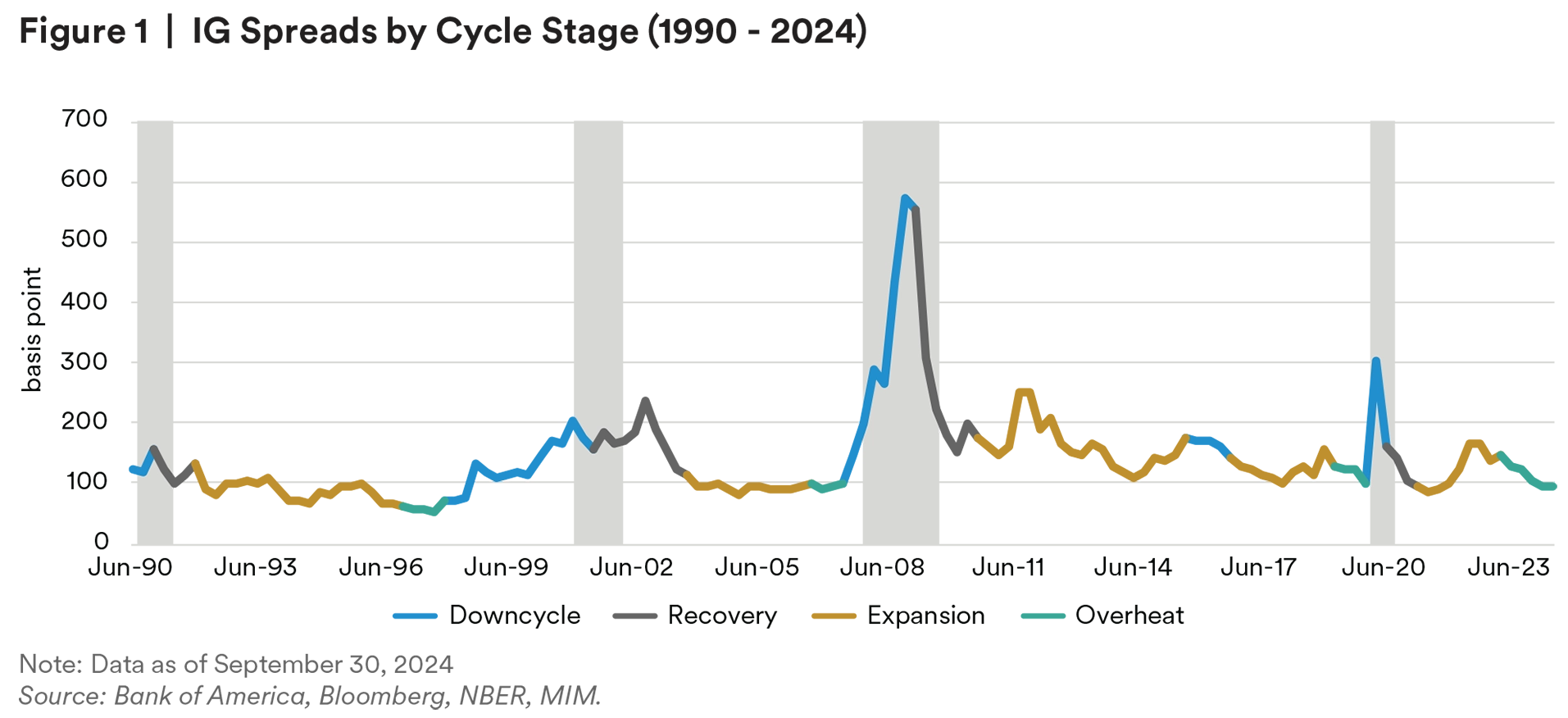
Starting in 2023, the Fed’s real policy rate rose sharply, the yield curve inverted and lending tightened, pushing the economy into the overheating stage. Overheating is the rarest of the four stages. The economy spends only 11% of its time, in roughly three-to-four quarter stretches, in the overheating stage. By contrast, the economy spends roughly half its time in expansion.
The overheating stage is marked by particularly tight credit spreads as investors demand less compensation for risk. Over the past 34 years, the IG spread has been about 90 basis points (bps) on average during the overheating stage, compared with 140 bps on average across all stages.
There have been three episodes of overheating since 1989, and each of these has ended in a downcycle — the stage with the highest spreads.

We may be able to take some lessons on spreads from the mid-1990s. In 1994, the Federal Reserve, led by Alan Greenspan, began tightening monetary policy to prevent the economy from overheating. By mid-1995, the labor market was clearly cooling, pushing the Fed to three rate cuts starting in July 1995. Around that period, Federal Reserve achieved a rare soft landing, skillfully navigating inflation without causing a full-blown recession. IG credit spreads remained tight — and indeed tightened — over the subsequent three years.
The current situation has parallels to that era, as the Powell Fed hiked rates from Q1 2022 to mid-2023, without (so far) sparking a recession. Spreads are now about as low as they were following Greenspan’s hiking cycle. If the rest of the path follows the 1990s example, and the Powell Fed manages to push off or completely skip a downcycle phase, spreads could remain around their current tight levels until another downcycle phase begins.

Overheating stages have historically been short-lived and followed by a downcycle. However, this time could be different — if the Fed manages to pull off a soft landing.
There are risks to our forecast, including corporate profit weakness, labor cuts, outright U.S. recession, and global economic weakness led by China and Germany.
However, our base case is for the Fed to pull off a soft landing. As a result, we expect the current overheating stage — already the longest in the 34 years we have analyzed — to continue. We anticipate IG spreads to remain tight for at least the next six months, as evidence of a soft landing accumulates. If the current overheating stage manages to avoid a downcycle and perhaps shifts straight to expansion, spreads could trace a much more moderate path over the next several years.
Endnotes
1. These indicators include measures of lending standards, corporate profits and debt, and various measures of returns.