With the longest federal shutdown in U.S. history now concluded, USDA operations have returned to normal. This piece examines how more frequent and extended shutdowns could impact meat markets and influence what consumers find in the grocery aisle.
Government shutdowns cause widespread disruption across multiple USDA functions. Food safety inspectors within the USDA’s Food Safety and Inspection Service (FSIS) are considered “essential” and must continue inspecting meat and poultry processing facilities, usually without pay. These conditions stretch personnel thin and risk burnout, morale decline and absenteeism, or even departures.
Under federal law, slaughter of “amenable species” – including beef, swine, broiler chickens, lamb, and ratites like emu – require USDA funded inspectors under federal inspection programs that are mandatory for interstate sale. In contrast, “non amenable species” such as bison, elk, deer, rabbits, and reindeer rely on USDA inspections that are funded privately by the processor. Because their compensation is financed by a resource other than appropriated funds, inspectors of non-amenable species may continue to receive pay during a shutdown. These arrangements effectively insulate non amenable species from disruption when government funding lapses, while leaving amenable species vulnerable to inspector absenteeism.
An intermediate scenario would be one where some packing plants close due to inspector absenteeism and others remain open. Reduced plant capacity would cause feeder cattle prices to fall, as feedlots compete to place their cattle before they age and lose value. Cow-calf operations would see margins decline due to reduced demand from feedlots, incentivizing them to retain more cattle and focus on herd rebuilding. Plants able to remain open would see margins improve significantly, while inoperable plants go dark.
An extreme scenario would be where every federal inspector not receiving pay stops showing up to work, and every federally inspected facility becomes inoperable. This would have dramatic distortionary impacts that differ for amenable and non-amenable species. State inspection of amenable species could proceed as usual, but state inspected meat can only be sold intrastate (with some exceptions discussed below). In contrast, processors of non‑amenable species could continue slaughtering operations, potentially extending their market reach while competitors are unable to ship across state lines.
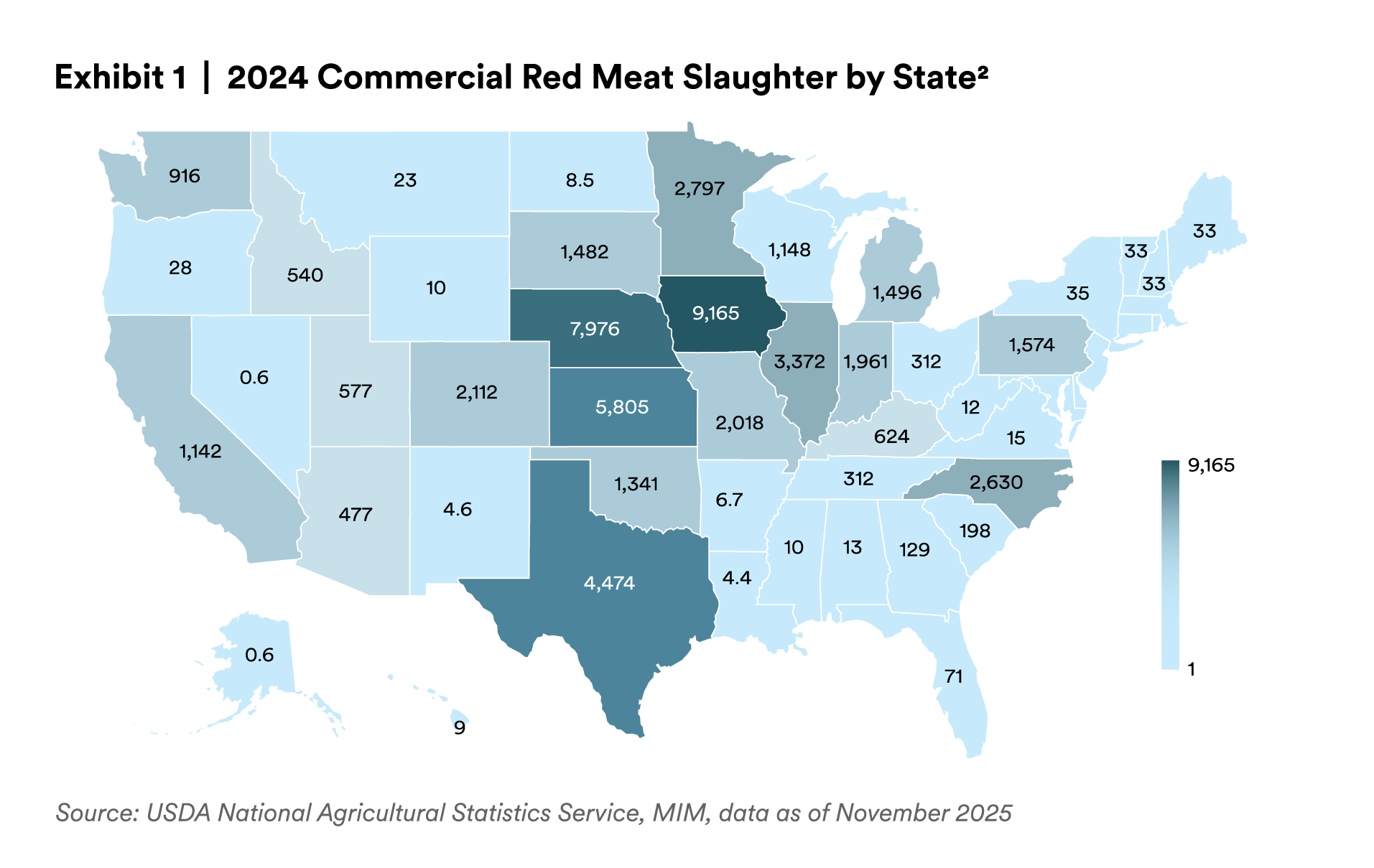
In this extreme scenario, states with extensive slaughter capacity but smaller populations such as Iowa, Nebraska, Texas and Kansas, could see localized declines in prices of beef and other amenable species as supply exceeds local demand. Conversely, densely populated states with limited local capacity such as New Jersey, Massachusetts, Connecticut and Rhode Island would face supply shortages and steep price spikes.
Meanwhile, bison, for example, would be unaffected and could see significant price premiums for its ability to move interstate, making it one of the few red meats available within states that lack a state inspection program and/or adequate direct-to-consumer beef sales. In Alaska, the reindeer meat industry is already struggling with getting USDA inspectors out to the rural Seward peninsula where its commercial reindeer meat industry is located. In response, the state has passed legislation that allows the sale of uninspected reindeer meat so long as it was slaughtered on snowpack, ambient air temperatures were at or below freezing, and the carcass was immediately frozen.1 As a result, grocery shoppers in Alaska might find reindeer steaks in place of ribeye.
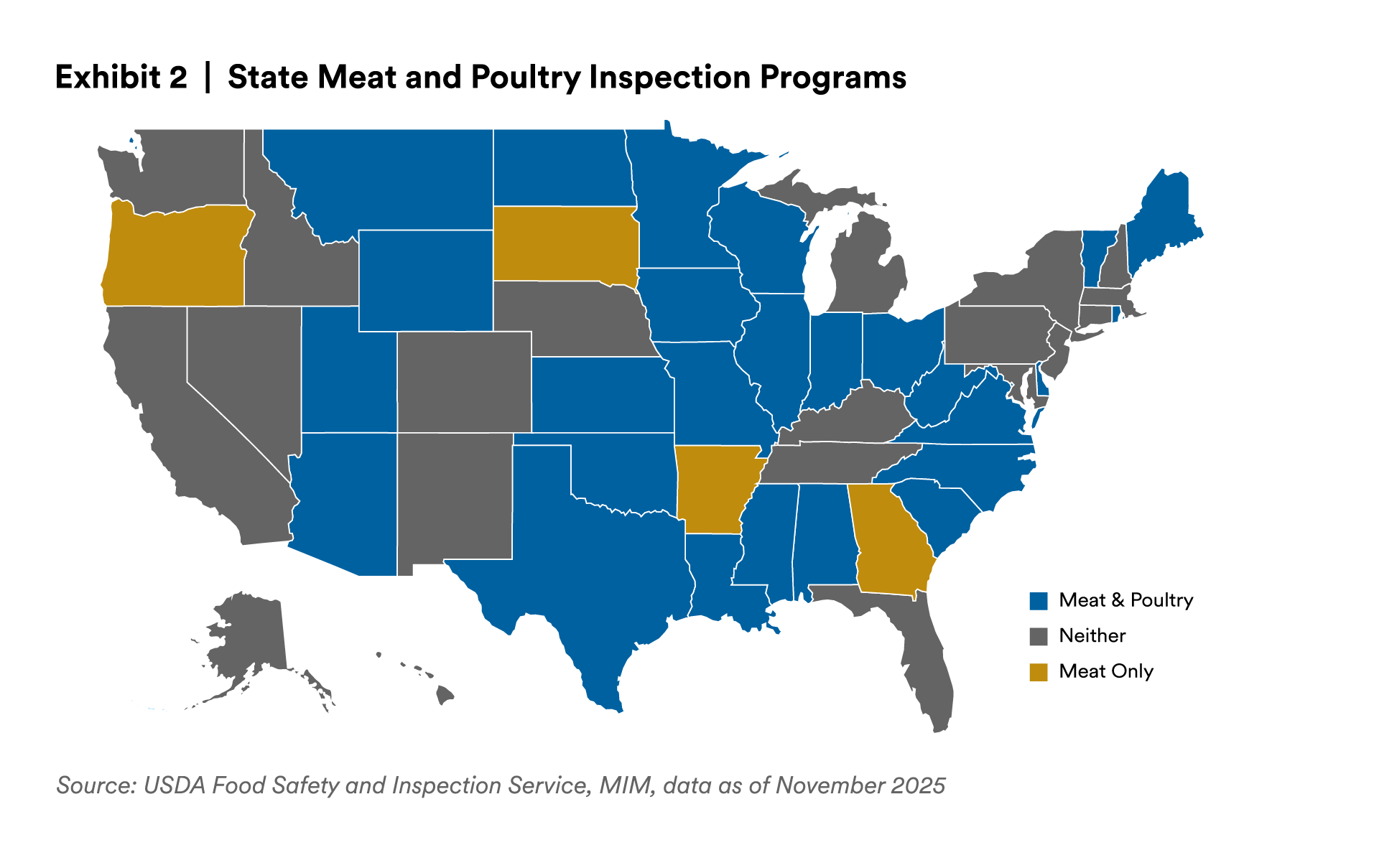
A handful of states (Indiana, Iowa, Maine, Missouri, Montana, North Dakota, Ohio, South Dakota, Vermont and Wisconsin) participate in the Cooperative Interstate Shipping Program.3 This program allows state‑inspected meat to be sold interstate among the participating states. But this program has severe limitations, most notably that only processing plants with 25 or fewer employees are eligible, dramatically limiting the scalability of this potential solution. Furthermore, only 29 states have an established Meat and Poultry Inspection Program,4 meaning that without federal inspectors, processing plants in 21 states would have no means of inspecting any meat processed within their borders (Figure 2).
Another, more prolonged government shutdown could unveil intriguing distortions rooted in the structural bifurcation between USDA funded inspection and producer funded inspection regimes. Although temporary, the resulting shifts in pricing, interstate commerce and supply chains would offer potent lessons in regulatory design and the resilience of our food systems, while causing windfall profits for some and shutdowns for others. Additionally, consumers forced to experiment with less conventional meats may discover a preference for them. Even a marginal substitution of beef consumption with bison, for example, could exert disproportionate upward pressure on alternative meat markets, given their limited herd sizes and production capacity. Such behavioral shifts, although driven by a temporary disruption, could spur more lasting changes in demand composition. Although this shutdown produced minimal disruption in meat markets, repeated extended shutdowns would only increase the probability of disruptions.
Endnotes
1 18 AAC 31.820 - Reindeer for retail sale to or at a market | State Regulations | US Law | LII / Legal Information Institute
2 Data for Connecticut, Maine, Massachusetts, New Hampshire, Rhode Island, and Vermont are combined by the USDA, as are Delaware and Maryland
3 Cooperative Interstate Shipping Program | Food Safety and Inspection Service
4 States With and Without Inspection Programs | Food Safety and Inspection Service