Ripe for Change: U.S. Apples in the Age of AI
Jul 10, 2026
View available investments in your area

Sorry, we couldn't find any results matching
Please:
.webp)
Key Takeaways:
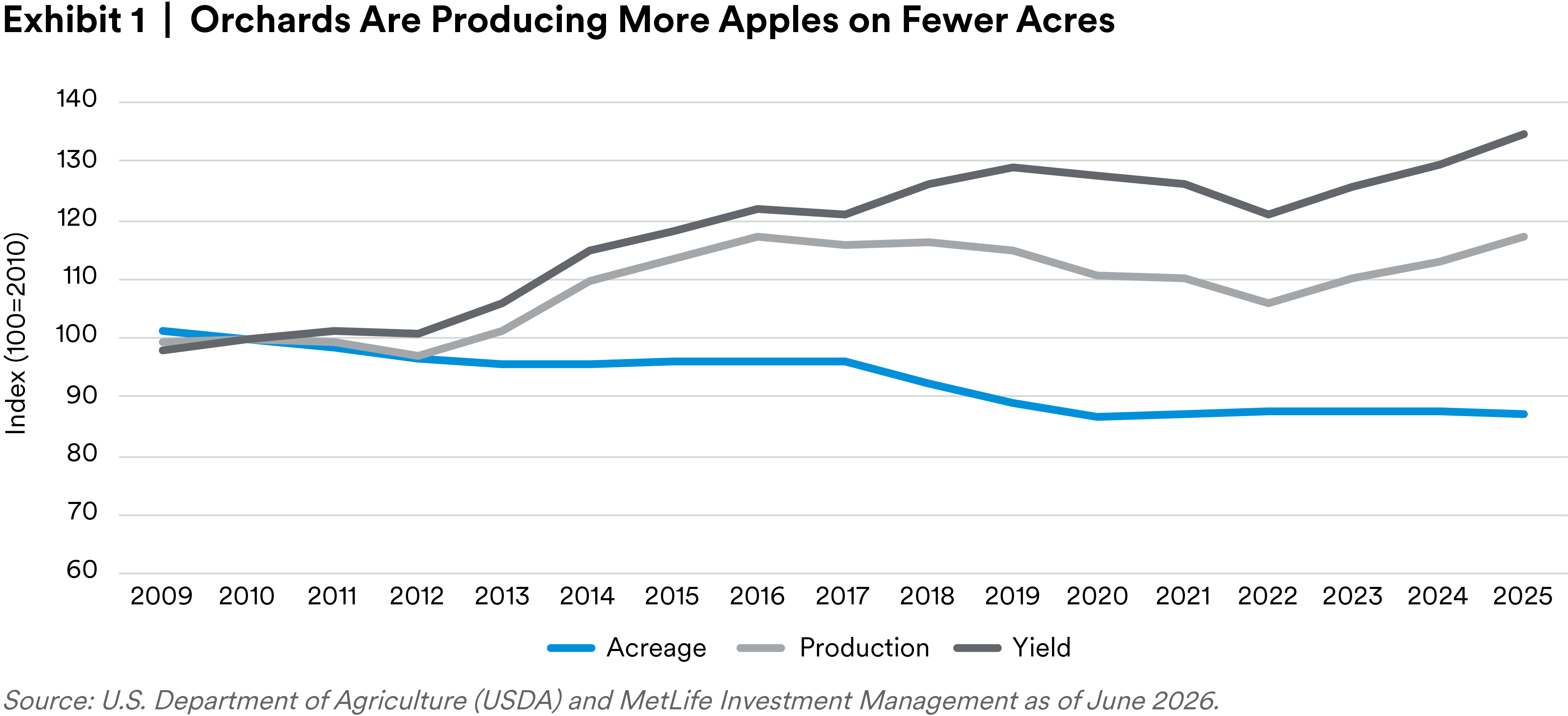
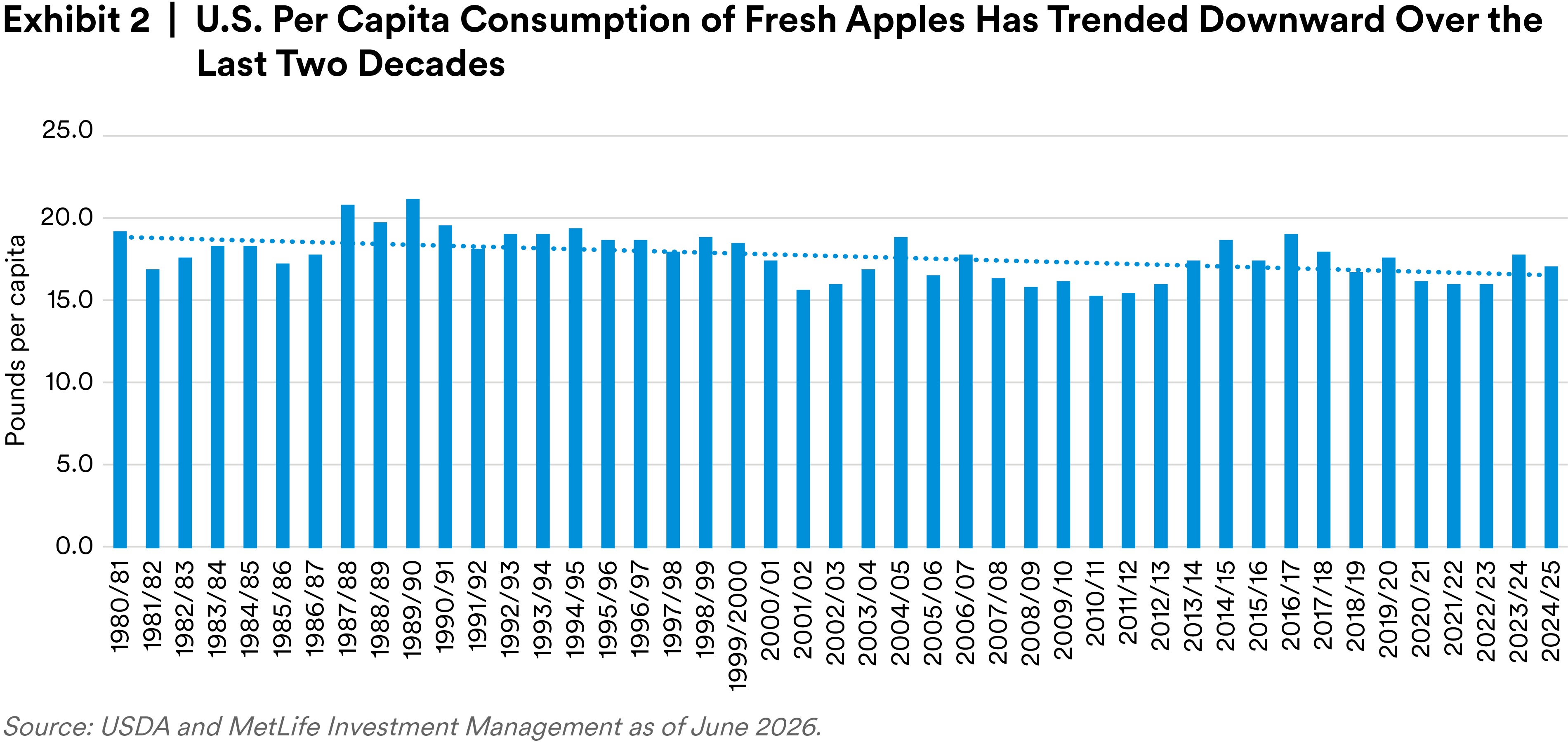
U.S. apple production has expanded by 17% since 2010, driven primarily by improvements in yields. While bearing acreage declined by 13%, yields increased by 34% as higher density and more productive orchards more than offset the decline in acreage (Exhibit 1). Orchard densities increased from about 200 trees per acre in the 1980s to 600–800 in the 2010s, and now exceed 1,000 trees per acre, driven by the adoption of dwarf rootstocks and V-trellis systems. While innovative new varietals have measurably improved the quality of apples and made them easier to store, demand growth hasn’t kept pace (Exhibit 2), which leaves the domestic market in a cyclical state of oversupply.
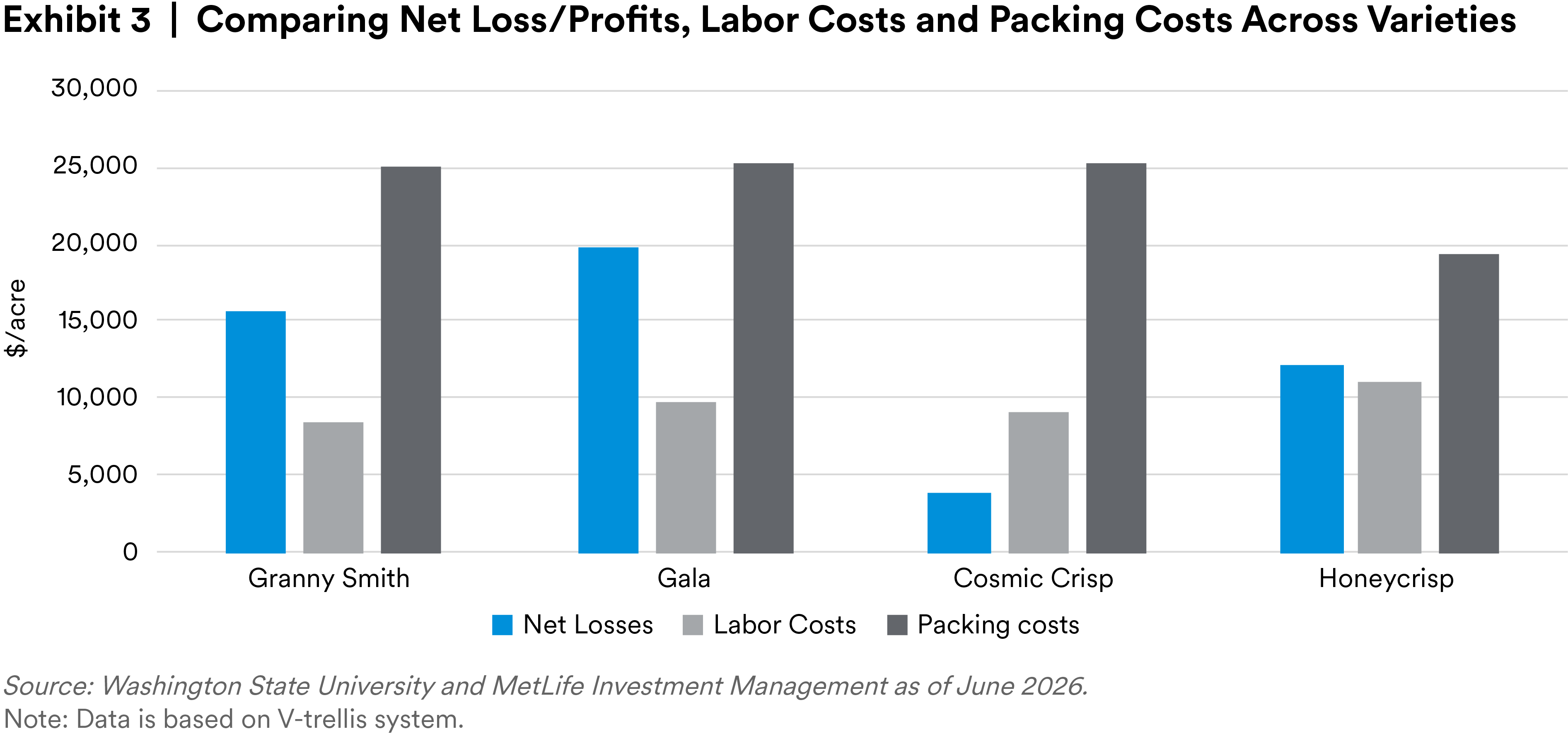
Adding to the pressures of oversupply, input cost inflation has outpaced revenue gains and eroded growers’ profits. In 2025, apple prices reached 26.3 cents per pound on average, only modestly above the 25-year average of 25.6 cents. Meanwhile, rising labor and packing costs have pushed margins into negative territory across most major varietals. Current estimates indicate economic losses ranging from approximately $4,000 per acre for Cosmic Crisp to nearly $20,000 per acre for Gala once opportunity costs are accounted for (Exhibit 3). The persistence of low prices alongside rising input costs has made profitability a challenge for a large portion of the industry.
 Limited Demand Growth Constrains Market Adjustment
Per-capita apple consumption across fresh, frozen and processed apples has been trending down since 2004, while U.S. population growth is expected to continue slowing. Short of a sudden apple-fueled dietary craze, the domestic market provides limited scope for absorbing incremental supply. U.S.-grown apples account for approximately 97% of domestic consumption.
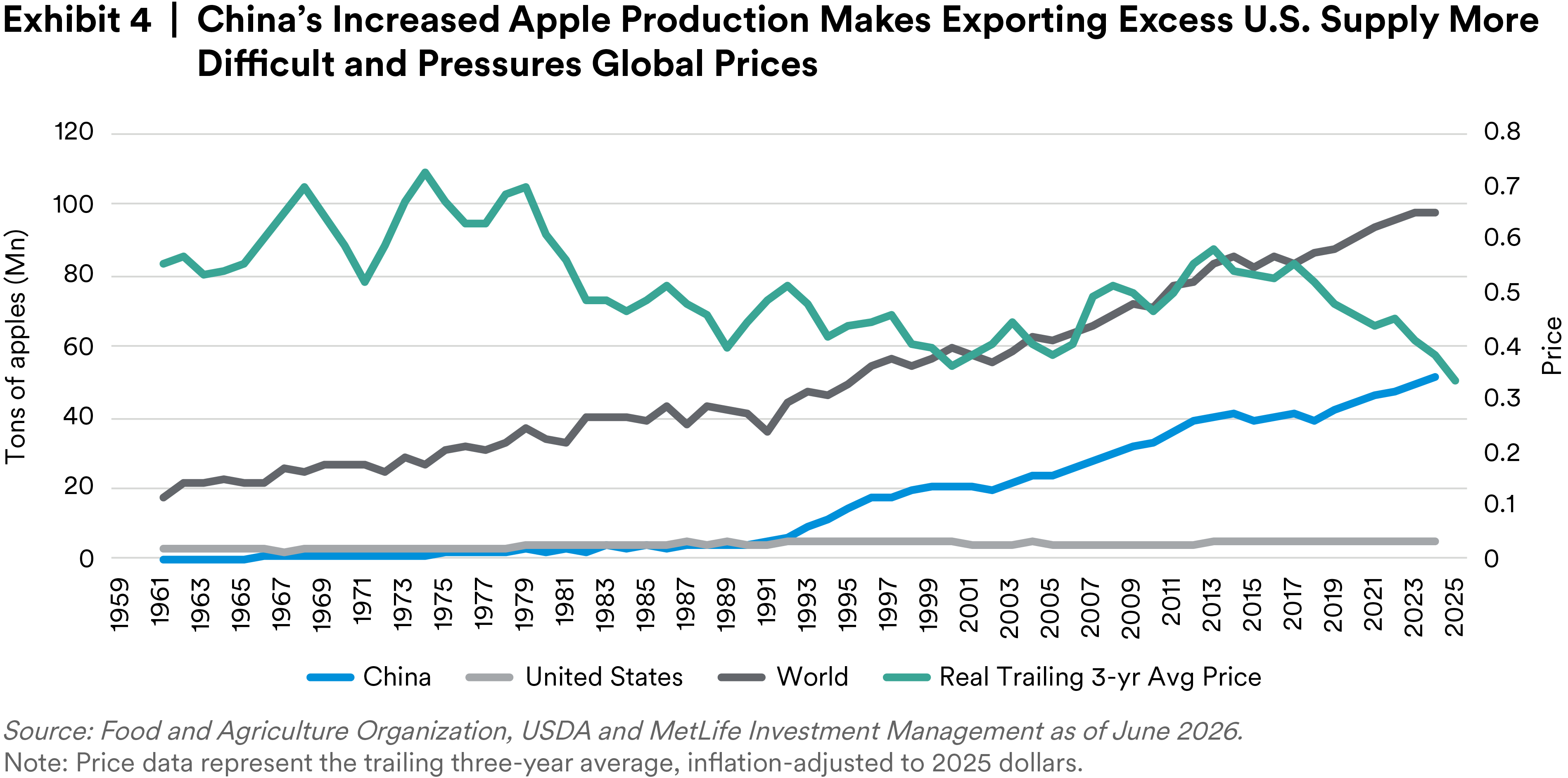
Exports offer limited relief. U.S. producers face higher production costs than key competitors, particularly China, which accounts for more than half of global apple production. This cost disadvantage hinders U.S. producers’ efforts to compete in global markets and absorb excess supply through exports.
Given constrained demand and limited new export opportunities outside of existing trade with Canada and Mexico, reducing supply is the most effective mechanism for improving prices in the near term. A reduction in bearing acreage would tighten domestic supply, allowing prices to rise and supporting grower margins. In contrast, further productivity gains without corresponding demand growth are likely to exacerbate existing imbalances. Given these economics, we expect U.S. bearing apple acreage to decline by at least 8% between 2025 and 2030, putting much needed upward pressure on prices. This outcome would be consistent with the historical cyclicality inherent to permanent crops and would reflect what is currently underway in the tree nuts sector, where increasing production drove down prices and resulted in the removal of less economical orchards.
Apple production is highly labor intensive, with labor accounting for approximately two-thirds of variable costs. The sector depends heavily on seasonal labor, particularly through the H-2A program, exposing producers to both wage inflation and policy uncertainty.
While recent reforms will reduce costs and ease some administrative burdens, structural trends — namely rising minimum wages — are expected to keep labor costs on an upward trajectory. Labor will remain a persistent pressure on profitability until it becomes possible to automate the effective cost of seasonal harvest operations, as well as other parts of the production process.
Apple harvesting has long resisted widespread mechanization because it requires a combination of perception, judgment and precise manipulation that is difficult to standardize. However, with the rapid expansion in AI technology, the potential for automation in the apple industry has never seemed like more of a possibility. Prototypes of multi‑arm robotic apple harvesters use camera and depth‑sensing systems, along with machine learning models, to identify fruit, assess ripeness and guide picking operations in real time. These systems can detect apples within the canopy, estimate their position and plan a picking sequence while coordinating multiple robotic arms. In field trials, such robots have demonstrated the ability to operate in commercial orchards and achieve harvest success rates in the range of roughly 70%–80%, with picking speeds approaching a few seconds per apple. However, current systems still face limitations in fully replicating human adaptability.
Advances in AI and automation have the potential to materially reduce production costs over the long term. Automated harvesting alone could reduce labor expenses by approximately 40%, while broader automation across orchard management could deliver reductions of 60%–70%. However, these technologies are unlikely to reach widespread commercial adoption until the mid-2030s, limiting their impact on near-term profitability. Orchards will also have to be redesigned to take full advantage of automation. We do not believe that fully automated apple-harvesting will exceed 10% of U.S. fresh apples harvested by year-end 2030.
While automation will reduce labor requirements, innovation — particularly in genetics — will determine the extent of long-term efficiency gains. This is the area where AI has the potential to have the biggest impacts if it can make meaningful advances in bioengineering.
Developing varietals optimized for mechanized harvesting, lower input requirements and improved yield consistency will be critical to enabling the next generation of orchard systems. However, long development timelines are likely to delay the economic impact of these innovations.
Because of these margin pressures and the need to reduce acreage, we expect increasing consolidation among apple growers. Larger, vertically integrated producers are better positioned to invest in new technologies and benefit from economies of scale. Over time, this dynamic will result in a more concentrated industry, with increased importance placed on scale, capital access and operational efficiency.
The U.S. apple industry is currently in a low cycle, driven by overproduction, but the long-term outlook is more optimistic. Production growth has outpaced demand, while rising input costs and stagnant prices have compressed margins across the sector. Restoring profitability in the short term will depend primarily on a supply-side correction. Growers are unlikely to replace aging, less-productive orchards and remove less efficient and less desirable varietals from the orchard. Industry consolidation is likely to accelerate as producers adapt to a more constrained and capital-intensive operating environment.
AI-enhanced automation and genetic innovation will ultimately reshape the cost structure of apple production in the long run, but these advances will take time to materialize. Producer timing will be critical. Early adopters stand to gain an upper hand, but pre-mature adoption can be particularly costly for permanent plantings. For an already time-crunched producer, time would be best spent tracking advances in genetics and orchard architecture, rather than automation alone.
i USDA, NASS
ii USDA, Economic Research Service
iii U.S. Census Bureau