Singapore Dollar Bonds Step into the Spotlight as a Safe Haven
Oct 2026
View available investments in your area

Sorry, we couldn't find any results matching
Please:

Key takeaways
SGD-denominated bonds are moving into the spotlight as the city-state’s strong currency, robust sovereign balance sheet and stable fiscal and monetary policies gain favor with global allocators looking to diversify their exposure to U.S. dollar denominated fixed income.
U.S. Treasuries and other U.S. dollar-denominated debt have long anchored institutional portfolios owing to their liquidity, scale and safe-haven status. However, in recent years, investors have had to navigate a new set of realities. Fiscal deficits have ballooned across developed markets, geopolitical fragmentation has increased, inflation regimes have become less predictable and correlations across traditional asset classes have shifted. In this environment, SGD bonds are emerging as a compelling defensive allocation.
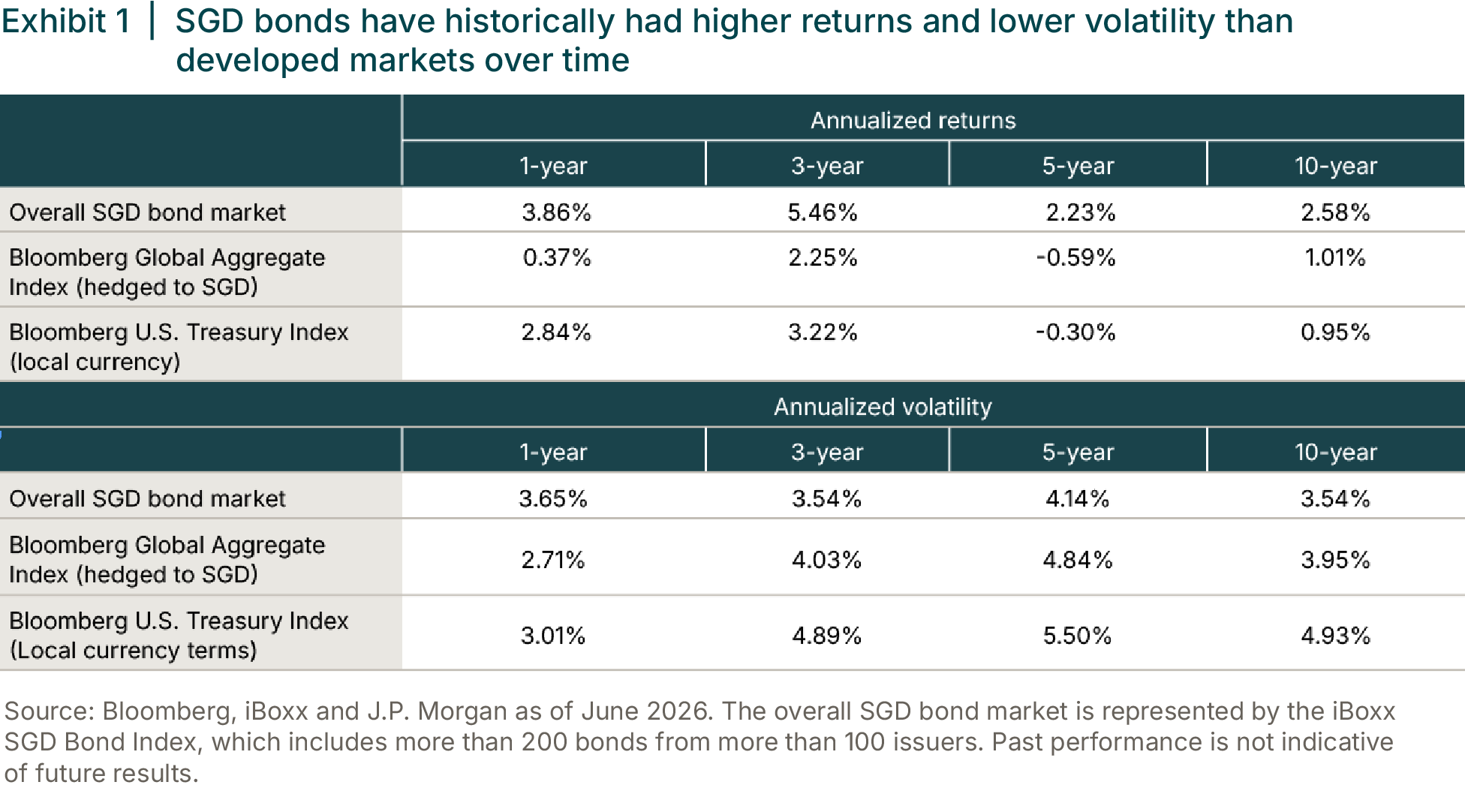
SGD bonds have delivered strong risk-adjusted returns over both medium- and long-term horizons, with lower volatility (Exhibit 1). Indeed, over every period shown, SGD bonds have outperformed both the global aggregate and U.S. Treasury indices.
The appeal of sovereign quality
Singapore’s sovereign strength is a key differentiator for the SGD bond market. Singapore remains one of only a handful of sovereign issuers globally to maintain top-tier ratings across all three major rating agencies. Its fiscal position is among the strongest in the world, supported by sizable reserves and substantial external buffers. Though the exact amount of Singapore’s reserves is not publicly available, the government has said that the Monetary Authority of Singapore (MAS); Temasek, the state-owned investment company; and GIC, the sovereign wealth fund, together manage at least S$1 trillion,1 or about $780 billion by mid-October currency conversion rates.
Crucially, Singapore’s government bond market fundamentally differs from those of most developed economies. The government issues bonds to facilitate capital market development and create benchmark yield curves, rather than to fund fiscal deficits. Singapore’s constitution requires the government to balance its budget over each five-year term of government, and it does not borrow to fund spending. Proceeds from market-development government bonds are invested and by law cannot be spent. As a result, Singapore government bonds carry the sovereign’s full, undiluted AAA credit quality.
Anchored by a stable currency
Over the past year, the SGD has stayed strong against the U.S. dollar, due to its exchange-rate-focused monetary policy and strong economic fundamentals. Unlike central banks in most developed markets, the Monetary Authority of Singapore (MAS) does not set an interest rate. Instead, the central bank in this export oriented economy manages the SGD’s nominal effective exchange rate, its value against an undisclosed basket of trading-partner currencies, within an undisclosed policy band. MAS sets three dials: the band’s slope (the pace of appreciation), width and center. It reviews these quarterly and intervenes in the currency market to keep the exchange rate on its path. Because Singapore imports most of what it consumes, a stronger currency is MAS’ main tool for containing inflation. Domestic interest rates are left to market forces, which is why SGD bond yields can behave differently from those in markets where the central bank sets the policy rate.
The MAS’ policy band has been set to appreciate steadily. Some of the Singapore dollar’s strength against the U.S. dollar of late reflects broad weakness in the greenback, but some is by design: MAS has tightened twice this year by steepening the band, partly to contain imported inflation. This calibrated approach maintains a moderately restrictive policy stance while preserving flexibility should external conditions evolve.
So far, however, price pressures remain relatively well contained. Although core inflation has begun to edge higher since the second half of 2025 and has moved slightly above 2% during the second half of 2026, inflation dynamics remain considerably more benign than in most developed markets.
Diversification beyond traditional fixed income exposures
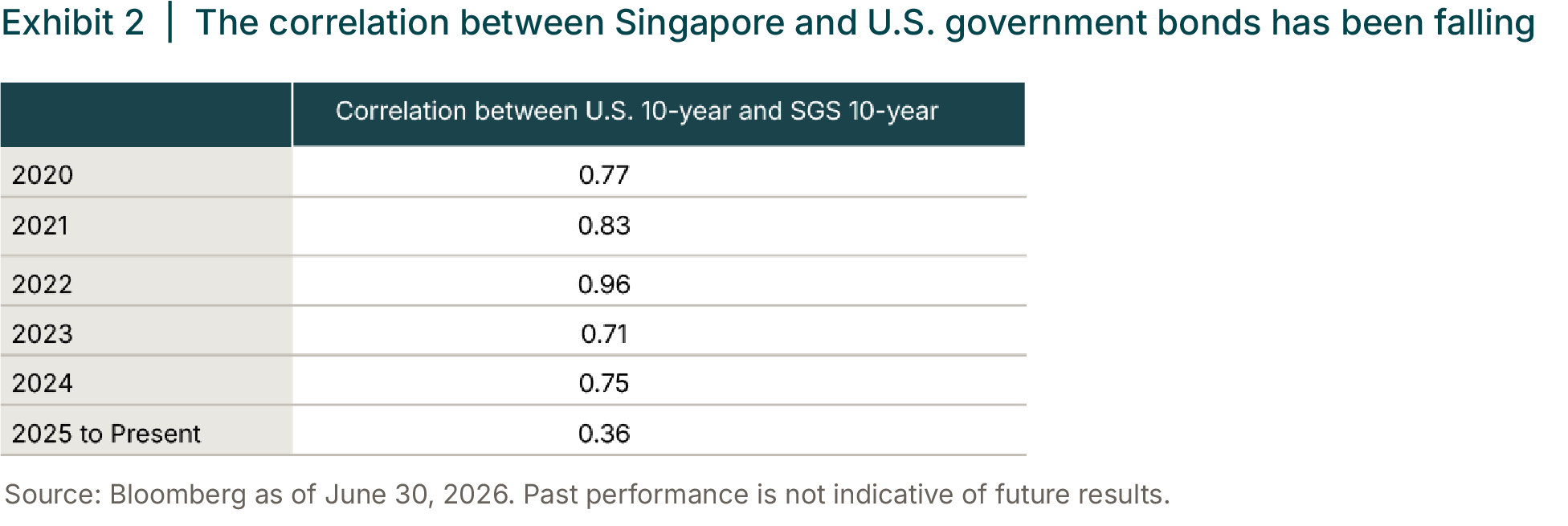
Singapore Government Securities (SGS) yields, which make up the bulk of the SGD market, were once highly correlated to U.S. Treasuries, but that correlation has moderated recently. While Treasury yields remain an important driver of global fixed-income markets, SGS yields have been supported by strong demand, controlled growth in government bond issuance and Singapore’s status as one of the few remaining AAA rated sovereign issuers (Exhibit 2).
The result is that SGS yields still tend to move in the same direction as U.S. Treasuries but often by a smaller magnitude. Periods of safe-haven demand have further reinforced this dynamic, as global investors increasingly look beyond the U.S. for defensive fixed income allocations. For investors, this creates the potential for diversification benefits while maintaining exposure to global duration trends.
A diversified economic structure
In the meantime, Singapore’s economic outlook remains constructive. The city-state continues to benefit from its position within global semiconductor and technology supply chains, commanding about 10% of global chip manufacturing and one fifth of semiconductor equipment production. Thanks to AI-driven demand, electronics exports have surged nearly 80% year on year in the first seven months of 2026.
While we expect the pace to cool over the next two years as the AI cycle matures, Singapore’s economy is broad-based, with sectors such as trade, finance, tourism and fast-growing wealth management services all contributing to growth. The country’s budget surplus and ample reserves provide the government with many fiscal levers to help buffer against an economic downturn.
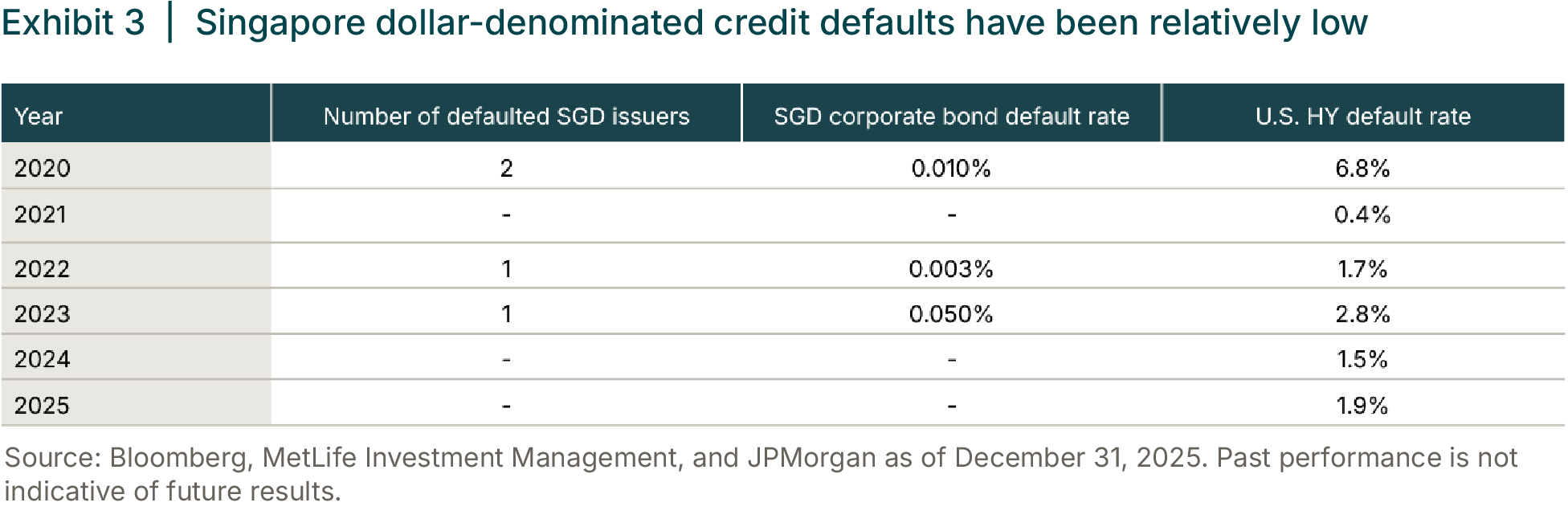
Credit performance reflects the city-state’s strong economic growth. Defaults in the SGD bond market have been exceptionally rare in recent years, particularly when compared with broader global credit markets (Exhibit 3). New issuance has increased steadily, yet high investor demand has generally absorbed supply comfortably.
While Singapore’s fundamentals remain robust, its small and highly trade-dependent economy is naturally exposed to shifts in global trade dynamics and geopolitical developments. Furthermore, the government’s active role in economic management means that policy decisions can materially influence growth trajectories and corporate performance. Against this backdrop, active credit selection remains critical. Our approach centers on identifying issuers with durable fundamentals, strong balance sheets and resilient business models, rather than relying on policy tailwinds or perceived government backing.
Conclusion
As investors rethink the role of defensive fixed income in an increasingly uncertain global environment, SGD bonds stand out as a potentially attractive source of stability, diversification and quality.
Backed by Singapore’s robust sovereign balance sheet, resilient currency, conservative fiscal policy, exchange-rate-focused monetary policy and supportive economic backdrop, the asset class offers a differentiated return profile compared with traditional U.S. dollar-denominated bonds. While external trade risks warrant careful credit selection, SGD bonds are increasingly well positioned to serve as a core component of globally diversified fixed-income portfolios.