Smaller Fed, Bigger Questions
Aug 26, 2026
View available investments in your area

Sorry, we couldn't find any results matching
Please:

Key takeaways
Federal Reserve (Fed) Chair Warsh’s balance sheet task force has the stated goal of examining “the costs, benefits and institutional implications of the Fed’s current balance sheet regime.”1
The leaders of the task force have varying philosophies regarding the balance sheet. Jeremy Stein favors a large balance sheet. Raghuram Rajan has written extensively about the problematic ratcheting effects of quantitative easing and prefers a smaller balance sheet. Karen Dynan, the third member, has less apparent views as she has not written much about balance sheet questions directly. The task force is supposed to finish its work and make recommendations by the end of the year, so any changes will likely take place beginning in 2027.
The task force could emerge with any one of a broad range of recommendations. We discuss three important aspects of the balance sheet they will likely consider.
The End of the Ample Reserves Regime?
After the 2008 financial crisis, the Fed abandoned its scarce reserves regime. Currently, the Fed operates under an ample reserves regime. Keeping ample reserves means keeping a high supply of cash in the banking system, and, instead of buying and selling small amounts of bonds to control rates, a focus on controlling administered rates, such as the interest on reserve balances and the overnight reverse repo rate.
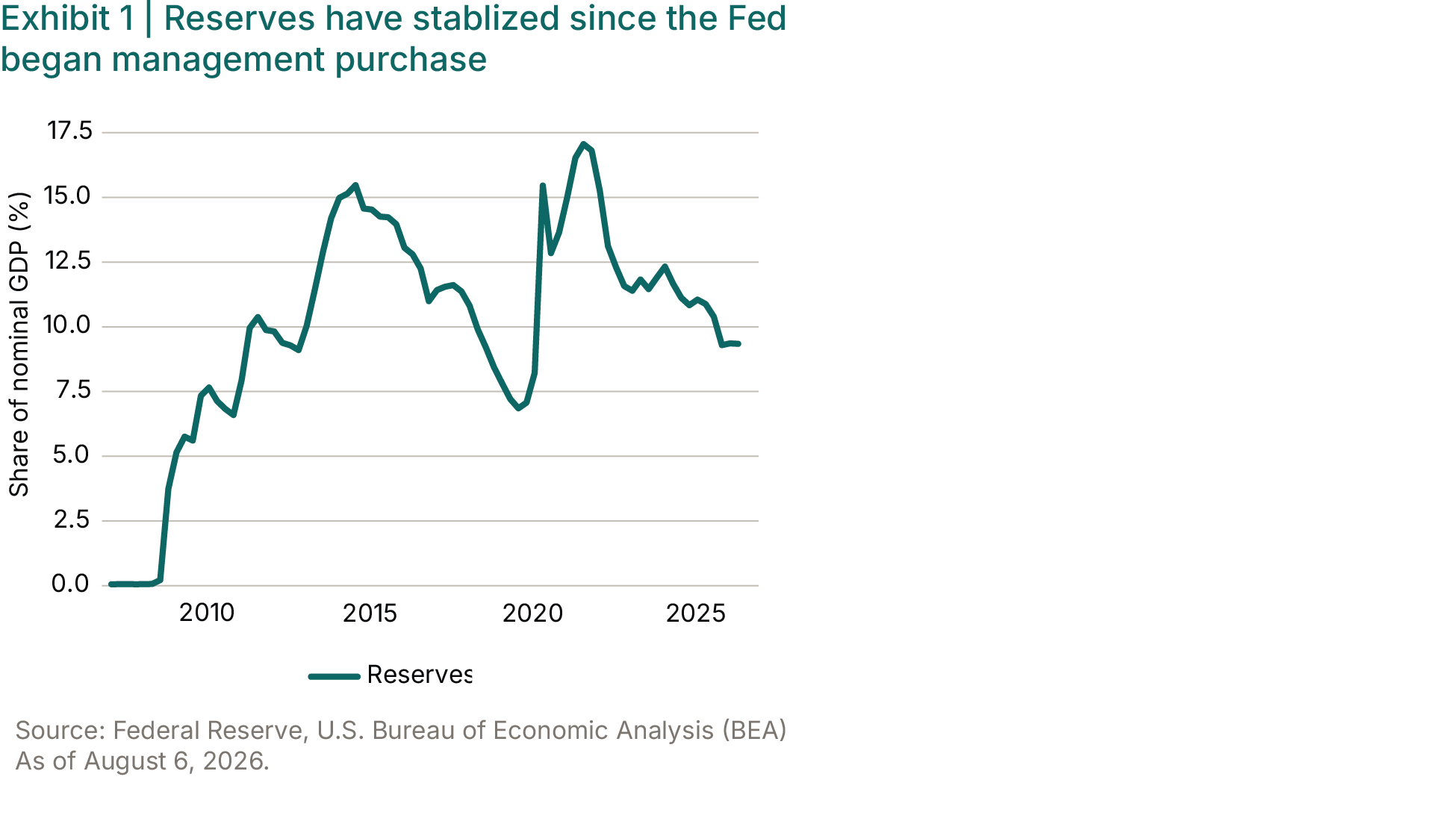
Reserves as a share of GDP peaked in 2021 at 17%. After the Federal Open Market Committee (FOMC) decided to begin reserve management purchases at the end of 2025, reserves as a share of GDP stabilized at around 9%. In the early 2000s, when the Fed was operating under a scarce reserves regime, reserves as a share of nominal GDP were less than 1%.
Returning to a scarce reserves regime is one way to reduce the size of the balance sheet. If the balance sheet task force recommends returning to a scarce reserves regime, then we would, in the short run, see the Fed buying fewer Treasuries. However, it would be difficult to quickly transition to a scarce reserves regime without causing market turmoil, unless the Fed puts in some policies to lower reserve demand first. To do this, the Fed could study new payment and settlement mechanisms and encourage more use of the discount window or alternative lending facilities like the Standing Repo Facility to lessen banks’ reliance on reserves.
If the Fed chooses to stay in an ample reserves regime, then we will likely see a gradual increase balance sheet size, as Treasuries are purchased to keep up with steadily increasing nominal GDP and currency in circulation.
Shortening the duration of the SOMA portfolio
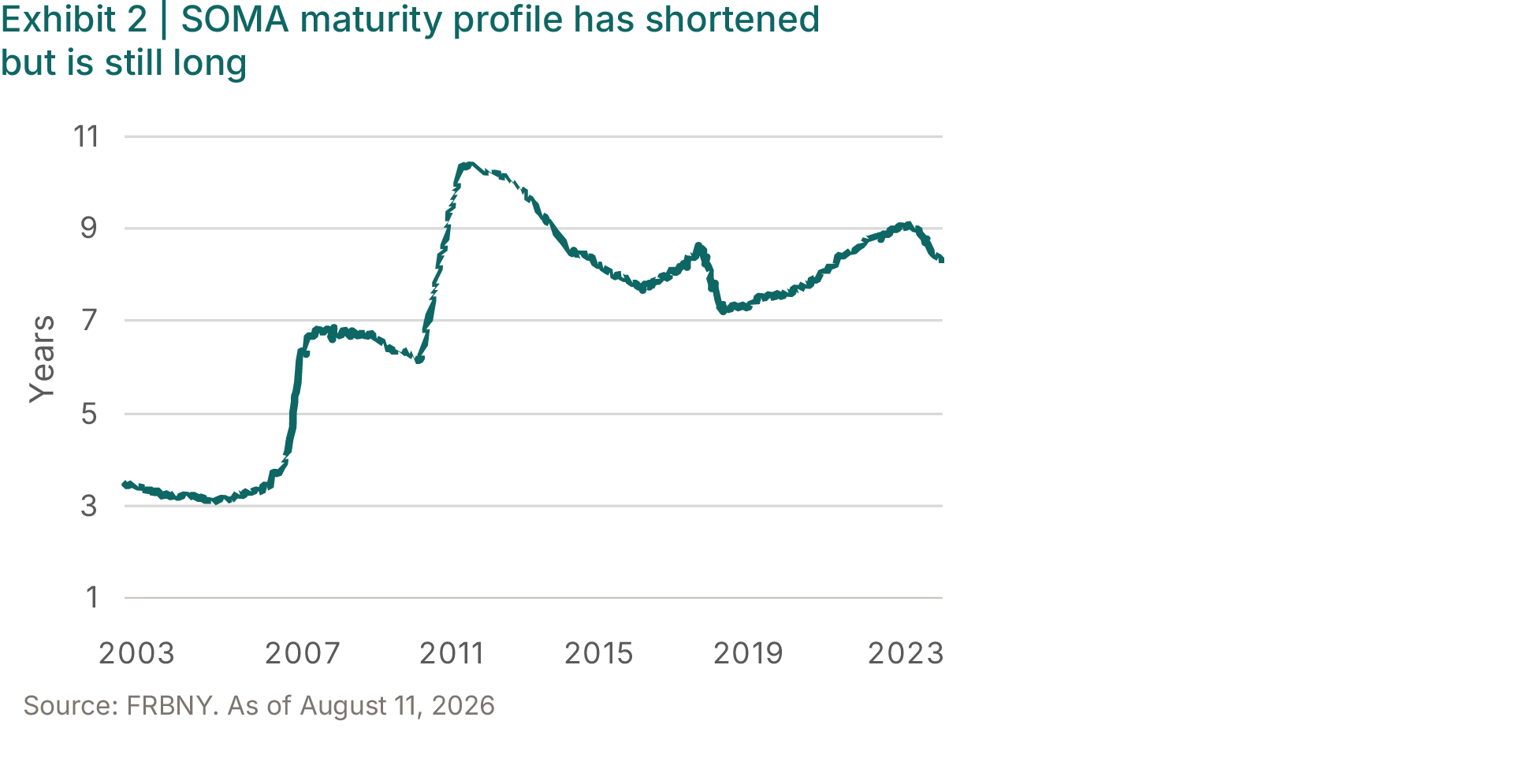
The Fed is also trying to reduce the duration of its portfolio. A shorter duration portfolio provides more flexible cash management and lower financial risk. Before the financial crisis, the System Open Market Account (SOMA) portfolio had a weighted average maturity (WAM) of approximately 3.25 years. After the pandemic, the WAM of the portfolio gradually increased from seven years to nine years before falling to just over eight years, where it sits today.
The task force is likely to evaluate adjusting the overall maturity length of the portfolio. There are a number of ways the FOMC could accelerate the process of reducing the maturity of the portfolio.
First, the Fed could allow higher roll-off caps for longer-term securities. The proportion of principal being reinvested into short-term bills also provides a lever for finer duration control. Another less traditional avenue would be to swap some longer-term assets for shorter-term ones with the Treasury.
Moving toward a Treasury-only portfolio would also help, but at the current pace of approximately $20 billion per month, it would take about eight more years for the remaining $1.9 trillion of agency mortgage-backed securities (MBS) holdings to roll off the balance sheet.
Simply selling off long-term assets would likely be difficult. With current high rates, the Fed would have to sell securities at a significant loss, and there is also the concern of making sure private demand exists for the new supply of long-duration bonds. Selling MBS could put pressure on mortgage rates and an already strained housing sector. Any change must be gradual to not disturb markets, and Chair Warsh has indicated that any moves will be well communicated.
Changing the relationship between the Fed and the Treasury
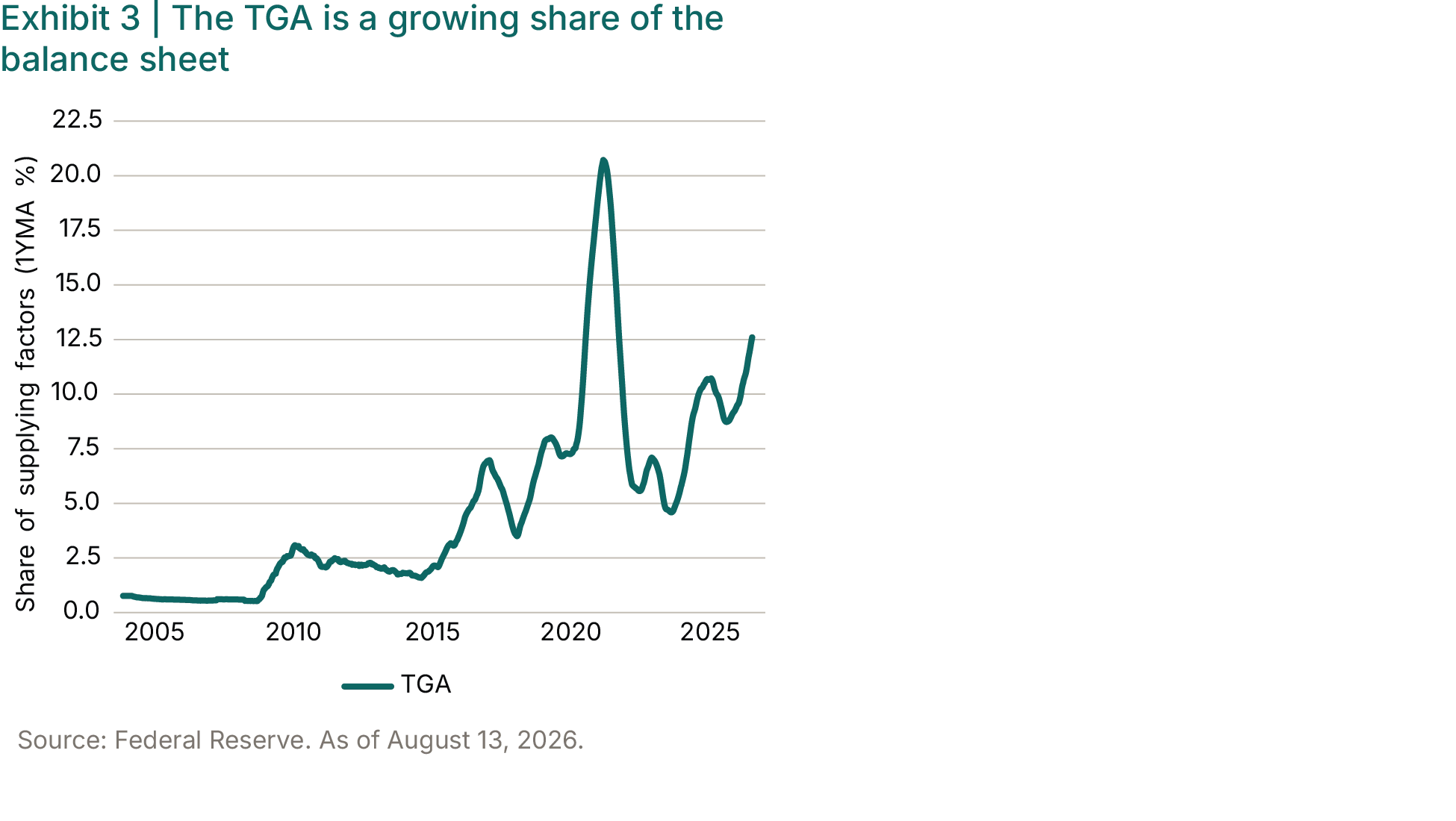
The Treasury General Account (TGA), essentially the government’s checking account, has ballooned in size. If the deficit continues to grow or political gridlock (debt ceiling and government shutdowns) problems become more severe, the cash buffer kept in the TGA may have to gradually increase as well. Since the TGA is a liability on the Fed’s balance sheet, a large TGA balance directly adds to balance sheet size. A rapidly changing TGA balance also contributes to volatility in reserve balances. Prior to the 2008 financial crisis, the TGA served more as an operational account rather than the large cash buffer it is today.
The task force will likely analyze some options to reduce the size and volatility of the TGA, but how the TGA is used is a final decision of the Treasury Department. To that end, the Fed would have to cooperate with the Treasury. That cooperation could be formalized by a new Treasury-Fed Accord, which Chairman Warsh has spoken in favor of in the past.
| U.S. | 2025† | 2026 | 2027 |
|---|---|---|---|
| GDP (avg. annual % chg.) | 2.1 | 2.4 | 2.4 |
| CPI (Dec. Y/Y % chg.) | 2.7 | 3.4 | 2.2 |
| 10-Year Treasury (EoP %) | 4.17 | 4.50 | 4.50 |
| Policy rates (upper bound, EoP %) | 3.75 | 3.75 | 3.75 |
| Unemployment (EoP %) | 4.4 | 4.3 | 4.3 |
Sources: BEA (GDP), BLS (CPI, Unemployment), Federal Reserve (10-Year Treasury and Policy Rates), MIM. As of August 2026.
† Italics denote 2025 actuals.
In August, we revised our forecast to incorporate both the economic effects of the AI investment boom and the continuing Iran conflict. For growth, we revised our 2026 forecast higher from 2.2% to 2.4%, given continued investment strength. For inflation, we increased our CPI forecast from 3.0% to 3.4%, largely a “mark-to-market” adjustment of headline inflation, given oil prices remained higher for longer than we initially expected. We continue to expect subdued core inflation. Despite weak payrolls growth, the unemployment rate remains low, and we expect this to continue at least through the end of the year.
Even with higher growth and higher inflation, we expect the Fed to remain on hold for the remainder of the year. Some tightening may take place via the balance sheet, and Chair Warsh also seems happy to let markets do some work in the form of higher long-term rates. Markets have continued to price in at least one hike by year-end, which appears to come from emphasizing the effects of oil prices. We see this as overdone.
Risks
In our previous monthly, the biggest risk to our outlook was the Iran war going on longer than initially expected and the resulting impact on oil prices also lasting longer. That risk came to pass, and we ended up revising our inflation forecast again.
The labor market getting significantly worse is a main risk to our baseline outlook. Even though payroll growth has been negative for just one month (July) so far, growth has been smaller each month since the start of the second quarter. Labor force participation has also dropped. The labor market is in a softer place than it was six months ago, even though the unemployment rate has been stable. We would expect the Fed to keep rates on hold unless there is a sudden and sharp deterioration in the labor market.