2026 Fixed Income Outlook: Stay Calm and Keep Your Carry On
Jan 04, 2026
View available investments in your area

Sorry, we couldn't find any results matching
Please:

Executive Summary:
Investors would be forgiven for worrying that credit issues may be looming. Recent isolated but high-profile bankruptcies have raised alarms that more such “cockroaches” may be hiding in the banking and private credit sectors — and have spawned fears of a more widespread “termite problem” eating away at the underlying financial system. Yet we think concern about these potential bugs in the system are likely overblown, and that the credit problems are indeed idiosyncratic and not a broader systemic concern. The one apparent common thread relates to the utilization of structured asset-backed and off-balance-sheet financings.
Our more optimistic, if still cautious, view is that credit markets and their infrastructure remain solid and will be buoyed by improving economic conditions in 2026, driven by supportive fiscal and monetary policy, U.S. tax cuts and deregulation, and, critically, ongoing AI expansion — a key area to watch.
While current tight valuations can limit upside potential in fixed income in 2026, we believe investors should stay calm and stay invested, focusing on maintaining yield and carry in portfolios rather than seeking outsized excess returns. That said, we think it’s critical to maintain a level of dry powder to deploy in the event that a pullback creates compelling opportunities.
Here we share our views on what investors should be watching across fixed income markets in 2026.
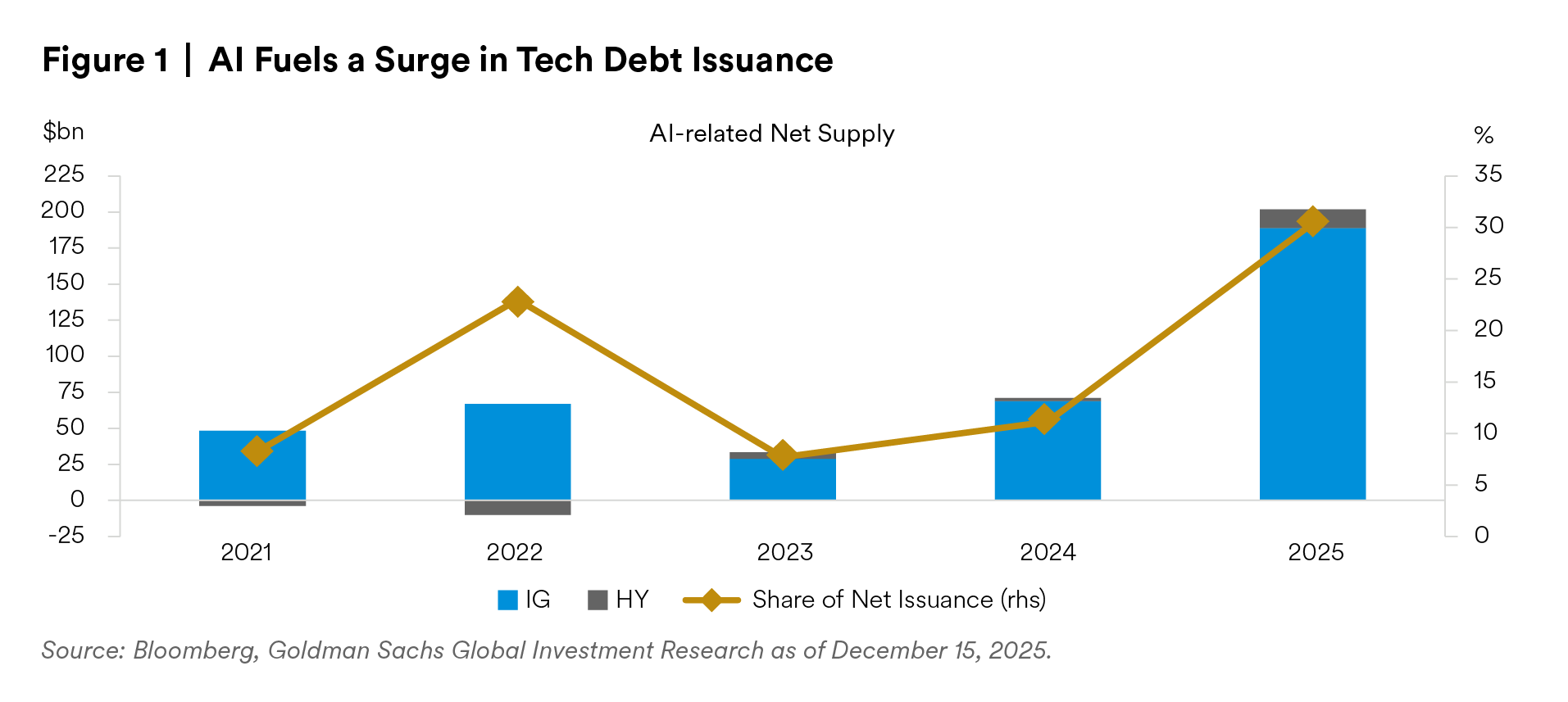
We have recently witnessed a marked shift within investment grade (IG) issuance, from the financial companies that had long dominated the market to a steep rise in tech-oriented issuers. Big Tech is beginning to fund AI build-outs with debt (particularly at the very long end) rather than relying solely on internal cash flow — a trend that could continue among technology titans and introduce correlation risk with equities due to the concentrated nature of AI investments. The explosion in AI-related issuance introduces both challenges and opportunities for investors, requiring careful fundamental security selection to identify the winners and to manage the increased risk, and we expect this theme to gain prominence as tech becomes a much larger part of the U.S. IG index.
Looking into 2026, we favor maintaining investment grade (IG) credit exposure at more neutral levels, particularly in the intermediate portion of the U.S. IG curve, which we prefer over longer durations. While U.S. credit and its underlying fundamentals have long been viewed as superior to other developed markets, the differential has been shrinking — and given the tight valuations, we think it prudent to reduce any substantial overweights to the U.S. and move toward more neutral exposures. Furthermore, the favorable credit profile and stability of investment grade, emerging market corporates could make such allocations a de-risking proposition on a strategic basis over the medium term, contrary to the false perception that they add risk.
Indeed, investors may be well served to diversify beyond U.S. government debt to include U.K. gilts, long-end Japanese government bonds, and select European and emerging market local currencies — particularly in Latin America (Brazil, Colombia, Mexico and Chile). EM investment grade debt has outperformed in 2025 and remains relatively cheap going into next year, which suggests it could offer select opportunities for attractive excess returns compared to pure U.S. credit. Notably, the banking sector across emerging markets is generally well-positioned to withstand downside risks in the global economy, and while rate cuts have reduced profitability, these cuts factor into a stable economic outlook that supports loan quality and liquidity across the system.
Our outlook on leveraged finance is broadly neutral, with high yield bonds and leveraged loans fairly valued overall, and we continue to emphasize balanced and diversified risk exposure. We believe it’s important for investors to maintain some dry powder that can be deployed opportunistically during potential market pullbacks — for instance, by holding assets such as single-A-rated CLO tranches, which offer yields comparable to those of BB-rated high yield bonds but with lower credit risk.
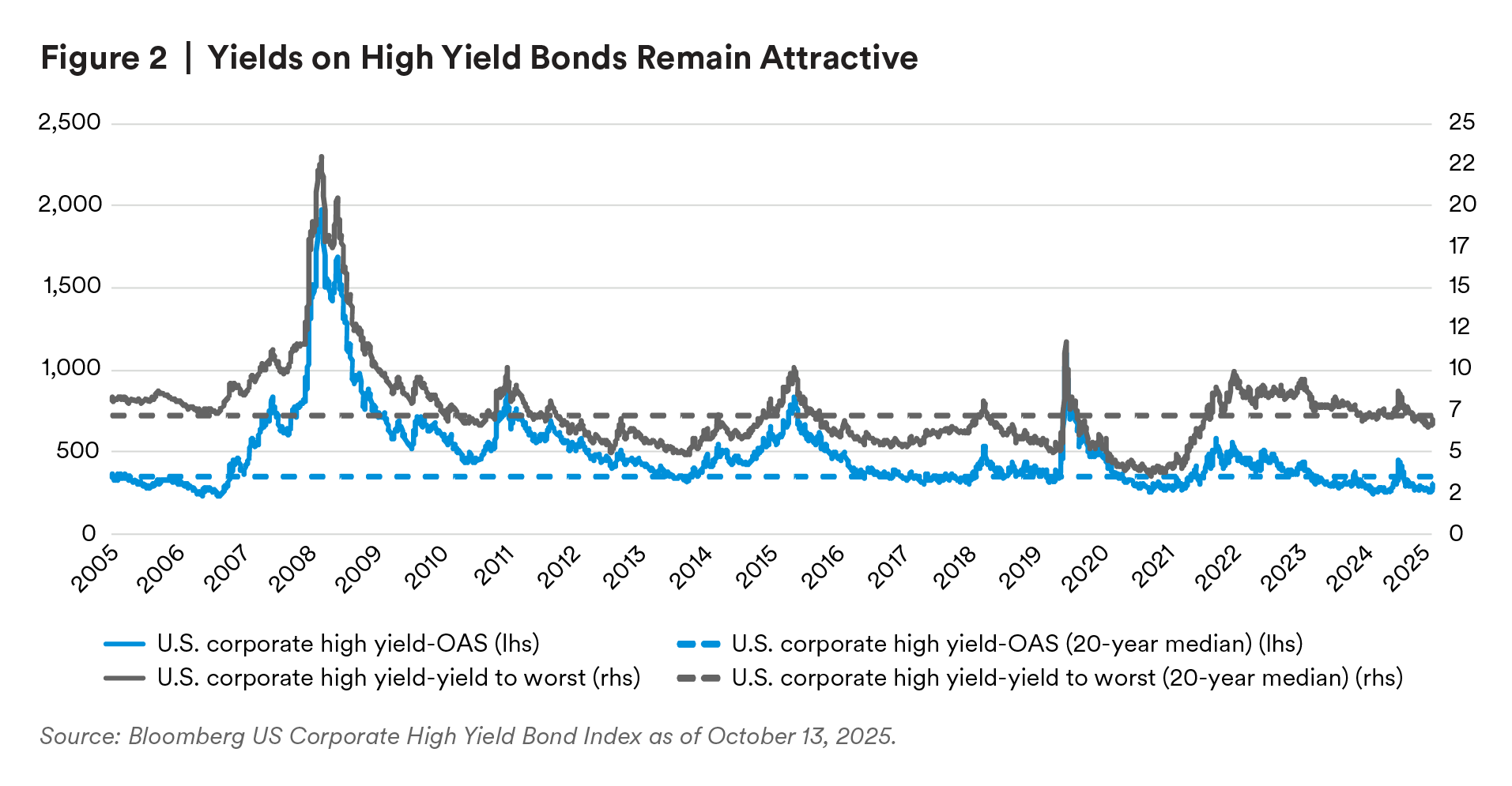
We believe high yield bonds remain an attractive asset class in a diversified portfolio, with all-in yields adequately compensating investors for credit risk amid moderate default expectations. We view valuations as broadly fair in the context of our 2026 economic outlook, which would be supportive of reasonably tight valuations.
High yield continues to offer attractive risk-adjusted yields relative to equities, where price/earnings ratios remain elevated; volatility is likely to persist; and earnings growth and capital expenditures are concentrated in a small cohort of companies. With its more compelling yields, we view the belly of the high yield market — low-BB to mid-B-rated bonds — as a sweet spot for investors, and we believe default risk remains low in aggregate and is concentrated in select companies and industries facing secular or structural pressures.
We are becoming more cautious on issuers tied to lower-income consumers, which may experience more pressure in the current K-shaped economy. Overall, we expect positive, carry-based total returns for high yield bonds (but muted excess returns) and believe defaults could tick a bit higher in 2026, albeit from low current levels.
Leveraged loan issuer fundamentals remain relatively stable, with leverage and other credit metrics on a healthy footing after multiple quarters of stable revenue and earnings growth. That said, performance for the asset class could be susceptible to shifts in top-down views on the economy’s expected trajectory due to the growth in the mid-to-low single-B segment of the market. However, the default rate, including liability management exercises (LMEs), are expected to dip slightly in 2026, and issuer fundamentals will be aided by recent and expected Fed rate cuts. However, this will reduce coupon yields and erode the current yield advantage over comparably rated high yield bonds.
The increasing dominance of CLO-related demand for loans also results in a demand gap for issuers that are downgraded to CCC, along with the emergence of a K-shaped market appetite for loans. If loan spreads were to widen more broadly — for instance, as a result of severely negative sentiment related to the job market or consumer health — we would expect increased opportunities to generate alpha through credit selection. However, any downside surprises in economic activity versus current forecasts would most likely justify further rate cuts, providing additional relief for issuer fundamentals.
While loans underperformed other fixed income assets in 2025 due to the lack of yield curve benefit, our expectation is that loans will be among the top fixed income assets once again in 2026.
In European loans and high yield, the underlying picture is more nuanced, with dispersion widening as the market increasingly splits between resilient issuers and a growing tail of credits under pressure. Weakness is most evident in sectors such as chemicals and building materials, where earnings softness persists, and among highly leveraged names facing the prospect of a default or LME. Yet despite increasing idiosyncratic volatility, we expect the broader market to continue to tick along steadily, and limited refinancing pressure should keep defaults contained. European loans plot as among the most attractive fixed income assets for 2026, but challenging liquidity and negative convexity for a sizable portion of the market persist.
We believe CLOs offer attractive opportunities to maintain carry relative to other equivalently rated, fixed income assets amid current conditions. Institutional demand for CLOs remains robust, and CLO ETFs saw more than 20 consecutive weeks of inflows through mid-October before experiencing some reversals heading into year-end. Despite likely headline-driven volatility in the coming months, we believe risks are balanced, though tight valuations tilt us toward an incrementally more defensive bias. We believe a nimble and robust bottom-up approach to security selection is paramount, given the dispersion in the loan market, in which certain CLO portfolios holding weaker credits may eventually experience impairments to the lowest-rated debt tranches — which could result in attractive opportunities to move down the capital stack.
Fixed income markets tend to thrive in periods of low and steady growth, without extremes — conditions that align with our supportive central-case scenario for 2026.
While we will be keeping an eye to structural shifts and emerging risks in credit markets — particularly the impact of AI-related issuance and stress in lower-income segments — we think investors need not be alarmed by idiosyncratic credit issues, or fear that they portend a credit cycle explosion. We view such an outcome as highly unlikely barring a major economic downturn (which we likewise don’t expect).
In a market that we view as fairly priced and stable, fixed income investors will benefit from a cautious but constructive approach that balances yield retention with diversification across geographies and sectors.