Relative Value & Tactical Asset Allocation
Q4 2026
Sep 2026
View available investments in your area

Sorry, we couldn't find any results matching
Please:

Key takeaways
Geopolitical risk on the rise again, shadowing the “hinge” economy
The Market Strategy team expects 2026 growth in the United States to outpace the growth seen in 2025 and looks for that growth to continue into 2027. With inflation likely to remain elevated over the next few quarters and policymaker patience wearing thin, it seems likely that the Federal Reserve will move to raise the policy rate in September. While the rate increase is unlikely to have an impact on inflation, it does increase the risk to the growth outlook.
Two main components are driving growth: investments in artificial intelligence (AI) infrastructure and consumer spending. However, the latter driver is also likely an indirect result of the former—the technology-driven equity wealth effect that is offsetting weak consumer sentiment and expectations for negative real income growth among all income cohorts. With other areas of the economy, such as housing, still acting as a drag on activity, the AI trade is the hinge upon which growth rests.
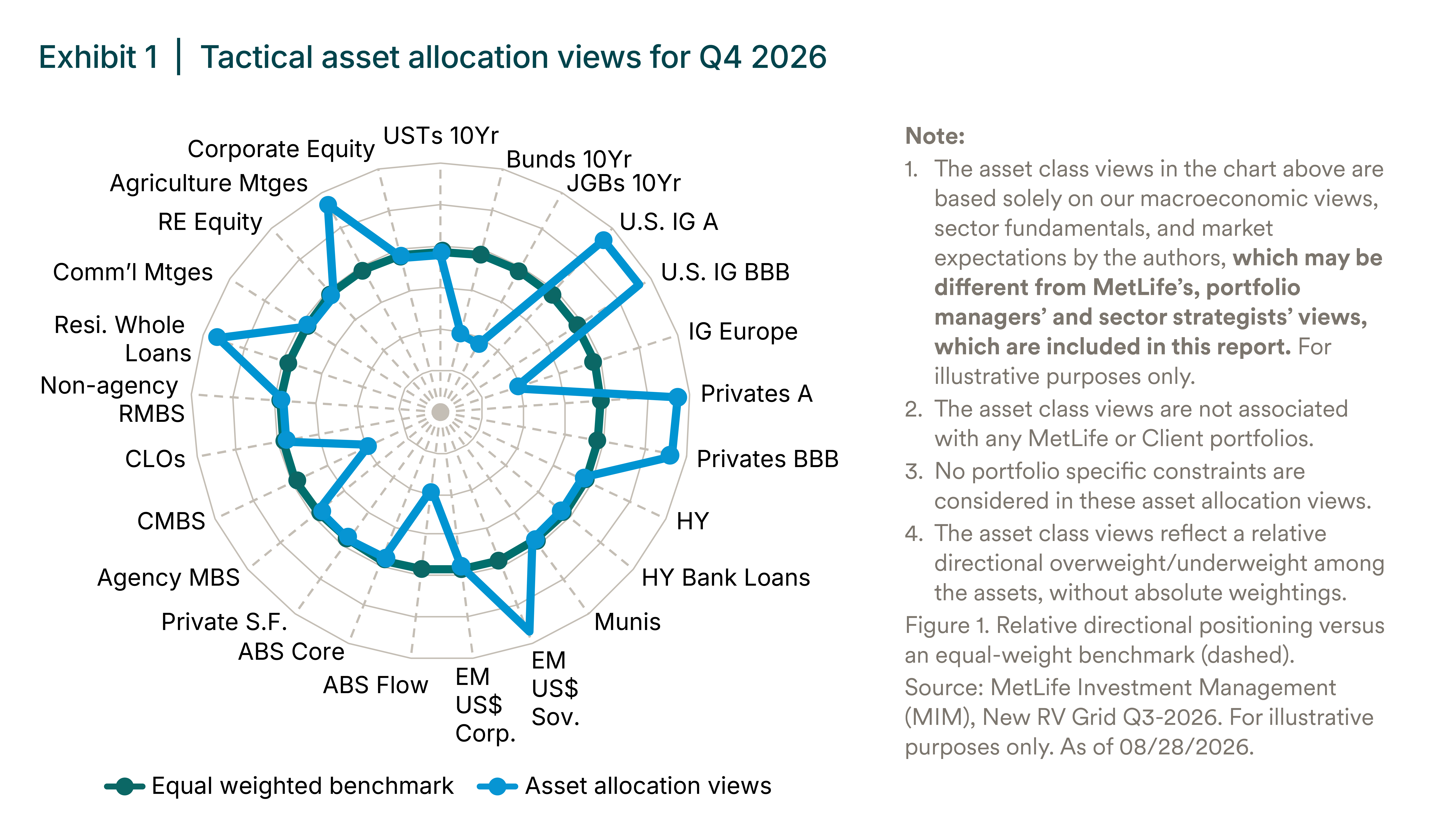
Against this backdrop, our portfolio posture is to earn carry that is up in quality: Overweight the sectors where all-in yields and fundamentals still compensate for the risk—U.S. investment grade (IG, public and private), emerging market (EM) sovereigns, residential whole loans and agricultural mortgages—while underweighting low-spread, rate- and convexity-sensitive sectors with asymmetric downside, such as German Bunds, JGBs, European IG, CMBS, flow ABS and cash.
Global growth holds firm as energy risks linger
United States
The August employment report pointed to a labor market rebounding from its longer-term gradual loss of momentum. Hiring improved from the recent soft patch and broadened across several sectors, while manufacturing and construction remained steady. Wage growth continued to moderate, limiting near-term inflation concerns, and a longer work week supported household income. The shift from part-time to full-time employment was also encouraging, although job creation remains modest by historical standards.
Broader indicators suggest a low-fire, low-hire environment: Unemployment remains contained and workforce participation has improved, but longer job searches point to reduced labor-market dynamism.
This backdrop supports continued consumer spending without signaling renewed wage pressure.
Europe—Euro area & UK
Euro area: Euro-area growth has proved more resilient than implied by the first-quarter soft patch. After growth in the first quarter contracted, second-quarter growth rebounded, keeping MIM’s 0.9%, above-consensus forecast for 2026 intact. The growth mix across countries remains unbalanced. MIM has have raised our euro area inflation forecast again, as the Iran conflict and resultant energy price pressures have dragged on. Headline inflation re- accelerated to 3.3% in August (the highest since 2023) and should stay elevatedinto winter, with gas prices pushing inflation toward the European Central Bank’s (ECB) more adverse scenarios even as core inflation stays contained near 2.4%. Food price pressure is also in the pipeline.
UK: The recent downside inflation surprise (favorable base effects and a lower regulated energy cap) is set to reverse. MIM expects U.K. inflation to peak near 3.5% by year-end. MIM has stepped back from expectations of Bank of England (BOE) hikes. The base case is now for the BOE to hold at 3.75% through 2026. MIM views market pricing of multiple policy rate increases as too hawkish. However, there continues to be a near-term hike risk should Middle East tensions remain. Growth remains weaker than the prior two years, leaving a “stagflation-lite” scenario as the main risk until growth firms and inflation eases in 2027. All that said, we have revised our 10-year gilt forecast up to 5.2% from 4.95% previously given the broad-based re-pricing of global developed market bond yields.
Asia—China, Japan and the region
China: China’s economy remains distinctly two-tracked. On one track, an AI-driven industrial upswing continues to support growth. Strong gains in semiconductors, electronics, robotics and new-energy vehicle production are boosting exports and manufacturing activity. Investment is increasingly concentrated in technology, telecommunications and intellectual property-related sectors, reinforcing the resilience of the industrial and external sectors.
On the other track, domestic demand remains weak. Consumption has softened, investment momentum outside strategic sectors continues to deteriorate and persistent labor market and property sector pressures are weighing on household confidence and spending. The property downturn remains the largest drag on growth, while consumer demand has yet to meaningfully recover.
Recent GDP prints have fallen short of expectations. Inflation was temporarily higher due to higher oil prices, semiconductors and equities—which helped push the Q2 GDP deflator back into positive territory (+1.6% year over year) for the first time since Q1 2023. Despite the softer growth backdrop, MIM maintains the full-year GDP forecast of 4.7% YoY. MIM expects Beijing to deliver additional targeted policy support rather than a large-scale stimulus package, with measures likely focused on employment, consumption and strategic investment. Ten-year government bonds have been trading in a tight range of 1.65%-1.8%. While USDCNY is expected to remain on a managed appreciation trend, it is trading close to MIM’s year-end target of 6.70.
Meanwhile, the Middle East conflict presents manageable, though not insignificant, risks. China’s diversified crude oil import sources, substantial strategic reserves and limited direct exposure to supply disruptions should help cushion the impact. On trade, the ongoing U.S. Section 301 review could result in tariffs on Chinese goods that are higher than those imposed during the International Emergency Economic Powers Act (IEEPA) period. Meanwhile, EU China trade tensions continue to rise. Both sides have agreed to a three-month consultation period running through October, although such a short consultation window is unlikely to materially reduce the structural trade imbalance between the two economies. The most likely outcome is continued dialogue alongside a gradual intensification of EU trade-defense measures.
Asia: Strong AI-related demand and the gradual normalization of energy supply chains should continue to support Asia’s growth outlook. We expect Taiwan, Malaysia and Singapore to outperform regional peers while it remains cautious on Indonesia, the Philippines and Thailand. Earnings growth has held up remarkably well in India, despite an oil shock. Moderation in oil prices would be supportive for inflation dynamics, although El Niño-related weather disruptions pose upside risks to food prices. Monetary policy trajectories are likely to remain uneven across the region.
LatAm: Latin America remains resilient, but uneven. Regional growth is expected to dip marginally in 2026 versus 2025. Mexico, Colombia and Peru are expected to outperform while Brazil slows and Chile lags. Inflation is broadly stabilizing, but dispersion remains wide. Country-specific fiscal, supply and political factors now drive more differentiation than commodity exposure.
Monetary policy paths have begun to diverge: Brazil has begun easing while Chile and Mexico are on hold. The external backdrop remains adverse, with Middle East tensions, elevated global yields and a strengthening El Niño lifting energy, food, freight and financing risks. Key catalysts through year-end are Brazil’s election, El Niño’s impact on Andean supply chains and Panama Canal capacity, and any renewed energy-price increases. Overall, weak trend growth and insufficient primary balances continue to limit debt-ratio improvement and keep sovereign-credit risks elevated.
Sovereigns still offer limited compensation
U.S. Treasuries (UST)
Market Strategy continues to expect the Federal Reserve to hike in September and potentially do one more hike by year-end given the weakness in housing, contained inflation expectations (despite elevated inflation) and the lack of a clear channel through which more hikes in the short end would limit any further yield increases in the long end of the yield curve.
With inflation likely to ebb a bit into year-end and ongoing geopolitical concerns, Market Strategy expects 10-year yields to end 2026 at 4.75%, on the edge of the “sweet spot” for yields that minimizes consumer savings/maximizes consumer spending.
The position of yields makes Federal Reserve decision-making even more pivotal. Policy rate increases that shift the expected average short-term rate will only result in higher long-end rates, which will move those rates off of the previously noted “sweet spot” and increase downside risks related to the consumer and, through the consumer, the entire economy.
Market Strategy sees a risk that the policy rate increase out of the Federal Reserve proves counterproductive, inhibiting growth while doing nothing to reduce inflation pressures. This could result in additional hikes that are likely to have the same one-sided effects, further elevating the risk of recession.
German bunds
MIM has turned more hawkish on the ECB. After June’s hike and September’s follow-on hike to 2.50%, MIM expects one additional hike by year-end as energy-driven, higher-for-longer inflation keeps risks tilted toward rate increases. We do not rule out a further hike if Middle East tensions do not stabilize near term. Our current year-end 10-year Bund forecast of 3.50% remains in place but acknowledge the risk of overshoot given the current growth and inflationary backdrop.
Japanese government bonds
MIM has turned more hawkish on the ECB. After June’s hike and September’s follow-on hike to 2.50%, MIM expects one additional hike by year-end as energy-driven, higher-for-longer inflation keeps risks tilted toward rate increases. MIM does not rule out a further hike if Middle East tensions do not stabilize near-term. The current year-end 10-year Bund forecast of 3.50% remains in place, but MIM acknowledges the risk of overshoot given the current growth and inflationary backdrop.
Credit: Look for high-quality, not incremental spreads
Macro credit overview
Current credit cycle conditions have improved from the last quarter, including high yield (HY) option-adjusted spreads (OAS), the 3-month/10-year spread and corporate profits. In addition, Fed policy has remained accommodative. Senior Loan Officer Survey data from the Federal Reserve, U.S. default rates and debt growth have all worsened.
U.S. IG and HY fundamentals from Capital IQ remain resilient, with second-quarter earnings per share having increased 33% (+28% ex-energy), a much stronger rate of growth than the first quarter and higher than the market expectation of a 22% increase. Expectations for full-year 2026 earnings have also been raised. The notable soft spot is the IG free-cash-flow-to-total-debt ratio, which has reversed four consecutive quarters of decline but remains below its long-term average. One troubling indicator is that the U.S. default rate has continued to rise after passing our 5% alert threshold. Moody’s expects U.S. speculative-grade defaults to continue a downward trend in 2026 and to fall to 2.3% from the current 5.2% rate over the next year.
In terms of the rating migration outlook, Moody’s sees a higher rising-star probability in the highest segments and, overall, more upgrades than downgrades.
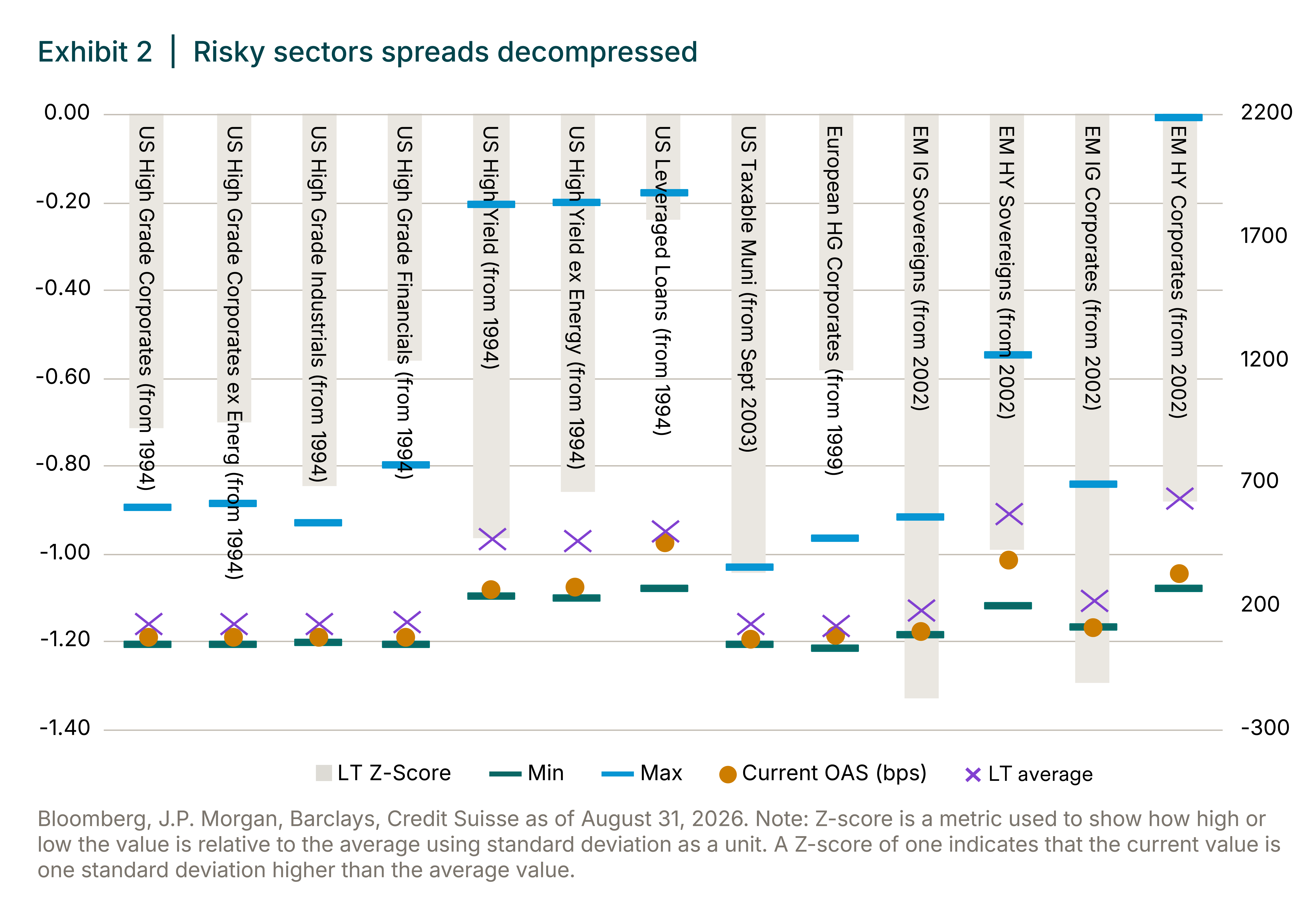
Spreads are compressing in IG, munis and especially in EM IG corporate bonds; those spreads went to an all-time low since data became available in 2002. Leveraged loans are more attractive compared to HY from a valuation perspective (Exhibit 2).
U.S. IG
IG spreads remain near all-time tights even with record supply ($1.487 trillion YTD), as strong demand continues to absorb the massive amounts of issuance coming to market. Coinciding with this, higher Treasury yields across the curve have also been a key factor driving yield-oriented demand.
Geopolitical risk is back in focus with news surrounding the war between Iran and the United States dominating headlines. Continual flare-ups have impacted commodity prices and caused concern over supply chain logistics, which creates a trickle down on inputs and drives prices higher across commodities. Elsewhere, so-called hyperscaler issuance and the buildout of AI data centers and infrastructure are additional areas of focus. Over the summer months, several large deals came to market in the IG space, further inflating supply. We expect this trend to continue.
Valuations still appear rich relative to history and suggest the market may be susceptible to negative catalysts in the near term. It has become evident that U.S. Federal Reserve Chair Kevin Warsh has a difficult situation ahead of him as we approach the FOMC meeting and the market prices in a hike this September. Despite this, underlying credit fundamentals have remained strong. We continue to favor a selective, defensive approach to portfolio construction with an emphasis on credit selection amid rich valuations and an unbalanced risk/reward profile.
European IG
European earnings growth remained resilient through the second quarter, with continued support from Financials and Energy, although performance across cyclical sectors remained mixed as investors balanced improving fundamentals against macro uncertainty. Credit spreads experienced periods of volatility during the second quarter but generally remained near historically tight levels. While spread dispersion across rating buckets persisted, market technicals and strong demand for high-quality credit continued to support valuations. Second-quarter euro OAS spreads reversed most of the 19-basis-point (bp) widening seen during the first quarter, opening at 97 bps and closing at 80 bps. Euro IG primary issuance remained vigorous in the second quarter at €224 billion, supported by refinancing activity, strategic funding requirements and continued participation from hyperscalers. Supply was readily absorbed, underscoring the strength of investor demand despite a rich valuation backdrop. Ratings momentum remained broadly constructive, with balance sheet discipline, deleveraging efforts and stable operating performance continuing to underpin the credit quality of European IG issuers. The positive momentum remained strong across most euro IG sectors, with the benchmark upgrade/downgrade ratio at 4.6x for the second quarter.
Despite supportive fundamentals and strong technical conditions, European IG spreads remain near post-Global Financial Crisis tights. Given ongoing geopolitical, fiscal and macroeconomic risks, MIM continues to favor adding exposure selectively in higher-quality issuers rather than pursuing incremental yield in lower-rated credits.
Investors continue to remain wary of adding in long duration, given the ongoing rates weakening, both in U.K. gilts and euro-denominated benchmarks. Overall, MIM remains cautious—underweight—on EU IG, preferring to add only in quality names rather than chase spread or yield at current levels. Even after taking into account the yield boost from swap euro to USD, MIM still expects EU IG to underperform.
U.S. HY
Overall, MIM remains constructive on the HY bond market and expects a carry-like return for the balance of the year. Elevated Treasury yields, higher oil prices and the conflict in the Middle East have introduced uncertainty and volatility into the markets. While the length of the war will have an impact on the global economy and financial markets, the HY asset class remains supported by a resilient U.S. economy, strong corporate earnings and stable credit fundamentals. The new issue market also remains healthy, with expectations for 2026 volume to exceed last year’s strong issuance. Increasing AI supply will continue to be a headwind for the credit markets as investors navigate this growing segment of the market. While spreads remain at or near all-time tights, overall yields remain at or above long-term averages, compensating investors given the supportive credit backdrop. Given rich valuations relative to loans, MIM remains neutral on U.S. HY.
Leveraged loans / bank loans
MIM maintains a preference for an up-in-quality approach within leveraged loans. A moderate, but resilient, economic backdrop, coupled with expectations that policy rates could be higher for longer than previously anticipated, should continue to support the asset class through strong floating-rate income. Elevated SOFR and a higher forward rate path enhance the carry profile of loans, even as spread compression limits further price appreciation. Loan market technicals remain favorable, driven by robust CLO demand, healthy capital market access and improving corporate confidence. While refinancing activity continues to dominate issuance, MIM expects M&A, sponsor-backed transactions and capital-raising activity to gradually increase as earnings growth improves and regulatory uncertainty eases. Given current valuations, strategists generally expect a carry-driven year for loans in 2026. As corporate activity accelerates and leverage appetite increases, MIM believes an up-in-quality approach remains the most prudent strategy, emphasizing issuers with durable cash flows, strong liquidity and manageable leverage profiles to participate in attractive income while limiting downside risk. On balance, MIM remains neutral on bank loans.
Municipals
Fixed-income markets remained resilient in the second quarter despite persistent inflation, geopolitical risk, elevated deficits and policy uncertainty. Higher absolute yields continued to attract demand and compress IG spreads. The Bloomberg Taxable Municipal Index yielded 5.12% at quarter-end—an 87th-percentile level over 10 years—while spreads stood near historic tights. Higher Treasury rates and tighter spreads have generally offset each other. MIM expects taxable municipal spreads to remain range-bound in the next quarter, supported by limited net issuance, attractive yields and sound credit fundamentals. With spreads near historic tights, interest rates—not spread compression—are likely to drive returns. In MIM’s view, inflation, Federal Reserve policy, heavy corporate issuance and geopolitical developments remain the principal sources of volatility.
Given limited compensation for liquidity, structural and lower-quality risk, MIM continues to favor larger, liquid issues with strong fundamentals, predictable cash flows and limited optionality. In tax-exempts, stretched valuations limit upside, although favorable summer technicals should contain downside. Absent a sharp rate move, opportunities for corporate-taxed institutional investors remain scarce. Overall, MIM remains neutral on municipals.
Emerging markets—sovereigns & corporates
EM assets have remained resilient, and the global capex cycle provides a further tailwind for parts of the universe.

Sovereign fundamentals are broadly stable to improving (Exhibit 3), underpinned by fiscal discipline, credible monetary policy, stronger external balances, reform momentum and engagement with multilateral institutions. These trends support market access and create potential for additional ratings upgrades and rising stars. EM corporate and financial balance sheets also remain sound: refinancing risk has declined, maturity profiles have lengthened, leverage is manageable, free cash flow remains supportive and bank capital is solid. Although earnings growth is moderating, measured capital spending and investment linked to global capex should benefit selected industries and commodity exporters.
Technicals remain constructive but more balanced after strong performance. Issuance has been readily absorbed, expected sovereign supply appears manageable and EM debt remains under-owned by many global investors. Despite tighter spreads, EM credit continues to offer attractive yields and relative value versus developed markets, including favorable spread per turn of leverage. MIM therefore remains focused on long-term fundamentals and selective risk-taking, recognizing that U.S. dollar strength and Treasury volatility may create near-term swings while carry, improving credit quality and limited net supply support the medium-term outlook.
Structured products: Favor the structure, not the spread
Asset-backed securities—flow & core
ABS: Asset-backed securities issuance remains exceptionally strong, with second-quarter volume equal to roughly 120% of the comparable 2025 level, supported by robust investor demand and putting the market on pace for record 2026 supply. Unsecured consumer issuance has also been active year to date, while digital infrastructure financing is also on the rise. Consumer spending remains resilient, but it is increasingly being funded at the expense of savings—the personal savings rate is moving back toward its 2022 lows at roughly 3.0%, compared with 2.2% at the trough. Against this backdrop, ABS supply is outpacing 2025 and fundamentals are mixed: The consumer outlook is weakening, while commercial fundamentals remain neutral. Valuations are broadly neutral, warranting a selective, up-in-quality bias across both ratings and shelves. Portfolio emphasis should remain on large, established franchises with consistent growth and transactions backed by prime borrowers. Exposure should be limited in consumer sectors that depend heavily on discretionary spending, as well as in subordinated classes issued by weaker sponsors or newer platforms. Key areas to monitor include the accelerating data center supply pipeline and possible public pushback, rising delinquency trends among non-prime borrowers and broader affordability pressures that could weaken household credit performance. MIM remains underweight in the ABS sector.
Private asset-backed finance (ABF)
Private ABF remained in an expansion mode through the summer, but investors have grown more selective. The quality of the collateral, sponsors’ track records and the structure of each deal now matter far more than the broader market trend—and while capital continues to flow into private ABF, most of that demand is concentrated in sectors backed by hard, low-obsolescence (HALO) collateral.Consumer ABS remains the softest area from a credit standpoint, as the bifurcated, “K-shaped” economy weighs disproportionately on lower-income borrowers. MIM has therefore maintained a deliberately defensive posture, favoring stronger, repeat sponsors, higher-quality collateral and spread levels sufficient to absorb loss curves well in excess of base-case expectations. That stance mirrors the broader structured finance market, where demand has concentrated in senior tranches and appetite for subordinated risk has become almost entirely collateral-specific.
The same selectivity is playing out across the private mortgage and fund finance markets. Within private mortgage credit, we continue to see steady private RMBS issuance backed by non-agency collateral, along with a growing volume of CMBS migrating to the private market as commercial real estate works through a historic refinancing cycle—a dynamic that is opening meaningful origination opportunities. In fund finance, issuance remains robust as constrained exit markets lead GPs and LPs to pursue liquidity solutions rather than forced asset sales. Pricing remains tight across each of the private ABF subsectors in which we participate.
In summary, liquidity and investor demand remain deep. Risks appear to be increasingly concentrated in consumer credit, where subprime collateral is exhibiting the greatest stress. Recent high-profile originator failures have also introduced renewed caution around originator and warehouse risk. As disciplined participants, MIM remains focused on well-collateralized exposures and on originating collateral with sound structural protections and adequate advance-rate cushion, rather than reaching for incremental spread in the more richly valued, lightly covenanted corners of the market. In an environment of compressed pricing, MIM believes disciplined structure and collateral selection—not spread-chasing—will ultimately protect our returns. MIM remains neutral on private ABF.
CMBS: Commercial mortgage-backed securities issuance remained strong in the second quarter, at 115% of the comparable 2025 level, with full-year volume expected to reach a post-crisis high. Non-agency supply is running roughly 25% above 2025, and CMBS representation in the broader index is no longer declining, although it remains modest at approximately 1.4% versus a historical peak near 6%. Conduit exposure now accounts for less than 1% of the index.
Despite the healthy issuance backdrop, credit stress persists, with the KBRA distress rate above 10% and delinquency pressure continuing across challenged properties. Multifamily stress is also increasing, although it remains more concentrated in agency product. Overall fundamentals are neutral, while valuations are neutral to negative, supporting a selective approach focused on junior AAA and AA tranches from high-quality, new-vintage transactions, duration additions through agency CMBS and strong single-asset, single-borrower deals. Exposure should be limited in subordinated tranches from selected conduit shelves and in transactions with sizable office or retail concentrations, where refinancing and property-level risks remain elevated. Key areas to monitor include further rating downgrades, sponsor decisions to relinquish properties rather than inject additional capital and servicer advances, which may signal increasing pressure on troubled loans and influence the timing and severity of realized losses. Overall, MIM remains underweight in CMBS.
CLO: Collateralized loan obligation activity remained healthy in the second quarter, with new issuance equal to approximately 89% of the comparable 2025 level, alongside middle-market issuance. Refinancing and reset volume also increased sharply from the first quarter. Underlying transaction metrics remain sound. However, declining weighted-average spreads remain a concern for equity distributions. The NAIC has finalized its methodology, introducing a 4% threshold and bringing middle-market CLOs, CBOs and CDOs within the broader CLO framework. From a relative value perspective, AAA CLOs continue to offer the highest spread-to-RBC ratio among floating-rate investments, while A2-rated tranches remain an area of particular opportunity. Overall supply is trailing 2025 despite the second-quarter pickup in refinancings and resets, and both fundamentals and valuations are neutral. Portfolio emphasis should remain on top-tier managers in middle-market CLOs, longer non-call structures in new issues and discounted secondary market tranches. Exposure should be limited to newer, less-liquid platforms and deals with outsized software sector concentrations. Key areas to monitor include ETF-related flows, the approaching software maturity wall and the potential impact of the NAIC framework on BBB and BB spreads. Overall, MIM believes that the CLO sector will offer comparable returns.
MBS
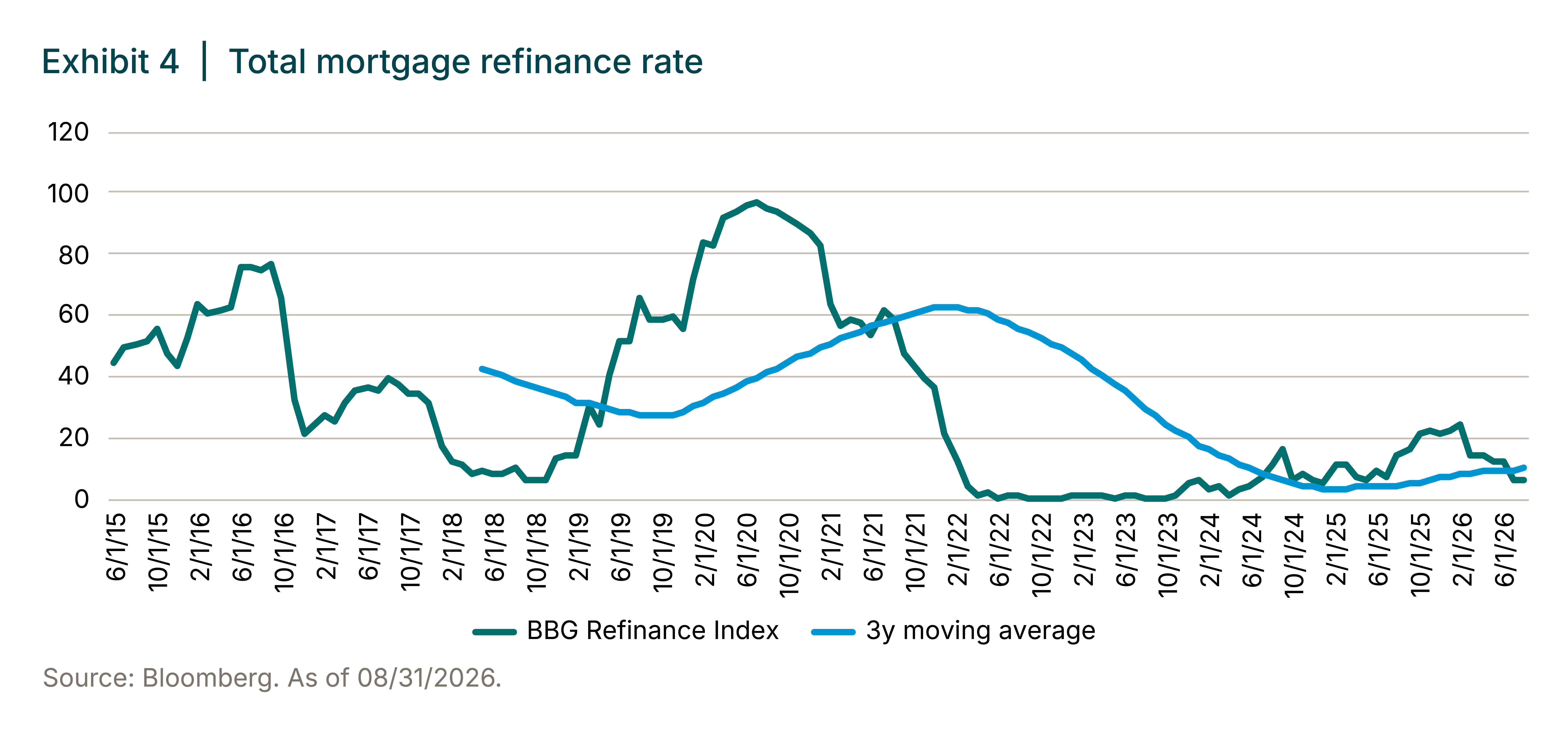
Agency RMBS: Agency mortgage-backed securities supply is broadly tracking 2025 levels, although net issuance picked up during the second quarter. Persistently high mortgage rates continue to constrain housing affordability, refinancing activity (Exhibit 4) and borrower mobility, even as home price appreciation remains positive. Against this backdrop, agency RMBS fundamentals and valuations are positive, supporting an emphasis on seasoned collateral across the coupon stack, lower-pay-up stories that are less exposed to elevated dollar-roll volatility and deep-discount, last-cash-flow CMOs. Exposure should be limited to higher-pay-up pools backed by new production, GNMA collateral and lower-capped floaters, where extension and structural risks may be less favorably compensated. Key areas to monitor include extension risk in newer vintages, refinancing activity and housing turnover trends, all of which will influence prepayment behavior, duration and relative-value opportunities across the sector. MIM upgraded the agency RMBS sector from underweight to neutral.
Non-agency RMBS: Non-agency issuance remained robust in the second quarter at approximately 146% of the comparable 2025 level and roughly 50% above last year. Non-qualified mortgage issuance is running at about twice the 2025 pace, while closed-end, second-lien supply is expanding rapidly year to date. Periodic supply surges have pressured AAA spreads, but underlying credit performance remains exceptionally strong and has helped keep credit spreads tight. Fundamentals and valuations are therefore neutral, favoring selective exposure to agency-eligible and investor senior mezzanine tranches, opportunistic positions in non-QM and jumbo subordinate bonds and closed end second-lien transactions. Exposure should be limited in structures with barbelled prime and non-QM collateral, non-QM pools containing elevated jumbo-loan concentrations and HELOC or home-equity investment products. Key areas to monitor include rising net supply in both non-QM and prime sectors and geographic concentrations in regions exposed to natural disasters, which could challenge collateral performance and technical conditions. Overall, MIM remains neutral in non-agency RMBS and inclining tooverweights if not for the compressed spreads.
Residential whole loans
Residential whole loan markets continue to stay steady with ever-increasing demand for the assets, along with support from stable housing fundamentals. The demand is growing, given the control investors have over the investment, which allows investors to navigate any regional softness in housing or specific loan markets. Delinquencies remain low, with borrowers protecting a stable equity position in their properties. Despite higher lending rates, supply in non-agency loans continues to grow, and MIM sees sufficient supply relative to demand.
Spreads for residential whole loans and single-family rental debt financing continue to offer strong relative value versus public residential credit opportunities, with loss-adjusted spreads in the high 100s on a blended basis. MIM remains overweight on residential whole loans.
Commercial real estate and CML continue their recovery
Commercial mortgages (CML) | Real estate equity
Real estate loans: There has not been much change to commercial real estate (CRE) fundamentals. The 2021–2024 inflation surge raised development and financing costs, and construction starts have fallen sharply across most CRE sectors, reducing future supply growth and supporting occupancy, rent growth and values. Office remains the weakest property type but continues to recover, with Q2 2026 vacancy down 20 bps quarter over quarter (QoQ) to 18.4%, while retail (6.8%) and industrial (9.2%) vacancies remain near stable levels. Valuations also are similar to last quarter: Little has changed in the more liquid segments of the CML universe, though stronger relative value is available further down the capital structure in mezzanine debt and preferred equity. Technicals remain relatively attractive as debt capital markets remain strong and new originations continue to tick up—according to the American Council of Life Insurers, life insurance companies originated $17.2 billion of commercial mortgages in Q2 2026, a 1% increase over Q2 2025 and the highest quarterly volume since 1Q22.1
Real estate equity: Fundamentals have begun moderating in sectors such as apartments and industrial, while office occupancy has bottomed and is now moving upward. Apartment vacancy fell to 8.1%, still above the 6.9% historical average, but sharply lower construction starts should limit 2026–2027 deliveries and support recovery. Industrial vacancy edged down to 9.2% on a shrinking pipeline, retail held flat at 6.8% near historic lows and hotel RevPAR grew 1.8% YoY, with occupancy at its highest level since Q2 2024. Valuations are fair; unlevered equity discount rates have been slow to adjust to rising bond yields, but measured against Baa corporate yields plus 200 bps, we believe real estate equity is fairly priced. Technicals improved from the last quarter as transaction volume improves from low levels: 2025 volume was 27% above 2024, volumes through the first seven months of 2026 are 33.6% higher than 2025 and MIM expects full-year 2026 to finish roughly 30% above 2025. Overall, MIM rates both real estate loans and equity as neutral.
Agricultural mortgages
MIM remains overweight on agricultural mortgages, which offer attractive carry and valuable portfolio diversification against a backdrop of stabilizing fundamentals. Valuations and technicals are all similar to last quarter. The U.S. Department of Agriculture projects 2026 net farm income of $158 billion, a $4.2 billion decline from 2025 but still 29% above the 40-year inflation-adjusted average. Annual crop prices sit at three-year highs, and OBBBA enhanced government payments of more than $45 billion will support grower incomes, though elevated input costs continue to pressure margins. Livestock profitability remains favorable on historically strong cattle pricing, and tree nuts have returned to profitability, while wine grapes and Pacific Northwest tree fruits lag. Agribusiness margins are near historical averages as a three-year destocking cycle ends, and timberland values keep rising on long-term housing demand. MIM’s 12-month rolling agricultural spread is 15 bps tighter YoY and roughly 12 bps below its 10 year average, with spreads on new production above 200 bps, unchanged from last quarter. Farmland appreciation slowed to 3.3% YoY, and Farm Credit System delinquencies edged up to 1.03% in Q2 2026, while agricultural mortgage volume growth continues to rebound and should keep expanding as credit demand recovers.
Equities: downside risk lingering
Corporate equity / S&P 500
We expect the S&P 500 to remain rangebound over the next quarter, with downside risks outweighing upside potential. The Federal Reserve’s path is unusually uncertain: Persistent inflation could extend restrictive policy, while softer growth or labor data could still revive the case for easing. Middle East developments add another unpredictable risk, as the duration, scope and market impact of any escalation—particularly through energy prices, supply chains and risk sentiment—remain difficult to assess. Strong earnings provide some support: Second-quarter S&P 500 EPS rose 33% YoY, above the 22% estimate, lifting full-year expectations to about 28%. However, elevated forward valuations limit further multiple expansion and increase sensitivity to earnings downgrades or macroeconomic disappointment. Because AI investment now materially supports both earnings and household wealth, weaker-than-expected AI capital spending remains a key tail risk. MIM maintains a neutral equity view.
Private equity remains cautiously selective
U.S. buyout activity totaled $157 billion in 1H26, down 22% YoY, driven principally by software, where dollar activity fell 76% amid AI-disruption uncertainty, while financing stayed available for durable, cash-generative businesses such as AI infrastructure, energy and financial services. Europe was more resilient, with deal value up 6.9% QoQ, and Asia was roughly flat at $52.9 billion. Exits improved, with global PE-backed exit value of $450 billion in 1H26, up 16% YoY on 1,348 transactions, led in Europe by 22 mega-exits and in Asia by $16.3 billion of trade sales. Yet, distributions remained below average at a 14.3% annualized yield versus 18.9% in 2025. Venture investment set a first-half record but was concentrated in AI, which represented more than 86% of deal value on roughly 43% of deal count. Valuations moderated as U.S. buyout multiples fell to about 10.5x EBITDA, the lowest since 2023, while the public market premium widened to roughly 68% against a 10-year average of 37% and direct lending priced at 450 550 bps. Fundraising reached approximately $323 billion, up 9% YoY, though buyout fundraising fell 7% to $148 billion and capital concentrated in managers raising more than $5 billion, who captured nearly 70% of buyout commitments. Overall, markets remain resilient but selective: improving exits and stable public markets are offset by inflation, geopolitical uncertainty, software disruption and constrained liquidity, so MIM maintains a neutral near term outlook and continues to deploy selectively with experienced managers.
Foreign exchange: a regime rotating back toward fundamentals
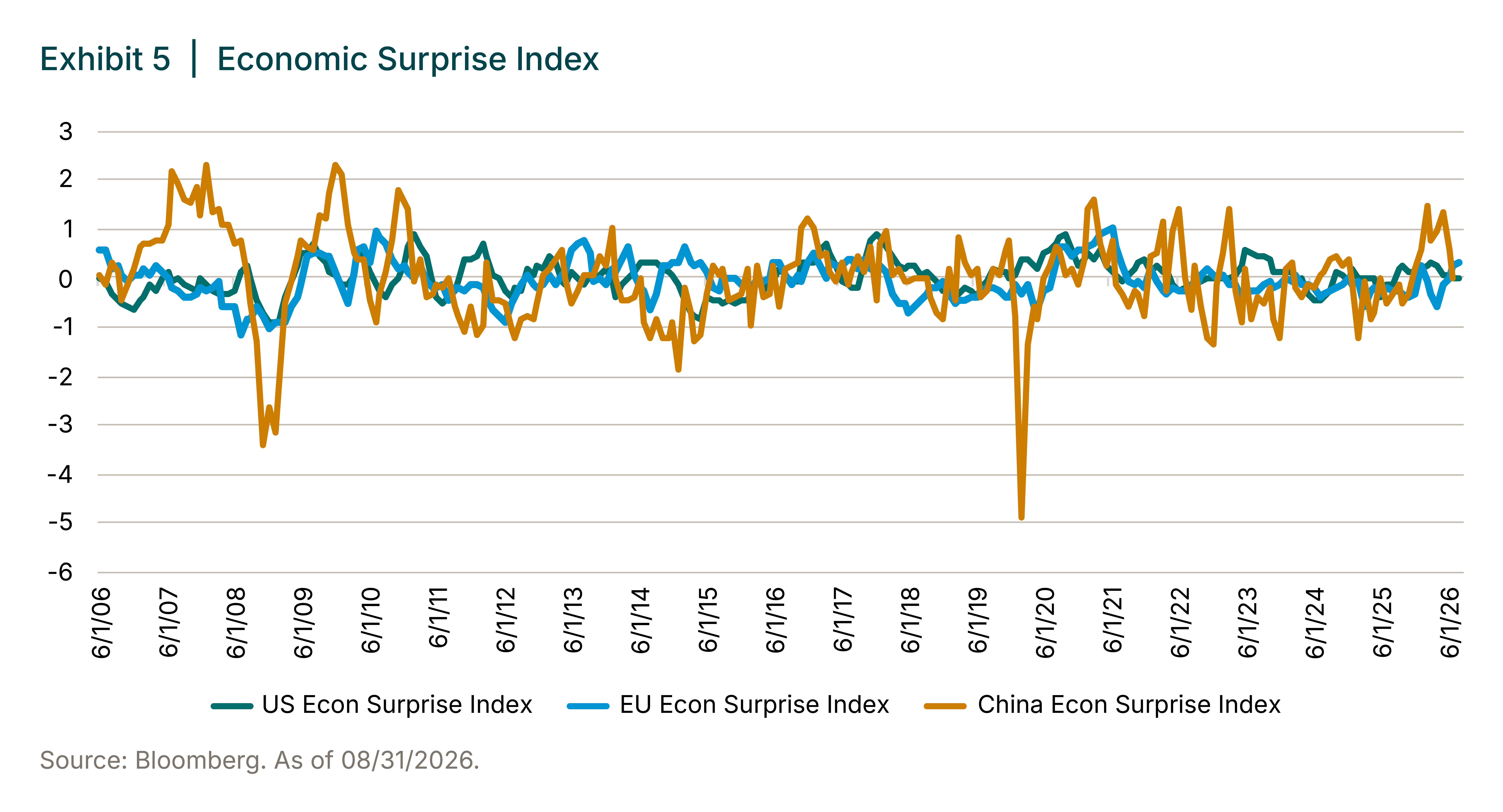
USD: The U.S. dollar faced pressure last month as a combination of softer U.S. data (Exhibit 5), uncertainty around the Fed’s policy framework and renewed de-dollarization narratives drove a broad-based decline. However, recent commentary from Chairman Warsh and rising U.S. real yields have highlighted the potential for cyclical factors to reassert themselves, particularly if labor market and inflation data surprise to the upside. The FX regime now appears increasingly bifurcated between traditional macro drivers, such as rate differentials and growth momentum, and structural concerns surrounding fiscal credibility and reserve diversification. For EM currencies, the implications are nuanced. Asian surplus currencies remain well positioned to benefit from renewed diversification flows, while high-carry EM currencies continue to draw support from favorable yield dynamics. Going forward, USD direction is likely to remain regime dependent. A rebound would be supported by stronger U.S. macro data and a hawkish Fed repricing, while further downside would require renewed momentum in de-dollarization themes and a continued erosion of confidence in U.S. policy credibility.
Asia: The outlook for Asian FX remains mixed, with JPY likely to remain the key driver within the region’s developed markets universe. Currency performance is increasingly being shaped by global rate differentials and evolving central bank policy, particularly as the BOJ continues its gradual normalization path. While higher energy prices remain a headwind for Japan through the import channel, narrowing yield differentials, threat of joint interventions and Japan’s strong external position should provide support for the JPY over the short term. Elsewhere in Asia, surplus currencies such as the RMB, KRW, TWD, MYR and SGD continue to benefit from resilient external balances and structural FX inflows. Overall, Asian FX should remain supported on a selective basis, although currencies exposed to higher import costs and weaker current account dynamics may continue to lag their regional peers.
Europe: European FX entered the quarter with relatively stable fundamentals, but performance has increasingly been driven by external developments rather than domestic monetary policy. Broad USD weakness and ongoing questions around U.S. policy credibility brought the euro back into focus as the market’s preferred alternative to the dollar, helping support the currency despite a mixed regional growth backdrop. Meanwhile, geopolitical risks surrounding the Russia-Ukraine conflict continued to weigh on Central and Eastern European currencies, particularly HUF, PLN and CZK. Going forward, relative monetary policy expectations between the Fed and ECB, alongside broader USD sentiment, are likely to remain the primary drivers of regional currency performance, with regional geopolitical developments serving as an important source of dispersion across the broader European currency complex.
LatAm: The outlook for Latin American FX remains broadly constructive, supported by attractive carry, favorable terms of trade and continued investor demand for high-yielding currencies. However, performance across the region is becoming increasingly differentiated as domestic political and policy developments take on greater importance. While currencies such as the MXN and PEN continue to benefit from supportive macro fundamentals, strong external accounts and capital inflows, BRL faces rising election-related uncertainty and volatility despite its carry advantage. More broadly, regional currencies should remain relatively resilient to shifts in global risk sentiment and commodity prices, and strong carry dynamics should continue to provide an important source of support. Overall, LatAm FX is likely to remain one of the more resilient areas within EM, although country-specific risks are expected to drive increasing dispersion in returns across the region.
Cash
MIM expects the Fed to increase rates slightly in 2026. We remain underweight cash, redeploying toward the high quality spread sectors highlighted above while preserving sufficient liquidity for resilience.
| David Richter Sr. Director, EU & Japan Economy Pierre-Pascal Lalonde Managing Director, Municipals Sara Strauch Director, EM Corporate & Sovereign Carrie Biemer Senior Director, Rates & Currencies | Samsara Wang Vice President, Asia (ex Japan) Economy Michael Brown Managing Director, Public Structured Finance David Williams Sr. Director, Agricultural Research Anthony Pollaro Analyst, Public Fixed Income HY | Jose del Rosal Director, LatAm Economy Alfred Chang Managing Director, Residential Whole Loan Agata Praczuk Director, Private Equity Owen Barlow Analyst, Public Fixed Income IG | Jean-Luc Eberlin Managing Director, Euro Investment Grade Priya Desai Managing Director, Private Structured Finance Jacob Kurosaki Associate, Real Estate Research |