2026 Midyear Fixed Income Outlook: Stay Invested, Stay Selective
Jun 2026
View available investments in your area

Sorry, we couldn't find any results matching
Please:

Executive Summary
Six months into the year, the message from our January outlook still largely holds: stay calm, stay invested and focus on diversified yield and carry rather than reaching for outsized excess returns. What has changed is the backdrop. Fixed income markets have absorbed a sharp reset higher in rate expectations, a new geopolitical shock in the Middle East and a resurgence of inflation concerns, yet spreads across many sectors have retraced much of their widening and are again trading at tight levels. In our view, that resilience continues to reflect the importance of carry, steady technical demand and fundamentals that remain generally intact, even as valuations leave less room for error.
Our core view remains constructive and selective. All-in yields continue to support fixed income, and fundamentals across much of investment grade credit, leveraged finance, CLOs and emerging markets remain reasonably sound. Valuations leave less room for error; market differentiation has narrowed; and investors are increasingly being paid for carry rather than for taking broad directional credit risk. In that environment, we believe portfolios should remain invested, while emphasizing security selection, diversification and dry powder to deploy during bouts of volatility.
Carry is still doing the heavy lifting. Across investment grade (IG), leveraged finance, CLOs and emerging markets, higher all-in yields have kept demand firm even as spreads sit near tights, and macro risks have risen.
Valuations now require more selectivity. We continue to see opportunities, but broad beta looks less compelling than it did earlier in the year, and issuer, sector and regional selection matter more.
AI is increasingly reshaping credit markets. It is changing index composition, issuance patterns and relative value across investment grade and leveraged finance, creating both opportunities and pockets of risk.
The key risk is that tight spreads leave less room for surprise — including persistent inflation, elevated energy prices and the possibility of central bank policy error — but markets have so far absorbed major shocks, while maintaining support from income-oriented demand.
Several assumptions behind our original outlook have been tested since January. Inflation expectations have moved higher; the path for the Federal Reserve has reset; and the conflict in the Middle East has lifted energy prices and added another layer of geopolitical uncertainty. Even so, credit markets have remained resilient. Spreads widened during the March-April sell-off, but many assets have since retraced that move and now sit close to local tights. In our view, that speaks to a market still dominated by yield buyers and supported by fundamentals that have not meaningfully deteriorated.
That leaves us constructive, while still mindful of broad market valuations. We believe fixed income can continue to deliver positive, carry-based returns, and we do not view recent stresses in private credit and software or idiosyncratic credit events as evidence of an imminent systemic blowup. The market is broadly pricing in a continuation of the current mix: Geopolitical uncertainty that remains contained; inflation that does not reaccelerate meaningfully; and growth that stays intact. If that path changes, tight spreads offer limited cushion, making selectivity important.
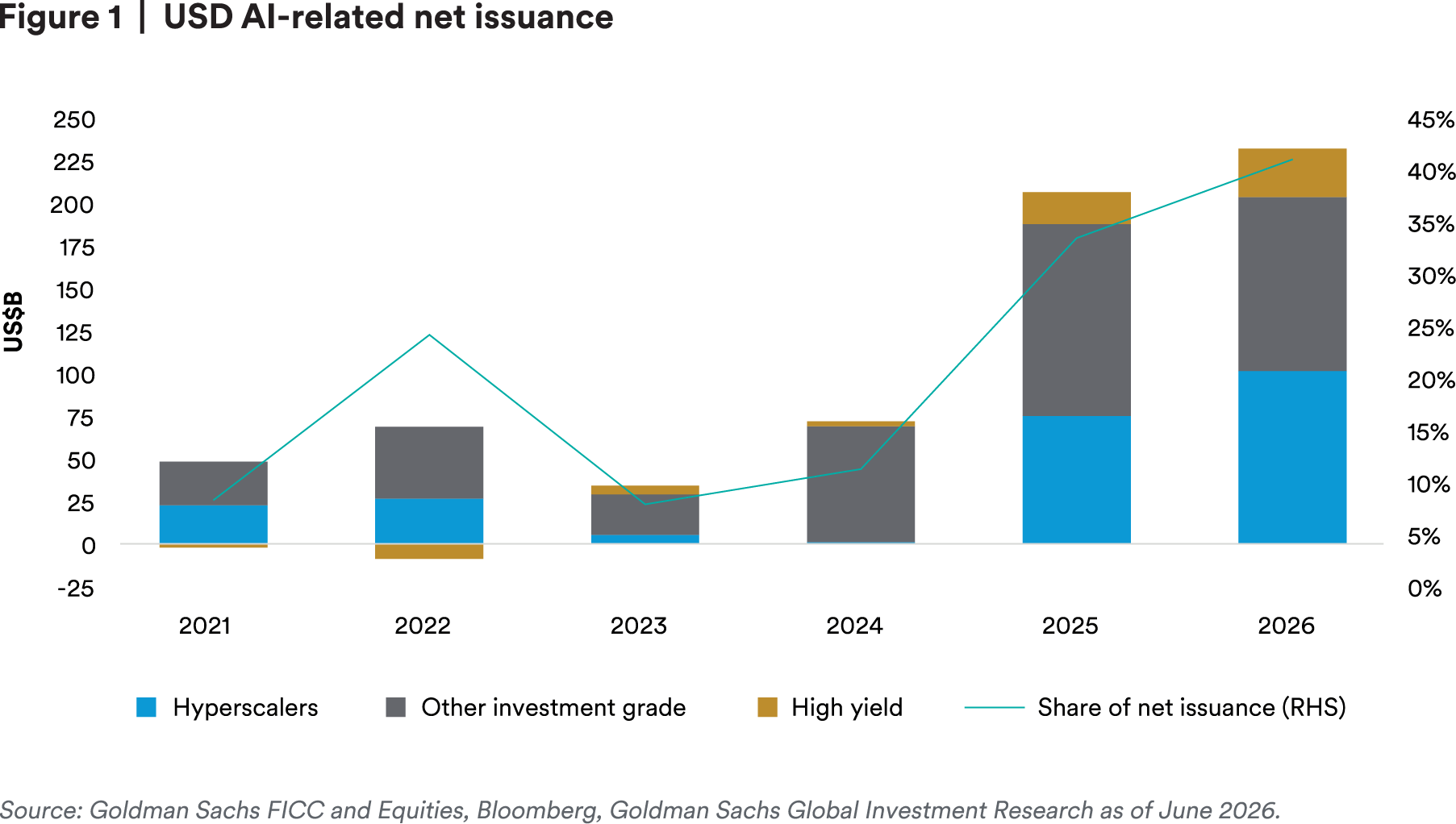
In IG, the first half of the year has reinforced a key point from our prior outlook: Technicals remain in the driver’s seat. Issuance rose sharply, helped by AI-related hyperscaler financing as well as M&A, corporate spin-offs and recapitalization activity. Yet the rise in Treasury yields reset all-in yields higher and kept demand robust. That push-pull between spread and yield has so far been won by yield.
AI is also having a more direct effect on the investment grade market than many expected in January. Companies with some of the strongest balance sheets in the market are now issuing debt to finance AI and data-center build-outs, increasing the weight of large, high-quality technology issuers in the index. That has improved index quality in some respects, but it has also changed market composition and introduced new questions around concentration, correlation with equities and how to value debt financing structures tied to AI infrastructure.
We also see a notable level of homogeneity in IG, with not a lot of issuer differentiation. This underscores our emphasis on seeking the best companies within sectors rather than relying on broad market exposure. Over time, we expect risk and spreads to become more differentiated, and we think it is critical to be positioned on the right side of that dynamic. We continue to favor intermediate investment grade credit over the long end and continue to seek exposure to the best companies.
Our leveraged finance view also remains broadly intact, though our relative preferences within the asset class have become clearer. We remain constructive on both high yield bonds and leveraged loans because yields continue to compensate investors reasonably well, and default expectations remain manageable. But we currently favor fixed-rate high yield over floating-rate loans. Loans still look optically inexpensive in places, but much of that apparent value reflects market composition. The loan market remains much more exposed to software, while high yield has greater exposure to areas such as energy that have held up better in the current environment.
The AI divide is becoming increasingly important here. In leveraged finance, the most direct beneficiaries are the “picks and shovels” of the theme — hardware, power, utility and data center-related issuers — while software and certain tech-enabled business models face more pressure as investors reassess business-model durability. That divergence is also feeding through to CLOs, where strong demand and elevated all-in yields continue to support spreads, but left-tail risks are rising, and manager selection matters more. We still see attractive carry in higher parts of the CLO capital stack and believe a nimble approach is essential if market weakness creates opportunities lower down.
More broadly, we still expect carry-based returns rather than large spread compression. In high yield, we continue to prefer the belly of the market — low-BB to mid-B rated bonds — where investors can avoid both the very tight spreads in the highest-quality tiers and the more acute default risk at the bottom of the capital structure. In loans and CLOs, we think disciplined bottom-up credit work and downside avoidance will matter more than broad beta exposure as markets become more selective.
Emerging markets (EM) have also held up better than many might have expected, given the rise in oil prices, renewed inflation worries and uncertainty around the Strait of Hormuz. The broad story remains supportive: Many EM countries still enter this period with stronger policy credibility, healthier balance sheets and more attractive real-rate profiles than their developed-market peers. That continues to argue for a strategic role for EM debt, particularly as a diversified source of yield and carry.
That said, the easy relative-value trade has become less obvious. The widening in March and April has largely been reversed, and the distinction between oil exporters and importers has narrowed much faster than expected. Investors searching for income have been willing to move down the quality spectrum despite macro noise, which has compressed spreads even in countries still exposed to elevated energy prices.
As a result, we think the opportunity set in EM is becoming more idiosyncratic. We believe EM corporates continue to add value relative to other areas and see value in selective local-currency exposures in higher real-rate markets and in parts of the single-B universe, while remaining mindful of inflation-sensitive areas such as high-quality Asia. Elections in countries such as Brazil and Colombia also warrant attention as potential drivers of sentiment and volatility in the second half.
At midyear, the central tension in fixed income is straightforward: Valuations imply a fair amount of good news, while the macro backdrop still contains meaningful uncertainty and risk. This is a subtle but important tension: The bullish case is less that fundamentals are great and more that income is compelling enough to overwhelm concerns. That makes the market more vulnerable if yields fall, recession fears rise, or risk appetite changes.
Elevated energy prices, higher food costs and tighter financial conditions could weigh on the consumer and slow growth in the back half of the year. At the same time, there is a real risk that central banks respond too aggressively to what ultimately proves to be a temporary inflation impulse. Either outcome would challenge a market that has been quick to buy dips and slow to sustain wider spreads.
Even so, we continue to view fixed income as attractive in a world where income is scarce, and uncertainty is high. We still believe investors should stay calm and keep their carry on — but with a more selective, diversified and valuation-aware posture. That means favoring quality where appropriate, leaning into areas where market composition has created better relative value, and keeping enough liquidity to respond when volatility creates more compelling entry points.