Minnesota Small Businesses Report
MetLife & U.S. Chamber of Commerce
The goal of this survey was to measure attitudes about paid family leave and the upcoming Minnesota Paid Leave Program. The U.S. Chamber of Commerce partnered with Ipsos, the global market research firm, to survey small businesses in Minnesota. This study was included within the quarterly Small Business Index. An oversample of 100 small business owners and operators based in Minnesota were surveyed, for a total of 109 interviews among respondents in Minnesota. Findings reflect the opinion of these respondents only.
The survey results indicate that paid family leave is important to the Minnesota small employer community. However, there is room for educating businesses on the Paid Leave program that is launching in Minnesota in 2026. The vast majority of these businesses believe that the Paid Leave program will have a positive impact while acknowledging that costs will increase for small businesses.
Ninety percent of respondents report offering at least one benefit to their full-time employees, higher than the national sample of small businesses (70%). Though, most of these Minnesota businesses have at least twenty employees, making them larger on average compared to the national sample. Among those that do offer benefits, 91% believe their employees are satisfied with their business’ current benefit offerings, in line with the national sample.
In the same vein, nearly all of the surveyed businesses believe employee benefits are at least somewhat important for the following:
- Demonstrating care for employees and their families (98%; 54% very important)
- Supporting workers across different generations (97%; 51% very important)
- Attracting and retaining employees (96%; 59% very important)
- Increasing employee morale (96%; 60% very important)
- Decreasing employee stress (95%; 48% very important)
- Increasing employee productivity and engagement (95%; 51% very important)
This stated importance is in line with that of the national sample of small businesses.
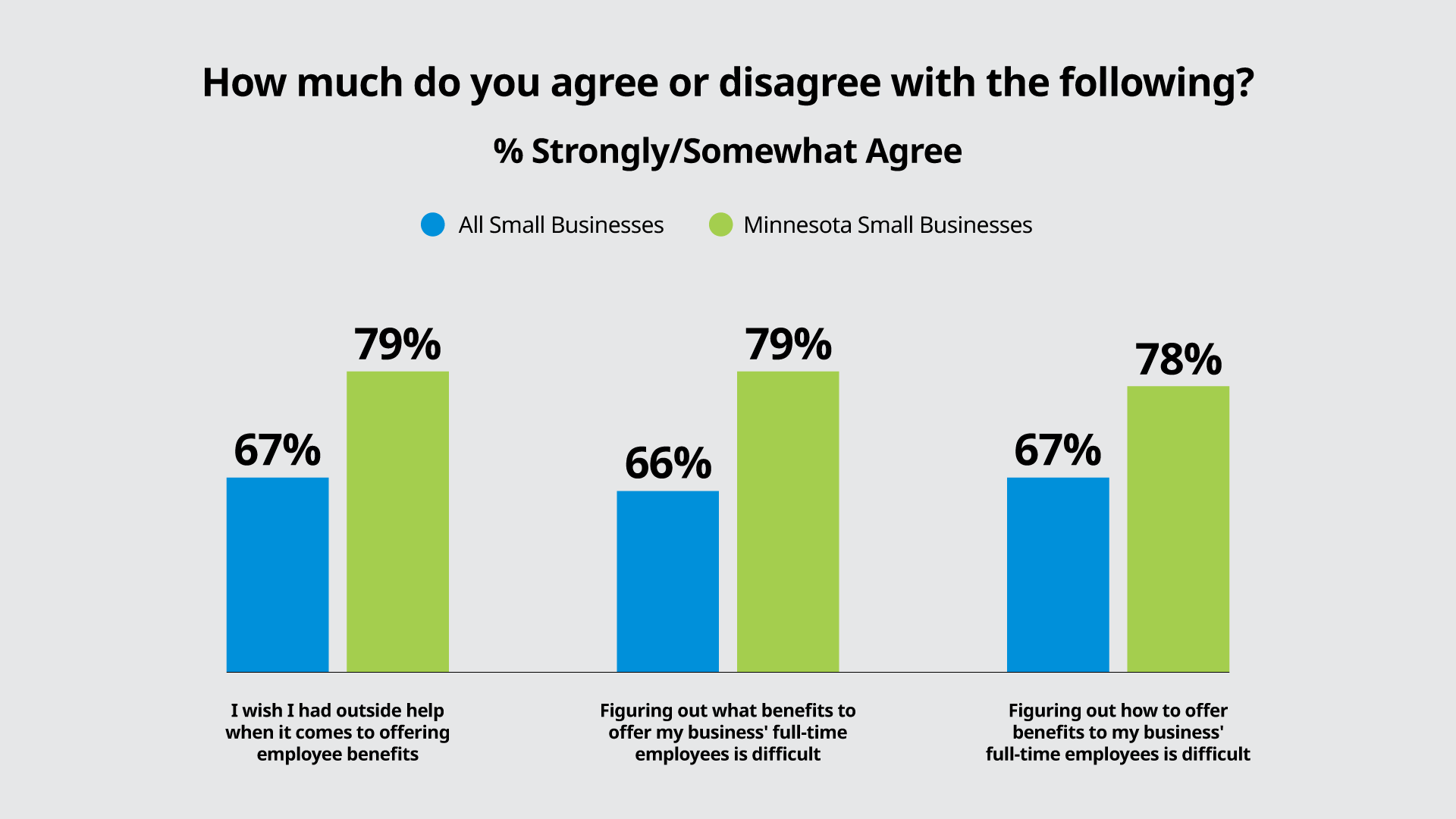
Despite the stated importance of benefits, many of these businesses have difficulty figuring out what to offer. Nearly four in five agree that figuring out what benefits to offer (79%) and how to offer benefits (78%) to their full-time employees is difficult. Seventy-nine percent also wish they had outside help when it comes to offering benefits. These Minnesota small businesses are more likely than the national sample of small businesses to agree with these statements.
When it comes to paid family leave, nearly all of these respondents say that it is at least somewhat important to their employees (91%), with half reporting that it is very important.
Additionally, when asked about their familiarity with Minnesota’s forthcoming Paid Leave program, seven in ten say that they are at least somewhat familiar. However, just 30% indicate that they are very familiar. Moreover, 19% percent report that they have only heard of the program, and 10% have never heard of it at all.
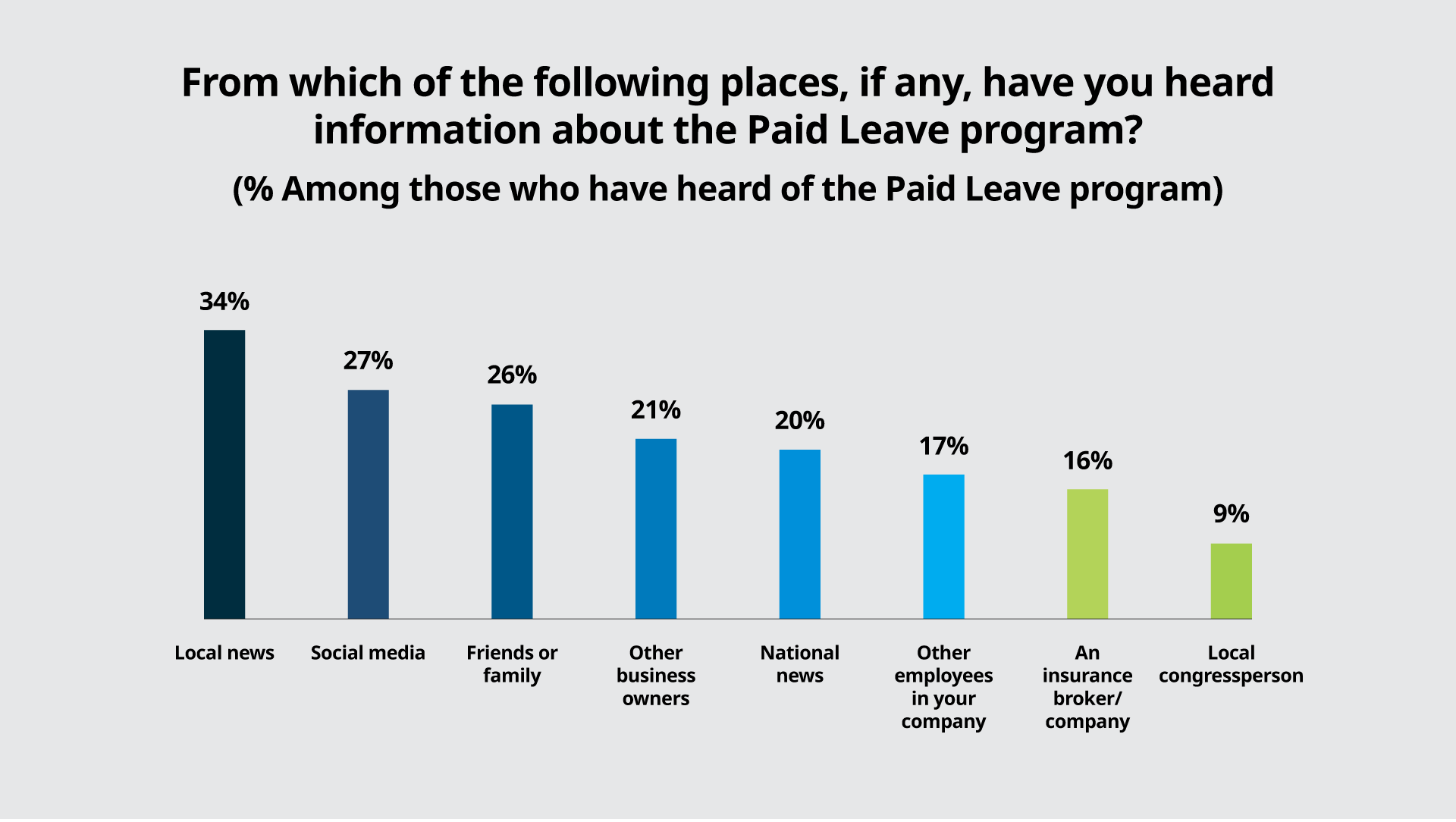
Among those that have at least heard of the program, where they received their information from is split among a variety of sources, including local news (34%), social media (27%), friends or family (26%), other business owners (21%), and national news (20%).
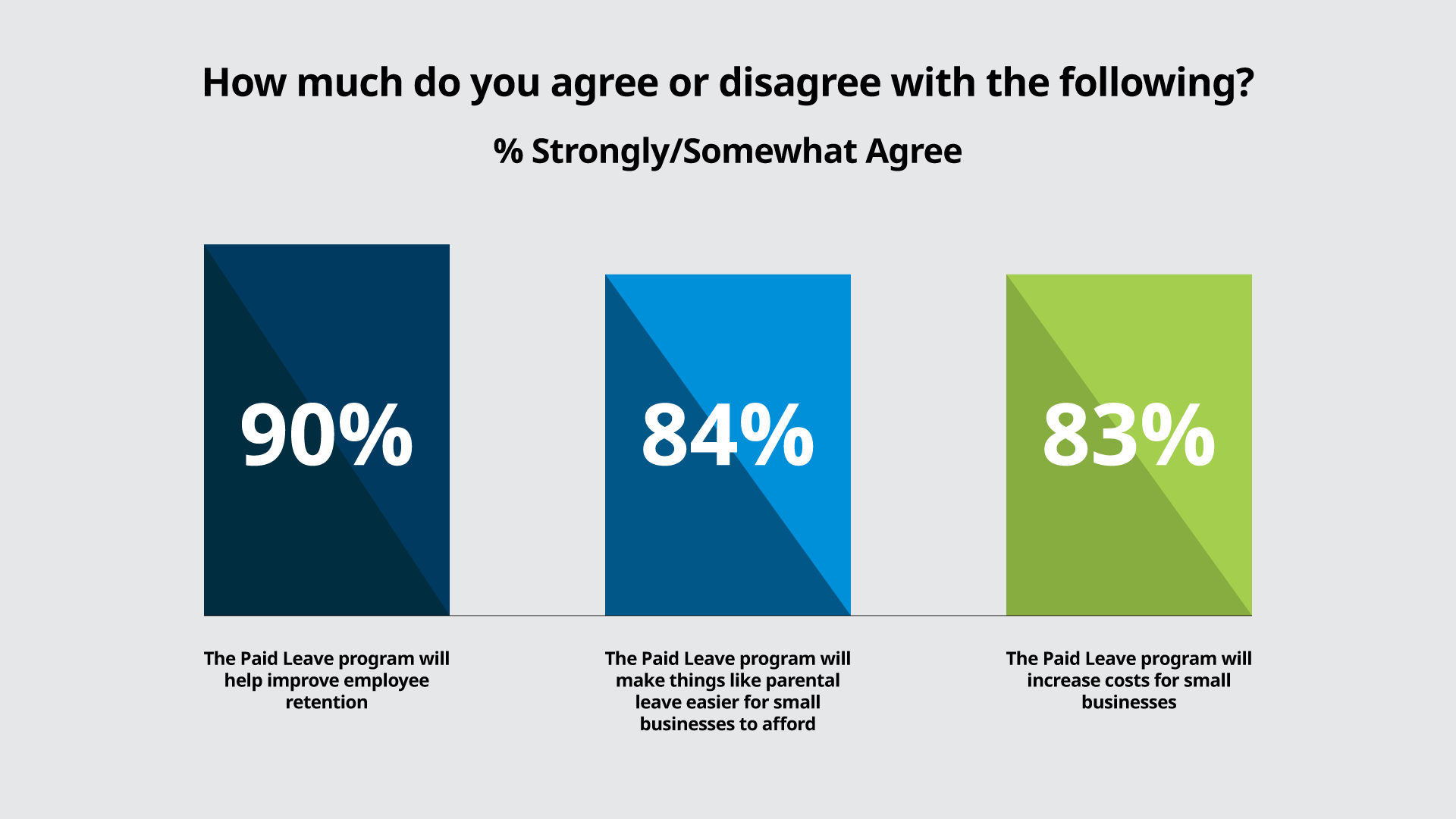
These small businesses have generally positive sentiments about the potential of the Paid Leave program. Nine in ten agree that it will help improve employee retention. Eighty-four percent agree that the Paid Leave program will make things like parental leave easier for small businesses to afford, and a similar percentage believe it will be easier to use as an employer (78%).
However, 83% also agree that they are concerned that the program will increase costs for small businesses, including 31% who strongly agree. This is notable, as these businesses cite the rising costs of employee benefits (43%) and limited budgets (34%) as the top two barriers to offering employee benefits. These are also the top barriers among the national sample of small businesses.
Lastly, beyond the Paid Leave program, these surveyed businesses have mixed views on paid family and medical leave (PFML) programs in general. At least four in five agree that the state PFML program allows their business to provide a benefit package they would not otherwise have provided (85%), and that a Minnesota approved PFML Private Plan is better for their small business to coordinate other employee benefits, including federal and state laws (89%). However, 86% also agree that there should be a federal law to create paid family and medical leave benefits for all employees instead of state-specific laws.
In summary, the survey results show that there is both an opportunity and a need to educate Minnesota small businesses on paid family leave and the forthcoming Paid Leave program. These businesses are generally positive about Paid Leave. However, these businesses also indicate that they are cost-sensitive. Cost pressures caused by a state PFML may put Minnesota small businesses at a disadvantage, which may be why 86% of the Minnesota small businesses surveyed believe there should be a federal PFML law to level the playing field.
Survey Methodology
These are the findings of an Ipsos poll conducted between April 16 – May 5, 2025. This survey was included within the quarterly Small Business Index, in which a sample of 760 small business owners and operators age 18+ from the continental U.S., Alaska, and Hawaii was interviewed online in English. An oversample of 100 small business owners and operators age 18+ based in Minnesota were surveyed online in English, for a total of n=109 interviews among respondents in Minnesota. The main national findings (n=760) do not include these respondents.
The memo is based on the findings of the Minnesota small businesses sample. No post-hoc weights were applied to the oversample of Minnesota small business owners and operators, and findings reflect the opinion of these respondents.