Capital Market Line: From Secular Stagnation to Secular Growth?
Oct 2026
View available investments in your area

Sorry, we couldn't find any results matching
Please:

For the past 15 years, many investors have viewed the global economy through the lens of secular stagnation. Aging populations, excess savings, modest productivity growth and the lingering effects of the Global Financial Crisis (GFC) were supposed to constrain economic activity, suppress inflation and keep interest rates structurally low. Even after the pandemic temporarily disrupted this framework, the prevailing assumption remained that once the effect of the Covid shock passed, along with its massive subsequent demand stimulus and Modern Monetary Theory-like central bank response, that the world would revert back to the “new norm” of subdued growth and low inflation. By contrast, our framework viewed this suppressed period as a regime, which like all other regimes creates material imbalances that can take well beyond an economic cycle to clear. Yet, one day they do clear, and the markets and global economic backdrop transition into the next “new norm.” There is nothing new about “new norms.”
We continue to believe that the next five years will likely be defined by a very different set of forces, creating what we would call a “running-hot” regime. Rather than a world constrained by insufficient demand and thus insufficient investment, evolving forces such as deglobalization, reshoring, climate change, geopolitical bifurcation and accelerated technological change in the form of AI have created a new mix of imbalances. Among other things, these imbalances are characterized by less savings, a rising investment intensity of GDP and growing competition for capital. If it were not for China’s rising savings rate, a precautionary measure in a sticky balance sheet recession, the world would be rapidly depleting the savings glut it amassed after the GFC. The significance of this shift in regimes challenges some of the core assumptions that have shaped investment thinking for much of the past 15 years.
The most powerful driver of this new mix of imbalances is AI. Much of the discussion to date has focused on the technology’s infrastructure buildout. Investors have been understandably captivated by the insatiable demand for capital to finance extraordinary spending on data centers, semiconductors and computing power. History nonetheless suggests that the most important economic consequences of transformational technologies are rarely found in the initial buildout phase. Railroads ultimately transformed commerce, not steel demand. Electricity reshaped productivity, not copper consumption. The internet revolutionized business models, not fiber-optic networks. Every major technological revolution eventually becomes a productivity story. We believe AI will as well. Time to think of what that means, and how to invest into it.
What makes AI particularly significant is where its productivity gains are likely to emerge. Previous disinflationary waves were concentrated in goods production through automation, globalization and increasingly efficient supply chains. AI has the potential to revolutionize services, an area that accounts for the majority of economic activity and has structurally higher inflation than goods in developed economies, but that has also historically been more resistant to productivity improvement. As adoption broadens beyond the relatively small group of technology leaders currently building out the capability, AI is likely to influence everything from software development and logistics to healthcare, financial services and professional advisory work. There are many potential tracks for the diffusion of AI, yet these areas are where the rises in productivity and disinflation of prices will be most beneficial.
If productivity growth accelerates meaningfully, the impact on the macroeconomic landscape could be profound. Stronger productivity is supply-led growth, which allows economies to generate faster growth without necessarily stoking inflationary pressure. While many of today’s investors are preprogrammed to believe that faster growth means higher inflation, it’s worth comparing AI to the Industrial Revolution. During that multi-decade regime, growth accelerated while prices deflated. Halfway through, a French economist posited Say’s Law, which states that supply creates its own demand...through falling prices. This theory sought to explain how the rapid productivity growth during industrialization led to falling prices: Supply chronically exceeded demand. We see this today in the semiconductor industry, where falling prices often create disproportionately higher unit growth. At the very least, one should be cautious about applying the lessons of the last 15 years too mechanically to the handful of years ahead, which is the horizon we focus on in our Capital Market Line (CML) expectations.
While we are AI optimists, our CML is not looking for inflation to disappear. While supply shocks today instantly conjure up presumptions of negative developments, like Covid, tariffs and the Strait of Hormuz (it’s tough to shake recency bias), bursts of technological change tend to boost supply through productivity. Demand tends to catch up with a lag, facilitated by either disinflating or, in rare instances, deflating prices. The Industrial Revolution was an outlier in terms of the degree of deflation amid rapid growth, but most garden-variety, technology-driven supply shocks tend to be disinflationary. Our CML doesn’t take too much of a disinflationary stand, as the future may also be characterized by greater inflation volatility. Forces shaping the global economy are becoming more diverse and often more unpredictable. Geopolitical competition, industrial policy, energy security, supply-chain restructuring and strategic investment priorities are unlikely to produce the stable backdrop that defined much of the 2010s. Inflation may ultimately average close to central bank targets, but the path there could prove considerably less predictable. Viewed another way, after a series of negative supply shocks, we wouldn’t be surprised by a positive supply shock; yet, the next regime could just as easily be less about inflation and more about investment. The latter seems easier for us to get our hands around.
One of the defining characteristics of the post-GFC period was the perception that the world suffered from too much saving and too little investment. Today, that balance seems to have reversed. AI infrastructure, electrification, grid modernization, defense spending, manufacturing reshoring and digital transformation all require substantial capital. Collectively, they point toward a global economy that is increasingly investment-led.
This distinction matters for markets because investment-led economies behave differently from consumption-led ones. They tend to not only support stronger productivity growth, but do so through greater capital formation, which is accompanied by higher demands for financing. Higher real interest rates are a feature, not a bug, of investment-led backdrops. That should not be interpreted as a constraint on growth. Empirically, it has been the opposite. Higher real rates reflect stronger demand for capital to create growth. For investors raised on the assumptions of secular stagnation, with the presumption of reversion to the mean of low nominal rates, we would point out that like all regimes, this higher-for-longer real rate regime can last a long time. At issue will be the extent to which AI productivity creates disinflation and inflation expectations come back down. Nominal rates will surely have to contend with higher and stickier real rates, yet these may come with or without lower inflation expectations. Mean reverters, beware: Inflation expectations will depend primarily upon the usefulness of tomorrow’s use cases and the speed and breadth of their diffusion into the economy. Monetary policy may also play a role, with a new U.S. Federal Reserve Chair who insists that inflation is a choice, which is his way of taking responsibility.
The United States remains central to this story. Its deep capital markets, entrepreneurial dynamics and leadership in AI innovation should continue to provide significant advantages, even though the next chapter of AI is likely to be as much, if not more, about implementation and diffusion throughout economies and societies. Still, even those not involved in upfront innovation are likely to achieve meaningful benefits, whereas those less active and successful might fall well behind.
While it has been popular lately to make a call on the end of U.S. exceptionalism, we think the country’s current AI leadership means this call is unlikely to come to fruition in the next five years. On the other hand, there is no standing still, and others may reach for and grab the AI brass ring. We would expect this toproduce a selective broadening, while the U.S. merely retains many of its structural strengths. A somewhat weaker dollar over the long term would be consistent with successful selective broadening—although, don’t count on this until after the massively capital-intensive period of AI’s buildout crests. Until then, the real rate in the U.S. may rise further and faster than others, boosting the dollar. Into a broadening backdrop, a softening USD wouldn’t necessarily be a sign of weakness, but rather a crest in the current high and rising investment intensity of GDP.
A regime geared toward higher capital intensity may also be unfolding in Europe. For decades, parts of the region benefited from inexpensive energy, access to Chinese demand for high-end goods and a security umbrella provided by the United States. Those props are now gone, and there is no guarantee that the continent rises fast enough or effectively enough to the occasion. Yet, the necessity is increasingly there. Germany, the country with the most formidable balance sheet in the region, has been the first mover, increasing its focus on defense, strategic autonomy and domestic investment. The transition by the other countries will surely be uneven, but the uncomfortable global backdrop suggests a more focused and investment-oriented European economy.
Even Japan, long cited as the archetype of secular stagnation, is beginning to challenge conventional wisdom. For much of the past three decades, investors viewed Japan as evidence that aging demographics inevitably lead to weak growth, low inflation and declining interest rates. So, too, did Japanese society and businesses. The downbeat backdrop helped elevate Prime Minister Shinzo Abe and Bank of Japan Chair Haruhiko Kuroda to power in 2013, focused as they were on defeating defeatism with their thousand arrows. Balance sheet recessions are difficult to get out of, but a dozen years later, developments finally suggest that Japan’s stagnation lies behind it. Wage growth has strengthened, inflation expectations have moved higher, and after suffering through a long period of deflation, policymakers have increasingly become confident that inflation can now achieve its 2% target. The significance of this extends well beyond Japan. After the country’s lost decades and lost confidence contributed to the global savings glut, increasingly Japan will be investing its own savings instead of lending to investors as the borrowing currency in carry trades. If an economy once considered permanently trapped in deflation can escape and grow again, despite a vastly older population, investors may wish to remain open to the possibility that other assumptions inherited from the post-GFC era may prove less suitable to the regime ahead as well.
China remains an important counterweight to this narrative. Demographic challenges, excess industrial capacity, an ongoing adjustment in the property sector and markets playing a less decisive role all continue to weigh on the outlook for the country. Its high savings rate has also continued rising, signaling that the country may have slipped into a sticky balance sheet recession. Importantly, its huge savings have contributed to the global savings glut, which China largely recycles back into the rest of the world despite a closed capital account for individuals and banks that are not state-owned entities. Importantly, China remains a powerful source of manufacturing capability and innovation and has positioned itself to go head-to-head with Germany and Japan for pre-eminence in medium-to-high end global manufacturing. China is exporting the related disinflationary pressures that come out of this to the global economy. The interaction between Chinese industrial strength in goods and AI’s productivity gains in services may become defining forces shaping the next decade.
Ultimately, the most important investment question of the next five years may not be whether inflation settles precisely at a particular level or whether policy rates end up slightly higher or lower than current expectations. The more important question is to what extent the world has moved away from the framework that has dominated investment thinking since the GFC and how to invest into this new backdrop. The emergence of AI, rising global investment requirements, evolving fiscal priorities and shifting geopolitical relationships all call for recalibration.
Economic regimes rarely announce their arrival. They emerge gradually, often disguised by the uncertainties and distractions of the day. For much of the post-GFC era, the defining investment debate was whether the world could escape secular stagnation. Remember all the angst and discussions about the required escape velocity? The defining debate of the next five years appears to be how to recalibrate and invest through an investment boom.
INSIGHTS FROM TODAY’S CML
Our Capital Market Line remains modestly steep, reflecting a reasonable risk/return trade-off (Exhibits 1 and 2). Despite somewhat faster growth and more disinflation coming through over the medium term, its central message remains one of high dispersion, signifying pockets of value and both more winners and more losers in the years ahead.
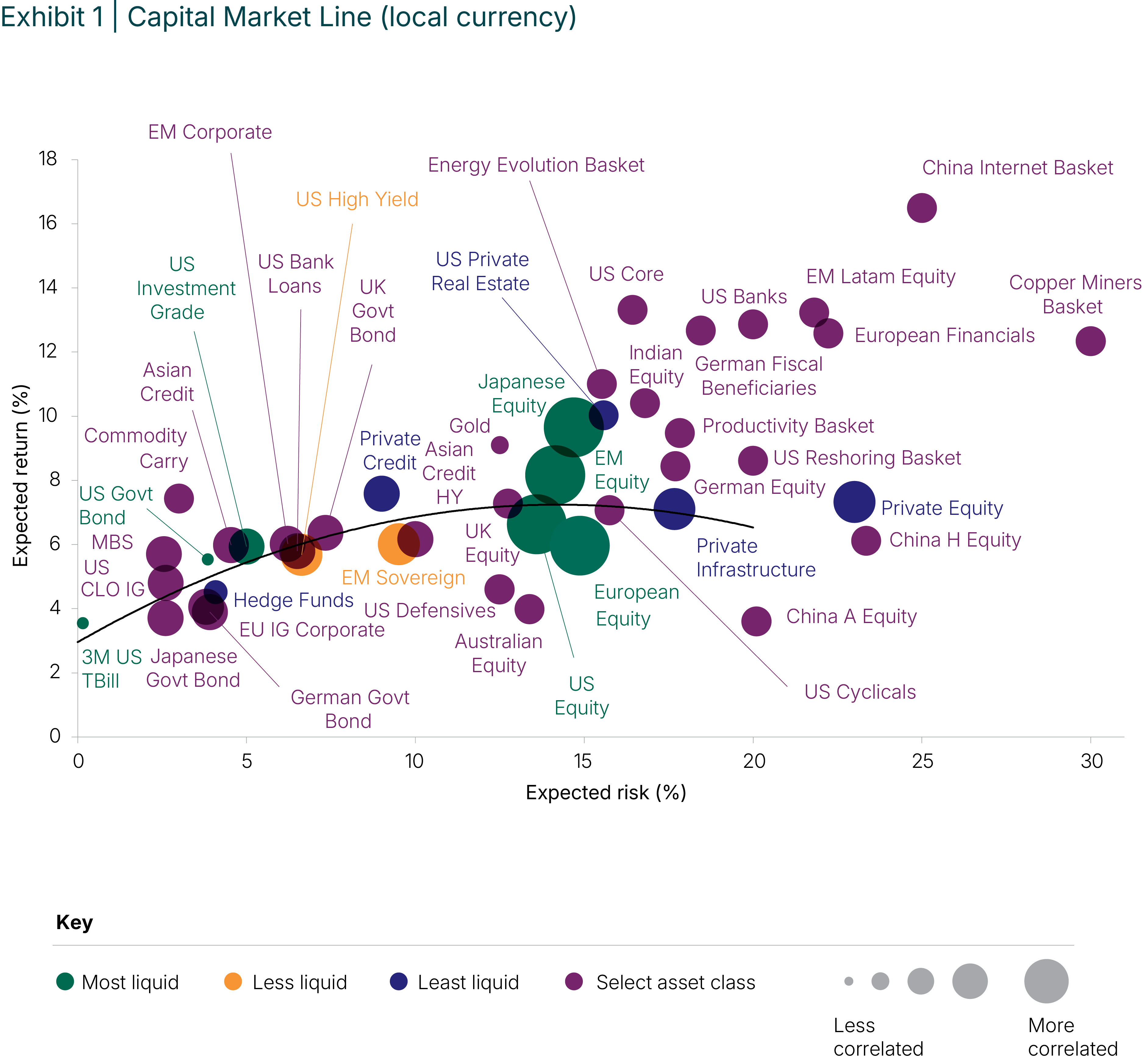
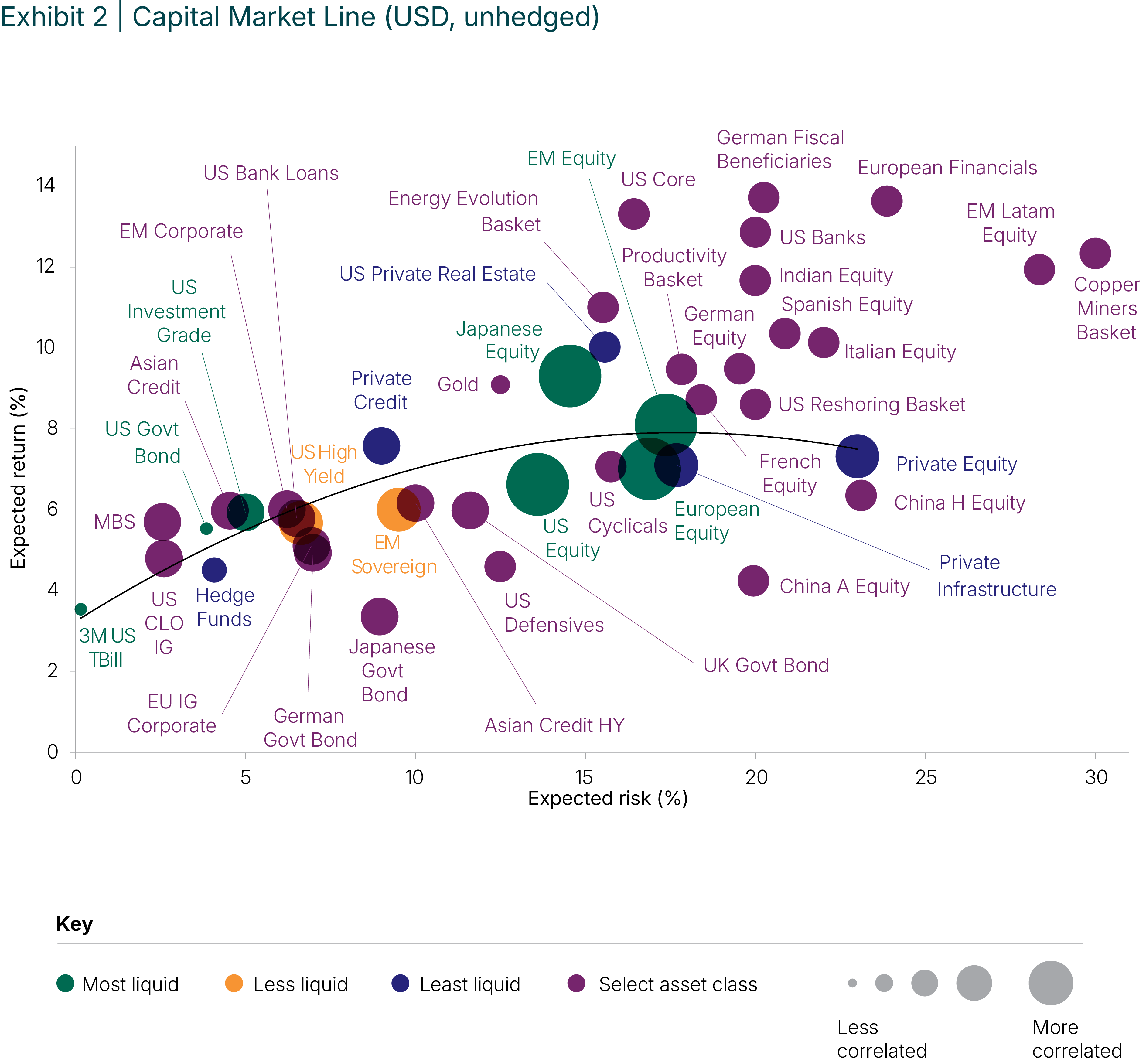
Please see Capital Market Line Endnotes. Note that the CML’s shape and positioning were determined based on the larger categories and do not reflect the subset categories of select asset classes, which are shown relative to other asset classes only.
What has changed is the growth and rates backdrop. The expansion is no longer carried by AI alone. U.S. activity keeps surprising to the upside, and Europe has begun to participate, with manufacturing recovering, export orders turning positive and German business confidence improving. Stronger growth has reduced recession risk, but it has also pushed real yields higher and raised the odds that policy stays restrictive for longer. The Fed has hiked, and the market debate has moved from recession and disinflation to how much tightening is needed and whether neutral rates are structurally higher than investors assumed.
Our medium-term forecasts still assume tariff and energy pressures fade early in the five-year horizon while AI’s disinflationary forces build throughout. Underpinning the view is what may prove the largest investment wave in decades: AI, supply-chain reshoring, an energy transition amid a growing electricity shortage and nuclear revival, and rising defense outlays. Investment demand of this scale normally should drain a global savings glut given time, pulling real rates substantially higher, particularly at the long end. Yet, China’s massive and growing savings pile still provides a partial offset. AI infrastructure also isn’t traveling alone. Synchronous trends in reindustrialization, energy and fiscal spending are now competing for capital at the same time, with markets trying to forget the last 15 years when pricing this competition. We expect an AI-driven productivity boom to lift corporate profits, support equity fair values for those who figure out how to benefit from AI and keep credit spreads contained for the adopters, while the higher-for-longer backdrop results in harsher treatment for CCCs and below.
Markets are transitioning from the later innings of early-cycle to the early innings of late-cycle. Early hiking cycles, particularly those that take policy rates higher, to and through neutral, can be hard on risk assets. This tends to be the case even when hikes were already priced in, because even more tend to get priced in once the policy cycle lifts off. Financially fragile firms and rate-sensitive segments suffer initially, followed by those in which fundamentals deteriorate as higher rates slow key segments. Despite that, earnings are already benefiting from rising productivity, even before the AI benefits kick in. P/E multiples have already reset lower this year, yet earnings expectations are rising faster than interest rates, which has provided an offset for large pockets within equities. Having said that, we expect higher rates will dampen growth selectively in the not-too-distant future. A crowding-out has begun,, and we now see opportunities and risks as roughly balanced over the near term. For those who share our view of rising earnings for the widening group of companies and countries applying and benefiting from AI, along with the disinflation that accompanies that, we would use interim pullbacks to re-engage with today’s growth assets, the structural winners of this technological, supply-led boom.
Equities: Focus on quality AI beneficiaries. The equity narrative is shifting from AI infrastructure spending alone toward broadening activity and tangible AI adoption. Growth indicators have strengthened across the U.S. and Europe. At the same time, higher real yields are narrowing market leadership again, pressuring cyclical and rate-sensitive segments such as small caps. We expect the next phase to reward being more selective, favoring companies that can deliver durable earnings growth despite higher-for-longer real rates, which includes companies with strong balance sheets and resilient cash generation.
AI adoption is also spreading beyond the enterprise buyer, who tends to be cautious in adopting new technologies. The rapid uptake of Meta’s Muse platform, which lets autonomous agents shop, search for travel and compare prices, shows how quickly demand expands once the technology becomes useful in daily life. Consumer-side token demand is a new source of compute consumption that reinforces the long term case for semiconductors, data centers and digital infrastructure. Frontier model capability is no longer the binding constraint; existing models can support years of deployment, so adoption, monetization and implementation will drive the next leg of growth. Lower token prices continue to lift usage faster than they cut revenue, and routing across frontier and open-source models strengthens the hyperscalers that own the customers, infrastructure and distribution.
We see the most compelling opportunities in high-free-cash-flow- and productivity-oriented strategies that pair today’s AI infrastructure beneficiaries with the next phase of adoption. Within technology, we favor higher-quality beneficiaries over broad exposure. Beyond the U.S., Japan and Europe remain slightly more attractive on valuations, lighter positioning and greater leverage to the broadening global recovery.
Higher real yields call for patience on duration. Fixed income is caught between very slowly improving inflation dynamics and an economy that is running hotter than expected. Inflation expectations remain well-behaved, but resilient activity amid rising issuance has led markets to price additional tightening. Real yields, not inflation, are driving rate markets, making duration a harder call as we wait for inflationary expectations (still running above target) to break to and potentially through the Fed’s 2% target.
Structurally, we expect real rates to settle higher, reflecting today’s higher investment intensity of GDP. Data centers, energy systems, reindustrialization and fiscal programs are competing for capital. Near term, we prefer shorter-dated exposure and see little reward in extending duration until the market has found a peak in Fed terminal pricing and AI gets closer to producing disinflationary benefits. These are the signals to move duration back toward portfolio norms.
Go where the issuance is not. Tight spreads, an investment-grade-financed investment boom, and accelerating M&A continue to erode investment grade (IG) credit’s edge over the higher quality portion of high yield (HY). Long-end, investment-oriented supply pressures IG more than HY, especially in the U.S. Resilient growth and rising AI investment put a floor under spreads, but higher real yields and restrictive policy argue for modest widening from today’s tight levels, with the most crowded issuance most exposed. We continue to favor Asian high yield (ex-China property) and select Latin American local-currency bonds where governments are turning more market-friendly and the investment wave is pulling along USD-priced commodity exports.
Alternatives: Diversifying our diversifiers. Stronger growth, rising real yields and positive stock-bond correlations continue to undermine traditional diversification, and they fail most when needed most, as during oil price spikes. Gold, once the core hedge when Fed credibility was in question, has lost its structural tailwinds: easing Middle East risk, higher real yields and a Fed chair less inclined toward balance-sheet expansion, which had fed a steady debasement bid since quantitative easing began. After a sharp multi-year rally, gold is expensive and increasingly correlated with risk assets, which reduces its diversification benefit.
A world shaped by AI investment, infrastructure spending, energy demand and reindustrialization requires a broader approach than the one that worked when rates fell and liquidity was abundant. We favor return streams that do not depend on the direction of equities or government bonds. Market-neutral alpha strategies top our list, followed by cash-plus liquid alternatives and, to a lesser degree, relative-value commodity strategies.
THE FUNDAMENTALS DRIVING OUR CML
Transitioning toward a more balanced mix of public- and private-sector growth. After the GFC, Western economies endured long, but mild, balance-sheet recessions. Private-sector deleveraging held back consumption and investment, while unconventional monetary policy and passive fiscal support left central banks doing most of the work. That “old abnormal” lasted until around 2015, when healthier household and corporate balance sheets began supporting higher growth. The post-pandemic fiscal surge was, in our view, a temporary and fragile form of U.S. exceptionalism. With the U.S. economy described as over-consuming and under-producing, the Trump administration is now rebalancing growth drivers, reducing government support and shifting momentum to the private sector through incentives such as dramatically accelerated depreciation to spur the supply side, paid for with tariffs that restrain the consumption side. Recent upside surprises in U.S. activity suggest the handoff is working. Within an investment boom, we see this as a necessary step toward a more durable, investment-led expansion.
China is easing to offset anti-involution policies. China’s anti-involution campaign has not curbed fierce domestic competition. Policymakers increasingly see a rising equity market as the preferred offset to cautious consumption, largely the result of a negative wealth effect from property investments gone bad. Their policies are attempting to channel excess savings toward stocks, while anti-involution attempts to trim excess capacity in services and advanced manufacturing industries, such as domestic electric vehicle production. Finessing this type of policy mix is easier said than done. Absent clear success, the government appears content to manage the downside in local taxes from pay cuts at state-owned enterprises and let real estate overbuilding run its course, so long as it does not infect the banking system. Both forces narrow wealth gaps as a policy goal at the cost of dimming animal spirits and boosting precautionary savings. Given the stagnant domestic situation, policy is nurturing an export-oriented “China Shock 2.0,” in which leaders use domestic deflation to manage the pace of yuan appreciation to preserve the country’s export prowess. Meanwhile, China’s growing savings pile, recycled through the SOE banks into global markets, tempers the global rise in real rates.
Europe is participating in the recovery, even as Germany’s fiscal spending thrust continues to pace behind expectations. Europe has begun to participate in spillovers from the AI boom into the global economy. Manufacturing activity has improved materially, export orders have turned positive after years of contraction and German business confidence continues to recover. Fiscal policy remains the main lever, led by Germany’s defense and infrastructure buildup, but that spending has come through more slowly than expected because of regulatory and permitting bottlenecks. We read the impulse as delayed rather than diminished and expect Germany to make up the shortfall in future years as projects are approved. Beyond Germany, the EU has implemented only a fraction of the Draghi competitiveness recommendations, the region remains over-regulated for the competitive world it faces and most member states lack the debt capacity to pull growth along.
AI: Adoption takes over from capability as the driver. AI remains the central structural force in markets, and the cycle’s next phase will be driven less by technological breakthroughs than by adoption, monetization, and real-world implementation. Existing models are already capable enough to support years of commercial deployment. Meta’s Muse platform shows how fast adoption can spread once AI becomes useful in everyday life and is paid for in a B2B manner, without consumers reaching into their pocketbooks. This is opening consumer-side token demand as a new source of compute consumption. The economics are improving: Total AI expenditure keeps rising despite lower token prices, agentic applications consume far more tokens per task, and revenues now run ahead of the depreciation on hyperscaler investment. Consumption-based pricing, more efficient hardware and routing across frontier and open-source models all support margins, while open-sourcegrowth broadens the ecosystem and sustains infrastructure demand.
The risks are also clearer. Value distribution across the stack is unresolved: Open-source models look set to erode pricing power at the model layer while infrastructure providers capture a larger share. Memory is a growing component of hyperscaler spending, tight supply is pressuring free cash flow and the largest beneficiaries by market capitalization are also the most exposed to rising capital intensity. Political and regulatory risk is rising in response to a perception that AI is advancing too fast and that its benefits may not be widely shared. Capturing the upside requires a dynamic, active approach that stays alert to these shifting risks.
Capital Market Line Endnotes
The Capital Market Line (CML) is based on our Global Multi-Asset team’s estimates of forward-looking five-year returns and standard deviation. It is not intended to represent the return prospects of any MetLife Investment Management products, only the attractiveness of asset class indexes, compared across the capital markets. The CML quantifies several key fundamental judgments made by the Global Multi-Asset Team for each asset class, which, when combined with current pricing, results in our annualized return forecasts for each class over the next five years. The expected return for each asset class, together with our view of the risk for each asset class as defined by volatility, forms our CML. Certain statements contained herein may constitute “projections,” “forecasts,” and other “forward-looking statements” which do not reflect actual results and are based primarily upon applying a set of assumptions to certain financial information. Any opinions, projections, forecasts, and forward-looking statements presented herein are valid only as of the date of this document and are subject to change. There can be no assurance that the expected returns will be achieved over any particular time horizon. Any views represent the opinion of the investment manager and are subject to change. For illustrative purposes only. We are not soliciting or recommending any action based on this material.
About the Capital Market Line
The Capital Market Line (CML) is a tool developed and maintained by the Global Multi-Asset Team. It has served as the team’s key decision support tool in the management of our multi-asset products. In recent years, it has also been introduced to provide a common language for discussion across asset classes as part of our Investment Strategy Insights meeting. It is not intended to represent the return prospects of any PineBridge products, only the attractiveness of asset class indexes compared across the capital markets.
The CML quantifies several key fundamental judgments made by the Global Multi-Asset Team after dialogue with the specialists across the asset classes. We believe that top-down judgments regarding the fundamentals will be the largest determinants of returns over time driving the CML construction. While top-down judgments are the responsibility of the Multi-Asset Team, these judgments are influenced by the interactions and debates with our bottom-up asset class specialists, thus benefiting from PineBridge’s multi-asset class, multi-geographic platform. The models themselves are intentionally simple to focus attention and facilitate a transparent and inclusive debate on the key drivers for each asset class. These discussions result in 19 interviews focused on determining five year forecasts for over 100 fundamental metrics. When modelled and combined with current pricing, this results in our annualized expected return forecast for each asset class over the next five years. The expected return for each asset class, together with our view of forward-looking risk for each asset class as defined by volatility, forms our CML.
The slope of the CML indicates the risk/return profile of the capital markets based on how the five-year view is currently priced. In most instances, the CML slopes upward and to the right, indicating a positive expected relationship between return and risk. However, our CML has, at times, become inverted (as it did in 2007), sloping downward from the upper left to the lower right, indicating risk-seeking capital markets that were not adequately compensating investors for risk. We believe that the asset classes that lie near the line are close to fair value. Asset classes well above the line are deemed attractive (over an intermediate-term perspective) and those well below the line are deemed unattractive.
We have been utilizing this approach for over a decade and have learned that, if our judgments are reasonably accurate, asset classes will converge most of the way toward fair value in much sooner than five years. Usually, most of this convergence happens over one to three years. This matches up well with our preferred intermediate-term perspective in making multi-asset decisions.